
Author: iimkashipurblog
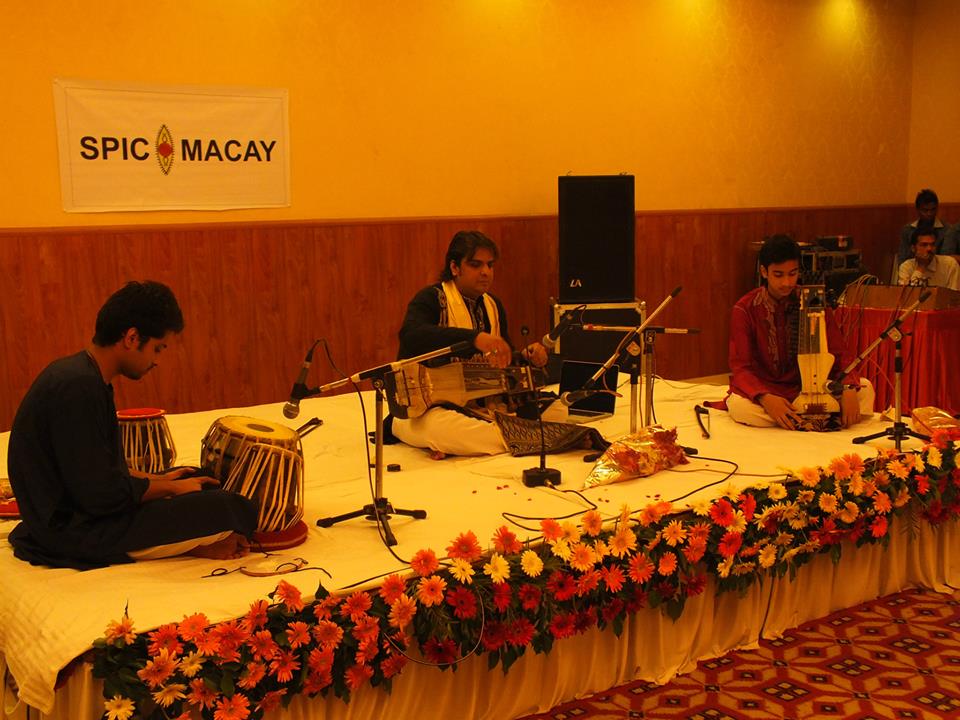
Sarangi maestro Ustad Kamal Sabari at SPIC MACAY, IIM Kashipur chapter


Mr. Nikhil Mehta, Executive Director, Corporate Strategy at Nomura

Adding onto the next chapter of the guest lectures by esteemed dignitaries, Mr. Nikhil Mehta, Executive Director, Corporate Strategy at Nomura interacted with the students at IIM Kashipur and gave them knowledgeable insights on Mergers and Acquisitions. He explained the length and breadth of financial market and the strategic reasons that drive organizations into M&A. The future managers also came across tactics of buyers and sellers and the important roles of Investment Bank in this arena.
Mr. Mehta is an expert in M&A and Strategy with 10+ years of financial services experience in mergers and acquisitions, corporate strategy, financial planning & budgeting and mortgage credit lending. He is an MBA from Georgetown University, a commerce graduate from Shri Ram College of Commerce and a Chartered Accountant.
Nomura is the leading financial services group which provides services across various divisions such as retails, asset management and wholesale. It provides a broad range of solutions to individual, institutional and government clients through its network in 30 countries. In 2009, it achieved a No.1 ranking for customer market share on the London Stock Exchange. Nomura was actively involved in the reconstruction of East Japan post the earthquake disaster and has contributed to the society through The Nomura charitable trust and Nomura foundation.
A tete-e-tete with Tata MindRover Season 3 winners – Ankita and Sulabh
It was an exhilarating experience to be among the top five teams of one of the most coveted competitions, ‘Tata MindRover Season 3’, after successfully competing with thousands of entries. We, Team “Balle Balle” (Sulabh Arora and Ankita Sharma), were to embark on an unprecedented journey to Mumbai in order to challenge the best in the business. On reaching the destination for the presentations, both of us were anxious but at the same time were thrilled to be at such a position.
We got to meet the top level management of Tata Motors and the interaction with them was splendid and rich. Meanwhile, waiting for our turn to showcase our analysis, we got an opportunity to interact with the other contenders who too were from reputed B-schools. After delivering our presentations, Tata Motors had a panel discussion in which all the participants were given opportunities to ask any queries that we had and we received great insights.
The team of TATA Motors clearly showcased unity, fun and dedication towards the company, which was highly inspirational. We secured the 3rd prize at the event for which TATA presented us with PPIs, certificates, and goodies. We had received warm hospitality from TATA Motors during the whole event tenure, which made us feel like a part of the TATA family.
Rakesh Kumar from PGP ’12 on clearing the CSCP (Certified Supply Chain Professional) exam
APICS (The Association for Operations Management) CSCP (Certified Supply Chain Professional) program is the only certification of its kind in the field of operations and supply chain management
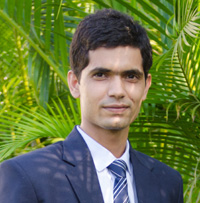
PGP ’12 student, Rakesh Kumar, recently cleared CSCP (Certified Supply Chain Professional) exam. He shared his insights on importance of CSCP and approach that is required to clear it.
1) What is APICS CSCP Program and what is its scope in today’s context?
APICS (The Association for Operations Management) CSCP (Certified Supply Chain Professional) program is the only certification of its kind in the field of operations and supply chain management. CSCP becomes even more important with enhanced role of supply chain management in success of business in prevailing cut throat competition, changing technological and economic dynamics. Accordingly this certification or designation is subject to renewal after five years as it becomes outdated after that due to obvious reasons like change in the ecosystem, technology, etc.
CSCP program requires prior work experience of two years as eligibility criterion along with bachelors’ degree. CSCP has only one exam, which consists of three modules (listed below) each having equal weightage-
- Supply chain management fundamentals
- Supply chain strategy, design, and compliance
- Implementation and operations
All these modules expose you to the essential terminology, concepts, and strategies related to demand management, supplier planning, sales and operations planning, and more.
2) Who should pursue this program? How does CSCP add value to a regular MBA?
CSCP program is essential if you want to acquire comprehensive understanding of supply chain management right from the supplier’s supplier to end customer. This program becomes very relevant if you are interested in making carrier in operations field and to be specific in supply chain consulting or ERP systems.
CSCP helps you in enhancing your knowledge and skills in the areas like risk management, sustainability, SRM, CRM, ERP, six sigma, lean production, and continuous improvement, etc. Not only that it also enables you to comprehend and compare various practices and tools against each other at one place which is not the case with regular MBA. In regular MBA the things or courses are taught or learned in fragmented manner depending up on the availability & timing of the electives. Further CSCP program exposes you to various challenges, best practices, trends and developments of supply chain industry in a consolidated manner.
3) Do you think the popularity of the CSCP is growing? If yes, what advantage do students have in placements if there are already many people having cleared CSCP exams?
Since its inception in 2006, more than 13000 professionals in 77 countries have earned APICS CSCP designation, which is pretty much an indicator of its popularity in the business world.
In India companies across various sectors like IT, FMCG, consumer durables, consulting, etc. do spend money and time to make their employees undergo this certification. Hence having CSCP certification (along with at least two years of work experience) distinguishes you as an industry expert with specialized, high level knowledge and skills. It indicates that student has an ambition to make a carrier in this particular field. Strategically speaking this gives you an edge when you are doing MBA from an IIM as after completing this certification, you will be having most sought after combination i.e. an MBA from a college like IIM and CSCP from a body like APICS.
4) How should candidates prepare for CSCP considering academic rigor in MBA?
Here is what I did/suggest –
- When to take exam?- APICS Exam is conducted every 3 months (March, June, September, December). To leverage the exam to the max during the final placements, I decided to take the CSCP exam just after completing my summer internship and not in first year. I made the decision keeping in mind the following points:
- Knowledge retention while facing the final interviews.
- Extended validity of the certification after graduating, as the certification is valid for only 5 years. Taking the certification in first year would have lead to wastage of 1 year of certification during the second year of academics.
- To be ready with the scorecard so as to include it in my profile at the onset of campus recruitment season given that it takes one month to get the score-card/result.
- Avoid clash with academic rigor, although it’s a risky affair considering the fact that if you don’t clear the exam in 1st attempt you will have to wait till September for a retake and it will be already November by the time you will have your certification/score in hand. So one might want to consider taking this exam in March rather than in June.
- What to study? – CSCP study material provided by APICS is a must as most of the questions are based on the concepts/ terminology mentioned in those modules. There are many useful references in these modules for those who want to study some concepts in detail. As far as the exam goes, I believe the given study material is sufficient.
- How much to study? – Ideally two readings of APICS content is must. First reading should be done with the motive to learn in general, while the second reading should be focused towards passing the exam.
In a nutshell, a candidate should be ready to spend at least 100hrs towards the preparation. If you are taking the exam with academics in parallel then you should start at least two months before the exam so as to have a reasonable spread of the load. The week before exam is “the showdown week” where you must put in more number of hours and take as many practice tests as possible.
From 1 to 26: IIM Kashipur Fostering Women Managers
The number of girls in the PGP 2013 batch jumped from 1 last year to an astounding 26 this year around
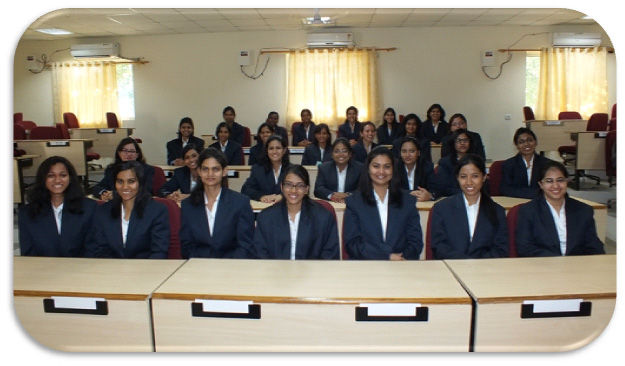
IIM Kashipur has witnessed a revelation. Breaking the jinx the number of girls in the PGP 2013 batch jumped from 1 last year to an astounding 26 this year around. Such a staggering increase, though not completely unexpected due to the fantastic facilities on offer in the newest offering from the esteemed group, the IIMs, was certainly splendid news. It was also indicative of IIM Kashipur coming out of the shadow of the so-called ‘new IIMs’.
Quiz Sajal Luthra on why she left institutes like IIM Raipur, Trichy and Rohtak and she cites the welcoming nature of the seniors and easy access to information about the institute on various social media portals that tipped the scales in favour of IIM K2. Also an opportunity to learn from a dynamic and vibrant personality like the director, Dr. Gautam Sinha was an opportunity that she just couldn’t miss. She is also eagerly looking forward to the Spanish and Taekwondo classes starting shortly.
Ask Natasha Singh, an inhabitant of the hot and happening capital of the country and she attributes this to a lot of factors not least of which surprisingly, is the contrast the place offers. A retreat from the hustle bustle, traffic and incessant noise enables students to not only concentrate on the hectic schedule that they have to follow but also gives them a welcome opportunity to have quality interactions with each other. It gives them a chance to get their priorities straight; and if you ever feel the need to party after a hard week, the fellow students are just the right company. She also talks about the perks of studying in an upcoming institute; while other ‘established’ b-schools already follow a set procedure and a structured model, newer institutes can make their own rules. They can form their own clubs, face new challenges and take up ventures with only themselves and their peers to guide them and this baptism by fire not only refines them but redefines them.
Hostel life is something that not many girls had experienced before and they are embracing every ounce of it. The seniors are fast going to have to get used to romantic Hindi songs being played on the speakers instead of the heavy metal that they were used to; lose live football matches to music channels and lose at least some of the careless privacy that they enjoyed earlier.
And so begins another academic year at IIM Kashipur; this time, with a lot more representation from the fairer sex. And the ladies have not only arrived on the scene but they are fast looking to capture it. There is not only huge participation but intense competition as girls are crashing the boys’ party in everything from sports and cultural events to core committee positions and academics. Sometimes, they miss their families and friends whom, for the next two years they are going to get just fleeting glimpses of. Sometimes the mountain of endless assignments and ceaseless quizzes seems unscalable but they still tenaciously manage to do it with flair. As Rocky Balboa says,” It ain’t about how hard you hit. It’s about how hard you can get hit and keep moving forward.”Life is not about the things that you have put down in black and white marked ‘to be submitted’ which matter so much as the crumpled sheets of ideas and initiatives that lie in the dust bin.
It’s a new dawn at the youngest IIM in the country. A new beginning. A new tomorrow with endless possibilities awaits. New summits to scale, new heights to attain and new lessons to be learned. So here’s looking forward to two more exciting years.
PGP ’12 student Harsh Patel speaks about clearing CFA Level 2
“The structured nature of the CFA course is very beneficial, as it helps in getting concept clarity and brings out clearly the interrelation and distinction among various theoretical aspects of finance.”
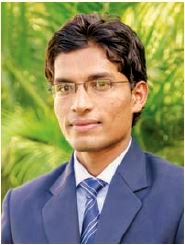
PGP ’12 student, Harsh Patel, recently cleared the CFA Level 2 Exam. He shared his insight on need of CFA and approach that is required to clear it.
1) What is CFA Program and what is its scope in today’s context?
CFA program is globally recognized course in the field of finance. CFA program includes three exams (Level I, II and III). After passing all three levels and four years of work experience in finance field one can earn the CFA Charter. CFA program primarily focuses on portfolio management, valuation and investment analysis. CFA level 1 covers fundamentals of finance like financial reporting analysis, economics, statistics, fixed income, corporate finance, derivatives etc. whereas CFA Level 2 focuses on aspects of valuation. CFA level 1 and 2 exams consist of multiple choice questions. CFA level 3 focuses on portfolio management and it consists of essay type questions and MCQs.
2) Who should pursue this program? How does CFA add value to a regular MBA?
CFA is a good course to pursue for those who want to build a career in the finance field. Especially for MBA finance students, it is an added advantage.
Regular MBA is focused on case study and problem solving while CFA gives you much deeper insight into theoretical explanations and well developed US financial markets. The structured nature of the CFA course is very beneficial, as it helps in getting concept clarity and brings out clearly the interrelation and distinction among various theoretical aspects of finance. CFA exposes an MBA student early to complex financial fields like derivatives, fixed income etc., which are not covered in MBA 1st year. This will give students more clarity regarding their career preferences.
3) Do you think the popularity of the CFA is growing? If yes, what advantage do students have in placements if there are already many people having cleared CFA exams?
If we go by sheer numbers, latest data shows Indian students form third largest group (5,173 candidates) after US and China while the total number of candidates registering for CFA level 1 December 2012 exam stood at 48,981. India has seen a huge rise in CFA registration in the past decade even after financial crisis.
Clearing CFA exams are highly appreciated by recruiters. It shows dedication of the candidates who shell out thousands of rupees for reading thousands of pages!! Passing CFA level 1 is not only a strong resume point but also helps to crack the interview for summer internship. For final placements, passing CFA level 2 will be a differentiating factor.
4) How should candidates prepare for CFA considering academic rigor in MBA?
Considering rigor of MBA, especially of IIMs, candidates should start early (at least three months before exam on average) and put in regular efforts so that they can allocate reasonable amount of time for their regular academics too. For the non commerce candidates, CFA level 1 requires more time to prepare as they are getting exposed to nitty-gritty of financial field for the first time. Students appearing for CFA Level 1 in June will find the going a bit easier, as some of the concepts will be covered in MBA classes by that time. Once one gains conceptual understanding it becomes easy to build upon these for the next levels.
Apart from CFA books, there are numbers of materials available that compile the course for sort of crash course preparation. But that is not advisable as it is difficult to get learning or understanding out of that. So better stick to its original books. Candidates should start solving mock exam papers (like Schweser test papers) at least 15 days before exam followed by performance analysis. Scoring more than 70% (generally around 65%) in exam would suffice to pass the exam, but the primary aim should not be just to achieve the score instead emphasis should be on learning and application in the real world.
Interaction with Industry expert: Mr. Nitin Jain, Chief Marketing and Sales Officer, OCM
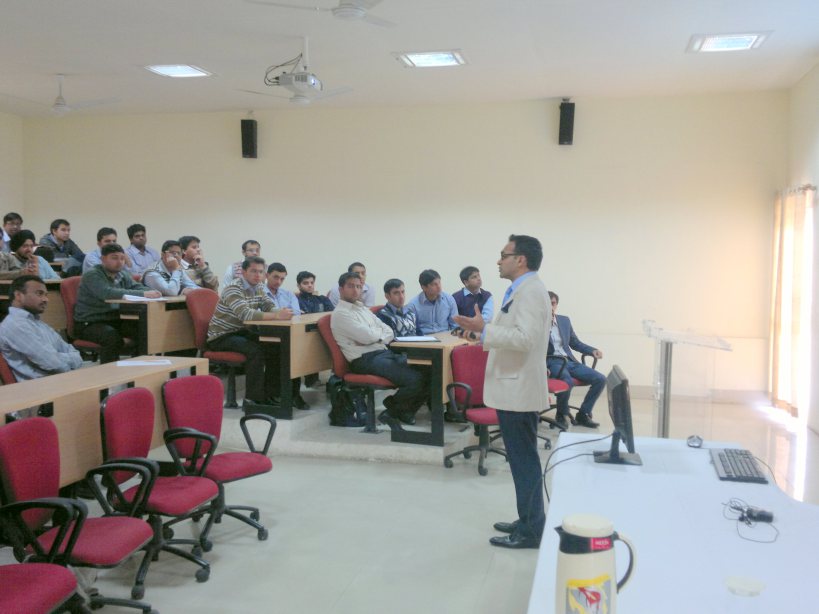
Mr. Nitin Jain (Chief Marketing and Sales Officer, OCM) visited IIM Kashipur on 29th Nov and shared his experience in marketing and brand building in the textile industry.
Mr. Jain has a vast experience spanning 15 years working with companies such as International Textile Group (ITG), Burlington Industries (now ITG) in United States and Nano- Tex in Hong Kong. He has also worked with Raymond (India) as President, Strategic Initiatives and has a keen interest in equity trading.
He started off the interaction by clearing some of the myths related to marketing. He briefed the students about the recent change in guard at OCM, and how it led to a rebranding exercise in view of OCM shifting its focus away from the ready-to-wear segment. The rebranding of OCM as “An affordable fashion for aspirational minds” and the ‘Face life’ campaign generated interest among the students. Participants discussed the finer aspects of the ad campaign and became curious as to why OCM moving away from using any brand ambassador.
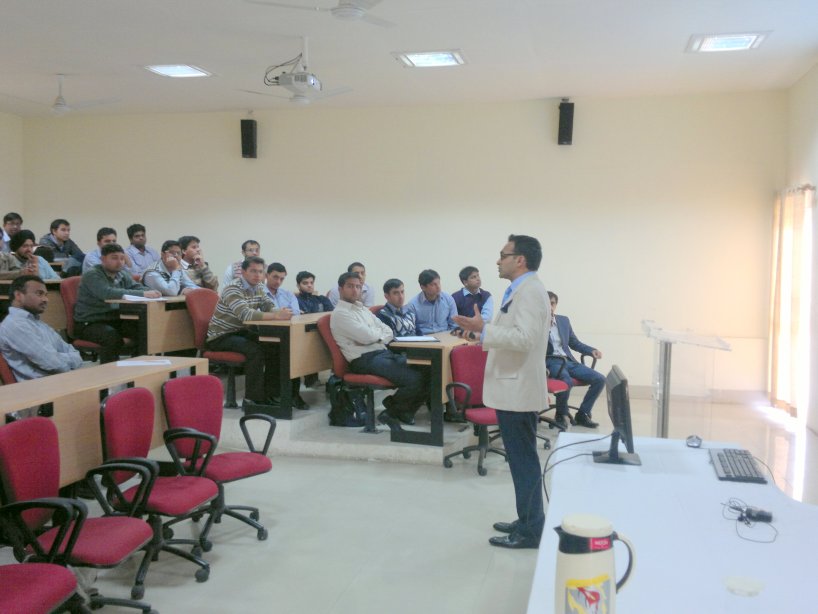
The suiting offered by OCM come in a huge price window and catering to the age group of 25 yrs to 35 yrs. Students were inquisitive about the go-to-market strategy of OCM to which Mr. Jain highlighted that Single brand retail stores were not cost effective hence they moved on to Multi brand outlets as their primary customer touch point. This strategy helped OCM in catering to the tier 2 and 3 cities.
The discussion was followed by the one to one interaction with the guest. The students picked his brain with queries from various aspects ranging from financials, operational difficulties, retail marketing and brand makeover. “Tailor made suits are the biggest challenge we face. Tailoring is a dying skill” he added when asked about the challenges faced by suiting industry. He also provided the students with the insights on OCM and its work culture. The students of IIM Kashipur enjoyed the session as it provided them with a clearer picture of what are the challenges in the textile industry and also informed about the expectations from them in the near future, if they venture into the marketing space in textile industry.
Interaction with Industry expert: Mr. Shouvik Mukherjee, VP and Growth Unit Head at Jubilant Life Sciences
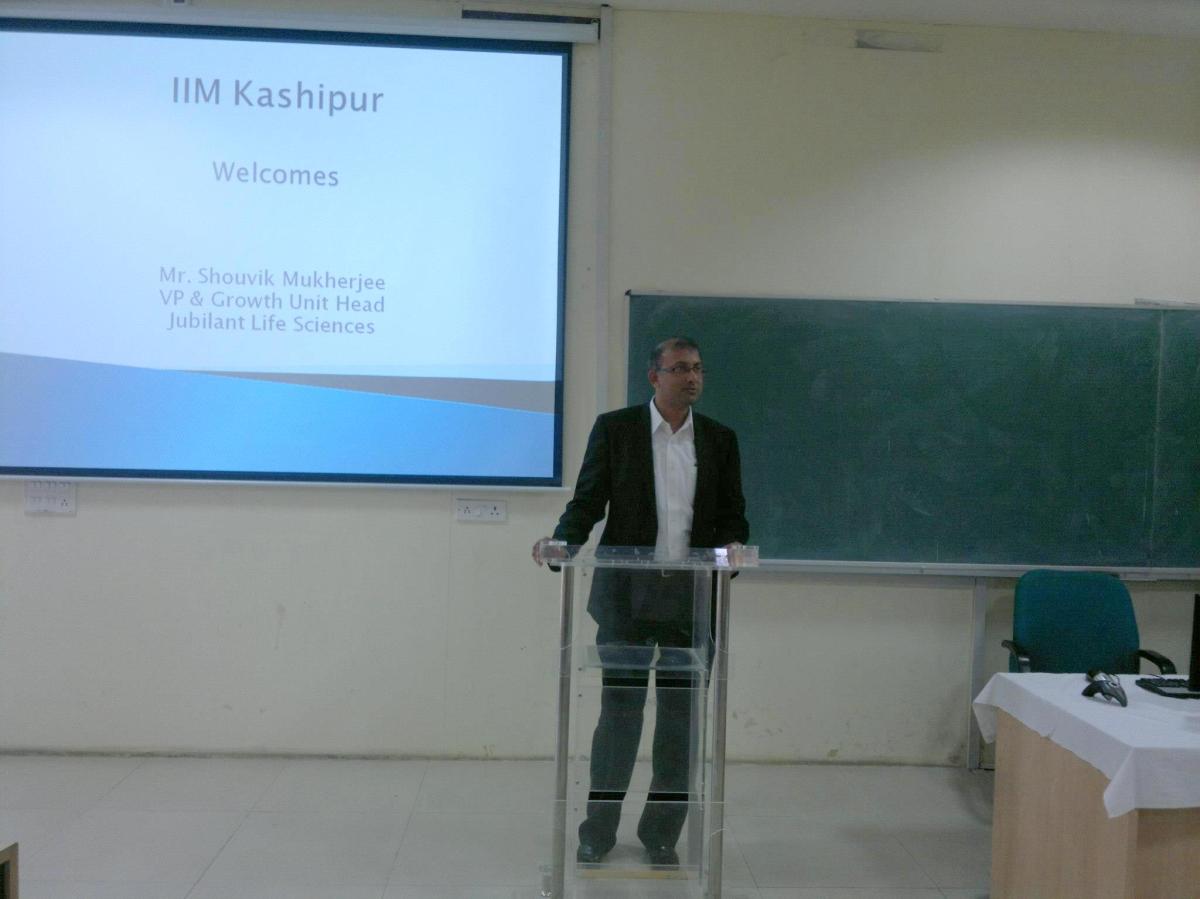
The students of IIM Kashipur got an opportunity to interact with Mr. Shouvik Mukherjee, VP and Growth Unit Head at Jubilant Life Sciences. Mr. Mukherjee has a Masters degree in Agriculture and has worked with renowned firms such as Bush Boake Allen, Monsanto and also served as the VP of Agrochemical division at Sudarshan Chemicals.
The session began in a very interactive manner as the students posed questions on topics such as Genetically Modified Crops and their regulation in India. In response to the questions, Mr. Mukherjee talked about the differences in marketing of agricultural products in India and abroad. He drew upon his vast experience in dealing with international markets and demonstrated the differences between doing business in India and abroad. He informed the students about the numerous avenues through which a company can acquaint itself with potential foreign clients. He stressed on using avenues like International trade fairs and Embassies of foreign countries in reaching out to clients abroad.
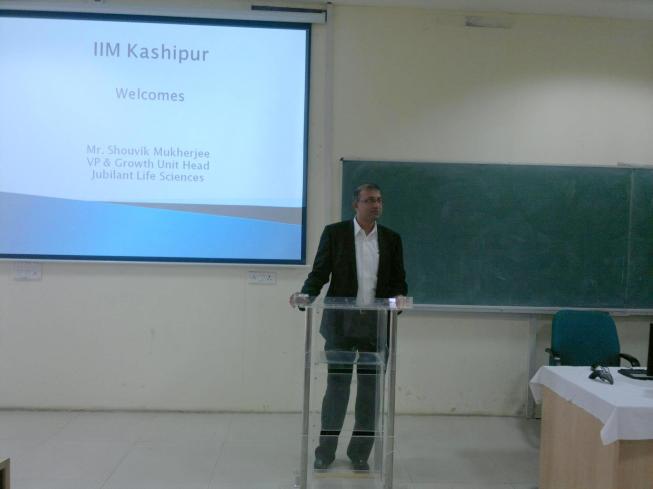
Speaking further on trade relations with International clients, Mr. Mukherjee spoke of obstructions to free trade and the negative impact of protectionist measures in preventing the opening up of new markets. He also discussed about the exact opposite, wherein the government steps in to prevent a meltdown of the local industry in the wake of fierce and unfair competition from firms operating in other countries. Spurred on by the keen interest of the students in cases where anti-dumping duties were imposed, Mr. Mukerjee elucidated the concept with some real examples from agri-business. Some of the students questioned the nature of anti-dumping duties and pointed out that it could be construed as a form of protectionism adopted by the home country. The confusion was eliminated soon after, as Mr. Mukherjee pointed towards several cases in which significant evidence of unfair practices could be found.
As the session came to a close, Mr. Mukherjee offered helpful advice to the students on building strong client relationships. He emphasized on the need to follow business etiquette in dealing with international clients and its importance in building rapport with people from vastly different backgrounds. The students of IIM Kashipur found the session very informative as it provided them with a better understanding of the life-sciences industry and also a glimpse of how global selling occurs.
Industry leaders discuss Indian Economic Reforms at IIM Kashipur’s Finance summit MANTHAN’12
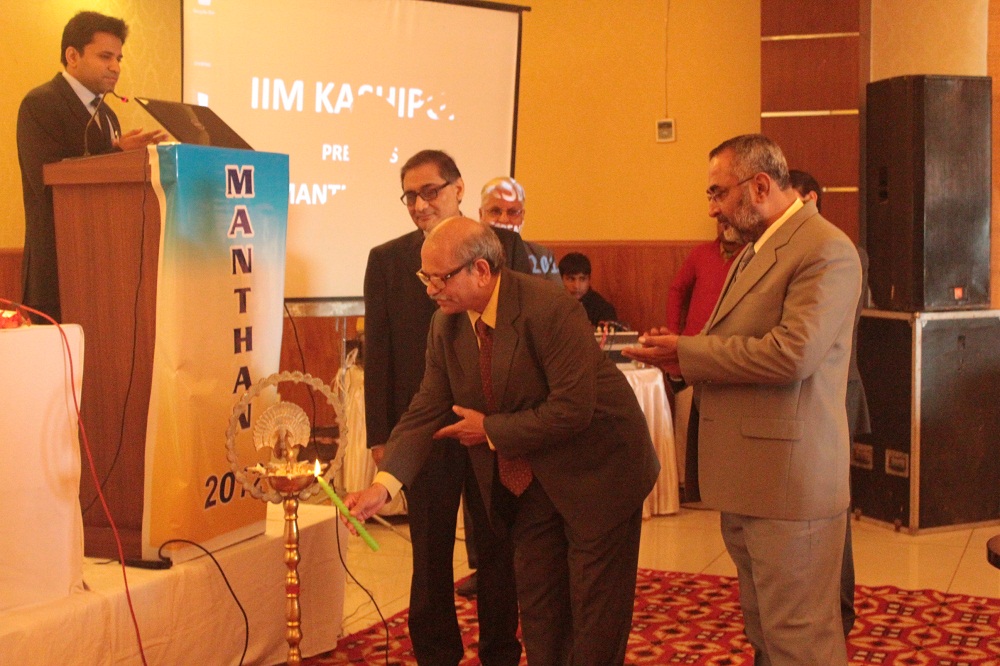
1st Dec 2012, Gautami Heights, Kashipur: Inaugurating the second annual Finance summit of IIM Kashipur, Dr.Gautam Sinha, Director, IIM Kashipur emphasized on the fact that India still faces many barriers in competition and a lot of work is required to be done for financial inclusion. According to Mr. Sinha, MANTHAN’12 aims at providing fresh ideas and insights about the needs of the present, through eye opening talks by domain experts.
MANTHAN is an annual Finance Summit organized by IIM Kashipur to provide a platform for state of the art discussions on the current state and future direction of the Indian economic reforms. The event witnessed a mix of eminent industry personalities from the field of economics, academia and students.
Reflecting on Indian Economic Reforms Dr. M Govinda Rao, Member, Economic Advisory Council to the Prime Minister and Director, National Institute of Public Finance and Policy said that more relaxations in service sector have made India a service centric country where less importance is given to infrastructure or power sector. He added that poor expenditure management and fiscal deficit in conjunction with election and increased petrol prices had led the deceleration of Indian economy in 2008. But at the same time he said that the repercussions can be more severe than the constructive effects of reforms such as price control by government often leads to a misallocation of resources. He emphasized on the fact that government reforms like creation of National Investment Board will be more helpful. Along with this, private sector should invest more & present a road map to government rather than reacting according to reforms.

Mr. Robin Banerjee, Deputy Managing Director of Bilcare Limited stated that debt w.r.t GDP is going down (decreased from 75% in 2006 to 67% in 2012) and the country will continue to grow for at least next 5 decades because it has a median age of 25yrs. which makes it the youngest in the world. But at the same time he said that, in terms of per capita income India stands at 135th position out of 180 countries, which raises a few concern. According to him the motive of economic reforms should be targeted towards removing distortion i.e. creating policies which equally favor rich & poor people and also manage competition. He added that two basic challenges faced by India are, first, lot of paper work which causes delay in getting permission to start a project and second, contractual agreements. In terms of following contractual agreements India stands at 184th position out of 185 countries which stops foreign investors from investing in India. Few of the suggestions given by him which will decrease the fiscal deficit as well as Gini coefficient are decreasing interest rate, selling the surplus land and divestment of loss making government companies.
Dr. D.S. Malik, Managing Director, Amex auto group Co., demonstrated the scenario of Indian auto industry post economic reforms. He emphasized the need of better tax policies. He also focused on labor laws that are currently practiced.
Mr. Ranen Banerjee, Executive Director/Partner, Pricewaterhouse Coopers, was of the view that currently India is having weak macro fundamentals. External factors like high crude oil prices and depreciating foreign exchange rate are among the main reason. He proposed REFORM 2.0, new changes that should be the future of economic reforms in India. It included giving more choices to bottom of pyramid rather than middle class, empowering the state government so that growth is triggered by them & not by center, rule of law i.e. strengthening the judiciary & contract laws in India and focusing more on emerging concepts like impact sourcing.
Dr. V. Ranganathan, Mentor Faculty at IIM Kashipur, RBI Chair Professor on Infrastructure and Member of Telecom Regulatory Authority of India said that making economic reforms are not enough, reforms in governance and attitude is the need of hour. Increasing the efficiency & response should be given more attention and reforms should not be limited only to papers but rather be implemented properly.
IIM Kashipur commenced operations from July 2011. The institute offers its flagship two years Post Graduate Program in Management (PGPM). The institute is set up with the objective of providing quality management education while sensitizing students towards the needs of the society.
 The IIM Kashipur Blog