From Kashi to Kashipur

After a year of toils, opportunities, experiences, and learnings from multiple domains switching, I have finally started on the journey of becoming the person I had always envisioned to be. It was the beginning of a new era, the realization of a dream!

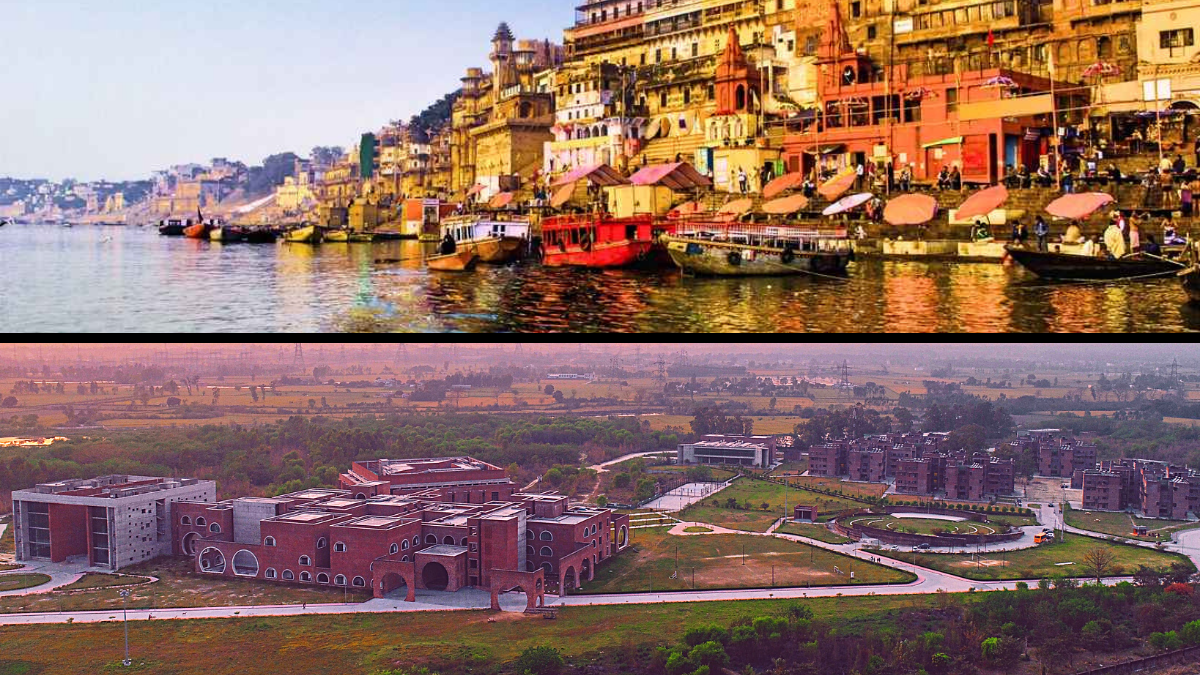
From a naive kid entering the colossal gates of BHU in Kashi to now entering IIM Kashipur as a confident adult with grace and poise, much has transpired in these years, and time is testimony to how much I have evolved in this odyssey.

IIM Kashipur is an IIM with a difference—its lush green campus, course structure, alumni network, and intellectual faculty have now become my oracle and chronicle of most prized moments.

The campus is heavenly. The green hills with a translucent carpet of sunshine, blowing zephyr, floating clouds, and the colossal red brick structures are both feelings of peace for sore eyes and soul. Getting into its coveted Analytics course was an added topping as Statistics became my second nature after conditioning myself to probability and Mathematics in all these years.

The first trimester at college taught me that MBA is more about learning opportunities than ‘learning’ itself! Each task can be done in different ways, and MBA taught me the most efficient ways to do it. The course on decision modeling and ‘optimization’ became the way of my life. I optimized my schedule to carve out time for my hobbies. I realized that this fast-paced on-your-toes life was all I wanted, and it came so naturally to me.

The pedagogy heightened my curiosity, and the dynamic projects challenged my thought process; the vastness and yet simplicity of all the things kept me amazed.

“Today, what seems hard, shall one day be my warm-up regime.” Life does show us tough times. Just =VLookup for patience and keep going happily no matter what (even if it is hard to EXCEL). I am thankful to IIM Kashipur for making me internalize this.

My journey to IIM Kashipur is proof of the adage, “What you seek, is seeking you.” Things we lose have a way of coming back to us in the end, if not always in the ways we expect. I postponed my MBA due to the pandemic and joined Masters in Statistics, but it was this deep-rooted love for pursuing management studies from an esteemed B-School, which got me here! Neither did I leave the holy city of Kashi, nor did it leave me. Coincidently, I joined the hilly terrain of Kashipur- the coveted IIM in the North. Joining the legacy of IIM along with my sister, who is pursuing IPM in IIM Rohtak, made it even more special! I still don’t know what nomenclature to use for the forces that worked their magic in bringing me to this place…

The college will always give you a choice whether to sit back and savor or whether to hustle or fill the caps with feathers, but no matter what we choose, we will always come out as a winner! As in the end, it is about reinventing yourself again and again. Which I mostly did; I learned the true meaning of passion, and to let go of things, and, most importantly, to know that I am going to emerge out of this journey as a better person.

Covid has taken a few precious months of our stay at the campus. Still, looking at the brighter side, given the grandeur that the institute is, even a virtual experience is thrilling and overwhelming for me. I can’t imagine how joyful and crazy the day is going to be when college resumes in offline mode and I would finally get the email that it’s time to come home!

About the author

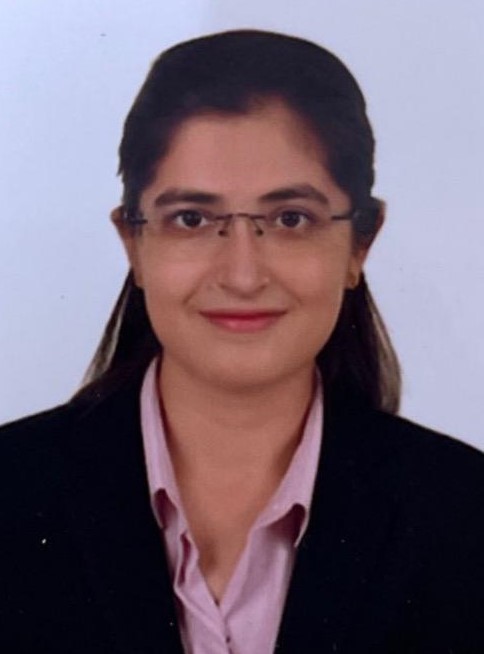
Saloni Singhal

She is the person with Statistics as a learned skill and management as inculcated passion, using both to solve problems for mankind and give optimum solutions. Continuously striving to break the glass ceiling and relishes the joy of contributing to social ventures to the best of abilities. You can connect with her on LinkedIn.

The Power of Storytelling

“Storytelling offers the opportunity to talk with your audience, not at them.”Laura Holloway

The vivid portrayal of ideas, beliefs, personal experiences, and life lessons through stories or narratives that provoke powerful human emotions and insights is termed storytelling.

When I think about the most well-known cinematic experience that made storytelling more than just a pastime, I revisit the scenes of “Tamasha.” The protagonist, who was inspired by storytelling from his childhood days and went on to become a renowned storyteller and stage performer, was the plot of the movie. Is story-telling, however, limited to the artists, performers, or an individual from a certain artistic domain? The answer is a conclusive ‘No.’ The world’s most successful people have always been the best storytellers.

Art, poetry, writing, and stage performance are not the only forms of storytelling. In any aspect of life, whether it’s business, sports, politics, or a classroom lecture, storytelling is always useful for conveying our emotions, ideas, solidifying complicated notions, and simplifying complex messages.

What are some real-life examples of how storytelling has led the way to success? Consider how Steve Jobs explained the world when he debuted the Macintosh, and how Apple envisions changing the world after this product, and the result is right in front of us. Apple Inc. is now one of the most successful innovative companies in human history. Whether you’re talking about Richard Branson, Steve Jobs, Sheryl Sandberg, MS Dhoni, or Oprah Winfrey, one thing they all have in common is that they’re all fantastic storytellers.

A great storyteller is the essence of a successful marketer, the one who understands the connection between the brand and the users when we talk about a successful marketing strategy. One of the most important aspects of successful branding is how you treat clients as the primary players of the story, with the brand acting as a supporting character in order to establish a long-term relationship. We don’t sell stuff; we sell experiences, as the saying goes.

For example, if you’re launching a campaign to sell the new sports equipment for the athlete community, a great storyteller will emphasize why the equipment is needed and what long-term influence it will have on the athletes’ community and their performance.

National Geographic is one of the best examples of using storytelling to build brand recognition. They perform a fantastic job with their social media branding approach by incorporating storytelling. National Geographic uses bright, exciting, and wild photos to attract the user’s attention, but it is when they combine those stunning sights with the fascinating narratives that a user is compelled to return again and again to relive those human emotions and connections.

Therefore, what does it take to be an effective storyteller, and how can you communicate your stories effectively? It’s very crucial to recognize who your target audience is. Who wants to hear your story? Imagine how you’d be able to make the story more personal for each of them. As a result, before you put ink on the page, make sure you know who will be reading or listening to you. For example, if you’re telling an intriguing story, attempt to build dramatic tension and suspense up to the conclusion of your story. Personalization of experiences has a bigger influence on the audience, and as a speaker, you may always draw inspiration from your own life while creating fresh stories. It is always good to narrate your words using a personal experience, whether or not you are delivering a true story directly based on a personal event.

What is the significance of this entire process? Because you, as a company, a brand, or an individual, are likely to have numerous facts, figures, and messages, the delivery of your message is critical to avoid monotony and bored faces. Engagement with the audience, studying other storytellers, and how you narrow down the spectrum of interpretation by the audience, particularly when relaying your real-life experiences, are all important parts of successful storytelling. Great storytelling necessitates maintaining eye contact with your audience, engaging them, asking them questions, and inviting them to be part of the ongoing conversation. Is it possible that you’re unfolding too much? Is it overly detailed and focused on figures? As a great storyteller, it’s your job to keep your words short and crisp, with fewer details, and to focus on the elements that make your audience want to listen more. Trusting that your audience will be able to follow your story and not overwhelming them with superfluous backstory or digressive plot pieces will keep them wanting more.

Storytelling is an art form, yet it is not limited to artists. It’s just a technique to learn an effective way to communicate with your audience now, whether it’s a group of friends, a gala, an investors summit, or thousands of sports fans waiting to hear you after a heartbreaking loss, your story determines how well you’ll be remembered when they return home.

Next time, when you experience a great story, imagine yourself in the speaker’s shoes and think about how it is a pure form of art, not limited to artists. It’s just a technique where you learn a way of using your imagination to effectively communicate with your audience, whether it’s a group of friends, a gala, an investors summit, or thousands of sports fans waiting to hear you after a heartbreaking loss. Your story determines how well you’ll be remembered when they return home.

About the author

Shubham Kumar is a first-year MBA student at IIM Kashipur from batch 2021-23. He is a commerce graduate from the University of Delhi. He has actively engaged in the Media and Public Relations Committee at IIM Kashipur. He is a creative content creator and loves watching Football during the weekend. You can find him on LinkedIn.

MBA in new normal-Months fly like days.

Months seem to be flying like days in MBA in the new normal. This statement would not be an exaggeration given the experience we have had during the first term of our MBA. It was expected that MBA is the kind of course which maneuvers one’s life in an unexpected direction, but real-life experiences are something of other kind. They tell us how much the theory relates to reality. Also they shows us how much capable we are to make the best out of that situation.

How it all remained the same

When we started our journey for the new academic session in the new normal after the pandemic changed everything, we were not aware of the fact that MBA remains the same despite of shifting from offline to online. Although mode of taking classes changed from physical classrooms to virtual ones, but the level of learning remained the same. The way of hanging out with batchmates changed from the canteen to google meets but the level of bonding remained the same. Despite placement processes were shifted from campus to homes, the level of preparedness remained the same.

The experience of the new normal

The new normal

Initially, we had the notion that being online there would be lesser work, lesser interaction and lesser MBA. But reality hit us the very first day we joined the classes and got to know we have signed up for a course that demands full dedication irrespective of its mode. It takes us on a path of improvement which is one of a kind. There are no boundaries of day and night and we do not just study here but traverse a way to rebuild ourselves. We lose track of time yet have deadlines dependent on seconds. All of us walk our individual journeys of self development yet support each other. We are in a course that totally changes us yet makes us meet our real selves.

We were attending classes, making presentations and doing assignments. At the same time, we were also doing live projects. We were working for the college committees, and preparing for our summer placements. The time flew like anything, and we thought of giving up at times. But the satisfaction after getting to learn from each class and the appreciation we felt after giving each presentation, and the sense of achievement after the submission of each assignment did not let us give up. These experiences taught us the subjective knowledge. They gave us a glimpse of how to work well in teams with different people and coordinate. They made us capable enough to drive the discussions in class and at the same time learn from our peers.

The expectations forward in MBA

When we had our term one exams towards the end, we were more prepared than we have been ever for any exam. That is how MBA learning turns out to be. It is everyday learning and applying it in practical situations rather than cramming on the last night of the exam. The process through which we went made us adapt to the new normal and made it easier for us to prepare for exams better than anything. This is how we got to know about the beauty of the course.

The three months felt like a couple of days, and it seems like yesterday when we clicked on the zoom link for our first-ever class of MBA. Moving ahead we feel the need for more learning, more interaction, and more of MBA. We feel we are ready enough to take the lessons, this course has yet to unfold. The measurement of time is going to be different for us than everyone else on the planet.

About the author

Author

Aarti Singhal is a first-year MBA student at IIM Kashipur from Batch 2021-2023. She is a B.Sc. Hons in Mathematics from the Delhi University. She is an active member of the Media and Public Relations Committee of the institute. She has keen interest in dancing as well as reading and content writing. You can connect with her on LinkedIn.

How to maintain Mental Hygiene during MBA?

World Mental Health Day

The feeling of excitement and happiness that we got after seeing the shortlist mail for our dream college is something that cannot be told but can only be felt personally. The emotional outburst after long hours of a hectic schedule, late night mock tests, hours of preparation for the Personal Interview questions
as well as the anticipation of waiting for that shortlisting mail for months is something that gives us a different view of achievement. Although we are on cloud nine when we enter the new phase of our lives with the onset of the MBA program, what we tend to overlook is taking care of our Mental Hygiene. Yes,
there is a different portion in our life that is as important as physical hygiene, and that is “Mental Hygiene”. This is the practice of taking care of our own mental health as much as we are characterized to take care of our physical health using different measures.

Choosing MBA with a concrete decision for a long-lasting impact on our career and our lives is a big decision that involves a lot of strength and rational decision making. After we dream of all those campus scenarios that can act as memories years later, and step into our new lives, the first week of induction is something that punches our emotions with the rigorous schedule amidst a pool of students that share the same vision and passion for life while pursuing an MBA. Throughout the struggle to adjust to the hectic schedule by delivering the tasks, we find people with different backgrounds and life stories that often intrigues us to know more of them in depth. The onset of the classes results in heavy loads of presentations, markings, endless assignments, time-bound quizzes, mid-term examinations, end-term examinations as well as student body selections. This gives no space for us to even look at mental health
and take measures to improve it which has drastically fallen at the beginning of the induction. Be it the day when we cried alone in our rooms looking at the laptop screen at the decision of taking MBA while doing the presentation with odd strangers at the starting of the induction process to feeling demotivated
when we are not shortlisted for our favorite company during summer placements, this has tremendously impacted our mental health. As society functions with the thought belief that crying is for the weak and that we should be oiled enough to face rejections and failures in life, we are still hit by the rejections, be it in our favorite student body. We tend to compare our lives and our failures with the success stories of others in the same batch because that has been the social stigma that sticks to generations passing this to
each other. From parents comparing your marks to your cousins or friends to the society taunting in case we are unable to clear the entrance exams, this is a permanent tradition that follows a particular hierarchy. This is something that creates friction in our minds when want to improve our mental health.

The feeling of competitiveness, comparison, the feeling of outcasting others in any task or presentation or interview is something that has been fueled in our minds throughout the process. But what we tend to forget is that everyone is different from the struggles and the investment that they have put in while reaching this place. This impacts not only the self-confidence but also it starts a battle of doubting the self-worth which results in a self question, “Do I even deserve to be here?”. The answer to this question should always be YES. This is the point when we should pause for a moment to breathe and take extreme care by following Mental Hygiene. Taking some time off to boost ourselves so that we are able to deliver quality content and not just burn ourselves is something that should be given utmost importance. The eating habits, which just include rushing to the mess and eating as fast as possible because we have pending tasks should be improved, and eating healthy by enjoying our favorite meal
instantly lights up our mood. The mental hyperactivities that are instilled by hour-long classes and day-long MBA schedule can be amended by having an organized schedule where we can cheat out some time for ourselves and we can do our activity which is our mood lifter, be it talking to our favorite person
or just scrolling through music playlists or dancing our heart out or in fact taking a small nap. This maintains emotional health and helps us in the motivational factor which will act as fuel in the protracted journey of MBA. Indeed taking some time while maintaining the balance of the quality of work that is expected from us and watering the flowers of our mental peace and health to influence Mental Hygiene is something that needs to be preached and practiced.

About the Author

Author Profile Picture

Ayushi Kulthia is currently pursuing MBA from IIM Kashipur from Batch 2021-2023. She is a Finance and Accounting student with 2 years of experience in Content Development and Research. She is also actively engaged in the Media and Public Relations Committee of the college. She is a drama enthusiast and loves exploring life by making memories as she is a part of various social service clubs as well. You can connect with her on LinkedIn.

Journey of the Best All Rounder – PGP 2018-20 batch

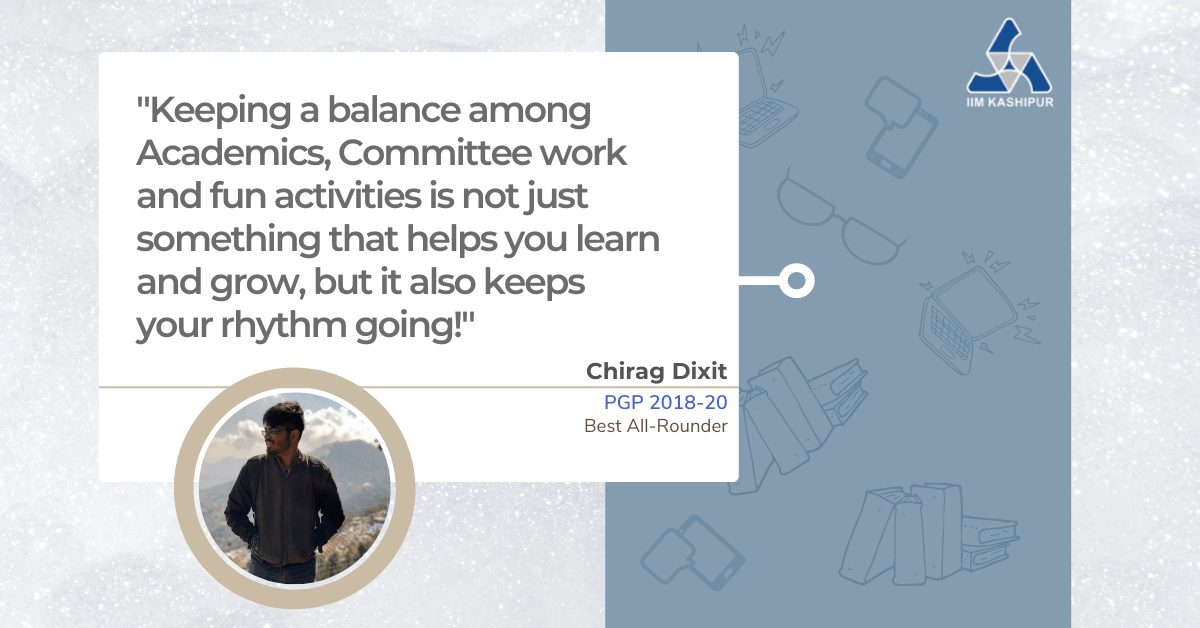
Keeping a balance of Academics, Committee work and fun activities is not just something that helps you learn and grow, but it also keeps your rhythm going. When I joined the Placement Committee, a lot of people asked me whether I’ll be able to find time for my academics or other activities. But one of the most important aspects of MBA is probably Time Management and once you do this well, you can do a lot more than just sail through. Enhancing my classroom learnings with active discussions with professors and peers, supplementing it with corporate competitions to utilize the classroom learnings in real world corporate case studies, and networking with corporates in order to foster institute relations with corporates – this is what I found myself doing for majority of my time at IIM Kashipur. But along with all this, spending time with a bunch of my peers – some of whom have turned into my extended family – was also something that got me through these two years and learning from each one of them made me a better person.
While I think each person has to carve their own journey, a suggestion would be to try and explore as much possible – sign up for a subject you think you find challenging but also interesting, take part in as many corporate competitions possible, do your committee work diligently and be a part of at least one to help a little in running the institute. You will always find the support from management and our beloved faculties!
All the best!

About the Author

Chirag Dixit is alumnus of IIM Kashipur. He is the best All-Rounder of PGP Batch 2018-20. He is currently working as Equity Specialist at Bloomberg LP. He specializes in Equity Analytics – client workflows and also has a focus on – BQL (Bloomberg Query Language), Launchpad, Bloomberg for Education (BMC) and MYBB transfers.

You can connect with him on LinkedIn

( We thank the Alumni Relations Committee of IIM Kashipur for serving as a bridge to beget  valuable insights about the journey of becoming a gold medalist from our erudite alumnus. )

Journey of Silver Medalist – PGP 2018-20 batch

After numerous interviews (alongside rejections), I was quite relieved to be selected at IIM Kashipur. It was a shock when the first words I heard from the professor was, ‘ Your journey and hard work has just started’ and it is indeed true. Induction and trimester 1 are very important to acclimatize oneself with the rigors of an MBA program. The beauty of MBA at IIM Kashipur is that there is not one way to be successful, people can target particular skill sets or competencies through academics or through various PORs of clubs/committees. I have seen friends get upset at not being selected at any clubs/committees initially, but without these extra responsibilities it gives one time to work more on Academics or relax a hectic day with leisure like sports, music, etc. (which IIM Kashipur has excellent facilities). The only important thing here is to identify why one was not selected in the first place , what improvements need to be done to overcome that drawback and hone skill sets accordingly.

Peer learning is one of the best ways to learn at an MBA. I was very lucky to have close friends with complementary skill sets and knowledge and thus enhanced my knowledge manifold. Whatever I achieved at IIM Kashipur a lot of credit goes to my friends for supporting me in dire situations. Building a good network and close friends made life at IIM Kashipur the most enjoyable two years of my life.

I strongly believe that getting too much pressurized by the rigors of MBA does one no good. It is important to enjoy your MBA life and relax yourself from time to time to re-energize yourself. Sometimes coping with all the academic pressure may not a one day process. One can try to cope with the pressure with time, set small targets (for example, if you cannot follow all the courses in a trimester properly at once, initially target two to three courses that you are interested in and faithfully follow everything related to course like case studies, assignments, etc.)

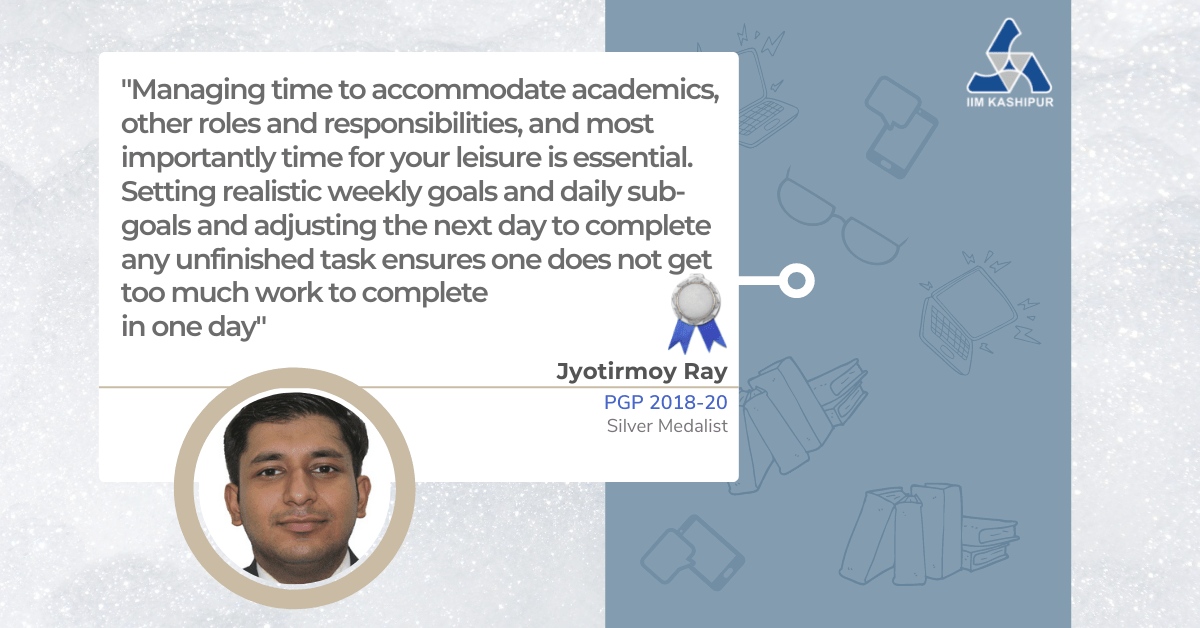
Managing time to accommodate academics, other roles and responsibilities and most importantly time for your leisure is essential. Setting realistic weekly goals and daily sub-goals and adjusting the next day to complete any unfinished task ensures one does not get too much work to complete in one day. Proper planning every day (if possible, planning for every four-five hours) and avoiding procrastination is a good habit to enjoy your MBA life. I will end with a famous Bo Bennett quote – ‘ When it comes to success, there are no shortcuts’.

About the Author

Jyotirmoy Ray is alumnus of IIM Kashipur. He is the silver medalist of PGP Batch 2018-20. He is currently working as Consultant (FS Risk) at EY. He is also a  June 2021 Level 2 candidate in the CFA program and looking for opportunities in Valuation, Risk and Equity Research in Finance. He is also a Member of Indian Youth Delegation Program to Kyrgyzstan in 2019 under the initiative of Youth Affairs and Sports, Government of India.

You can connect with him on LinkedIn

( We thank the Alumni Relations Committee of IIM Kashipur for serving as a bridge to beget  valuable insights about the journey of becoming a gold medalist from our erudite alumnus. )

Deadlines are sacrosanct

 ” Deadlines are Sacrosanct “The three magical words every Bschool graduate gets to hear very often. The phrase has been used many times by all, however, its importance, it seems, is yet to be known to many. The only sacrosanct rule at all IIMs is punctuality.

Good Management is only appreciated in its absence. So, while waiting for my food order in a queue made me realize how unaccustomed I have become to queues, waiting, and things not happening as they are supposed to. This further made me admire the beauty of time and how efficiently things happen in IIM Kashipur.

 I remember my first week of induction which was by far the busiest and most rewarding schedule as I was given a rehearsal for the life waiting ahead for me. I was reassured over and over that we will sail through it and no one has ever died of insomnia. For a moment 24 hours felt quite less seeing the ocean of things lined up -course work, assignments, enrolments, orientation sessions, alumni meet, student body meets, senior interactions, batch meets round the clock and then you have sacrosanct deadlines for them.

 If you want to know the value of one minute, ask the person who missed their deadline by a minute and has been awarded one grade lower than what they would have received if they had submitted the assignment on time.

 All this is done not to scare anyone nor does any faculty enjoy doing so, it is done to make us part of an erudite culture that values time above all commitments. As every management institute does, the IIM Kashipur framework serves as a paradigm of effective management. All tasks are done from a “better never than late” mentality, based on the central principle of punctuality. 

 The obligation of punctuality extends not only to students but also to both faculty and staff. No one is permitted to waste someone else’s time, resulting in a super-efficient system.When you have grown used to such a culture indoctrinated for the system to function smoothly, even a 15-minute line seems weird.

So my only tip is value and plan things ahead of time and keep an action plan ready for last moment hiccups. My go strategy for the same was to simply set all my clocks ahead by 15 minutes (and then forget about it).

About the Author:
Sakshi Poddar a Computer Science Engineer by qualification is now pursuing MBA (Analytics) from IIM Kashipur. She is a part of various student bodies like the Media and Public Relations Committee and Admission Support Body. She is an IT professional with 2 years of experience in Hewlett Packard Enterprise. She loves traveling and dancing. You can connect with her on LinkedIn

Rising Steel Prices: Can Fintech save MSMEs in distress?

The Alumni Relations Committee of IIM Kashipur has served as a bridge to beget valuable insights about the role of Fintech in MSME from our erudite alumnus. This article covers the questions surrounding the issue of rising steel prices and how Fintech can save the MSMEs in distress.

A sharp rise in raw material prices, (especially steel) over the last few months has impacted the recovery of manufacturing, construction, and small and medium industries from the COVID-19 pandemic.  The MSME industry needs to provide steel at reasonable prices so that export competitiveness of value-added products is maintained

A sharp rise in raw material prices, (especially steel) over the last few months has impacted the recovery of manufacturing, construction, and small and medium industries from the COVID-19 pandemic.  The MSME industry needs to provide steel at reasonable prices so that export competitiveness of value-added products is maintained.

Fintech lending platforms have the ability to address the credit gap for small businesses. Most digital lending platforms which used to rely only on equity and debt capital are now also looking at post loan origination sources of capital such as securitization and direct assignment transactions to improve liquidity. The fintech, banks, and NBFCs will play a huge role in powering small businesses in the post-pandemic new world and will help in reviving the economies. These new and innovative lending models will not only strike a right balance between financial stability and growth but also encourage a focus on the credit needs of small businesses in the country and NBFCs and fintechs are considered as better equipped to support this endeavour.

To understand the reasons behind the bullish prices, we can look at some of the factors affecting the price of steel:

Supply And Demand-

As with any commodity, supply and demand is a huge factor that determines steel prices. The higher the demand and the lower the supply, the higher the price. As lockdowns were gradually eased and construction work resumed, steel prices started rising with the rise in demand.

Moreover, the prices of steel are determined not just by current supply and demand, but by forecasted supply and demand. The more information available, the better this can be predicted, and the less volatile prices will be. We must also strive to be aware of inventory in the supply chain in every link from the steel mills to the end-user.

Industry Trends-

Price is also influenced by the demand of the various industries steel is used for. If the auto industry is strong, for example, steel demand may be higher; the same goes for construction, packaging, and other businesses that rely heavily upon steel.

Costs of Materials-

Scrap metal and iron ore are two of the main materials used to create steel. If there is a limited amount of these resources available, demand exceeds supply, and the cost of materials will jump up.

Iron ore fetching a year-end price of $175 a tonne on the Dalian Commodity Exchange (DCE), is now the world’s best performing major commodity for the second year in a row. Indian Steel Association (ISA) calls for Government Intervention and demands a six-month ban on iron-ore exports, restriction of e-auction sale to steel- and pellet-makers. The Government suspects that the steel-makers might be indulging in the manipulation of production to lift prices, forming a cartel in the cement and steel industry. However, on the contrary, in the steel industry where two major players, namely, SAIL and Vizag Steel are government-owned are also a part of the same trend.

Costs of Shipping-

By the same token, materials used to create steel and finished goods can be costly to ship, a factor that may help determine the price.

Time of Year-

Time of year has its effect on many industries, and those that use steel are no different. Holidays, weather, and seasonal highs and lows affect the output of new products, either raising or lowering demand. Seasonality can impact shipping patterns and transit modes.

All these events have left the MSMEs in jeopardy. Nothing was happening for several months because of the pandemic. The projects were shut down or were on hold. The rise in steel prices is eating into their narrow margins making it more and more difficult for them to sustain. A big issue of MSME credit gap can be solved by fintech lending platforms if they are able to access reliable digital data sets that can assist with credit risk analysis and cash flow-based lending, the regulatory framework supports a low-cost KYC and customer onboarding process and if these platforms themselves are able to tap into a wider set of channels for their own sources of capital.

About the Author:

Mr. Shahrukh Khan, an Alumnus of IIM Kashipur who has completed his PGP in the year 2019 is currently handling the Product & Process – OfCommerce at OfBusiness. While at the campus, he has been a Class Representative and Joint Secretary of Wellness Coordinators. He has also represented IIM Kashipur in multiple TT Tournaments.

Management from a Homemaker’s Lens

The word Management as defined in the dictionary means the process of dealing and coordinating with people. Management is a never-ending loop that begins when one gets up in the morning and ends when one sets the alarm for the next day and goes to sleep.

 Management is always conceptualized as a fancy degree from a Business school and jargons like Presentations, Entrepreneurship, SWOT, ROI, etc. Management is inevitably present and significant in all these fields, but what we often forget is that management is applicable in all walks of life. It covers all facets of our lives. We ignore this fact because we have been so used to doing these roles that we have forgotten about the management nature. Even a trip to Goa with friends or relatives requires proper planning so to effectively manage one’s schedule for an enriching experience.

 If we deep dive into our daily life schedule, I see my mother implementing all my MBA lessons in some way and the best part is though those decisions or acts of her do not bring any life-changing decisions but are pivotal for the smooth functioning of the house.

 The duties of a homemaker are frequently looked down upon, but as we look closely, we can see that becoming a homemaker demands immense management skills. One of the most difficult examples of management is managing an entire family, taking care of everyone’s special needs, settling petty conflicts among children, maintaining the bonds intact, ensuring food is prepared on time. All this might sound so simple when we compare it to the life of an MBA graduate but it is equally challenging and complex.

 If we draw an analogy between the life of a manager and a homemaker, it is quite indistinguishable. The only difference is the nature of the work they both execute. Just like in an organization, A manager is the one responsible for streamlining the tasks, planning things ahead of time so that the needs of the clients are fulfilled on time, and addressing the grievances of its employees. In the same fashion, Homemakers must plan for the whole family, predict future challenges, multitask and make the most use of their resources, and be armed with plans for any last-minute hiccups.

 Let us take a few examples where we see homemakers implementing various concepts of MBA.

 Before buying any vegetable, she does a SWOT analysis for it and checks for if it is the best available product in the market.

She keeps a close record of all house expenses and makes sure every expense is recorded and gets tallied with the money she has in hand. In some or the other way, she exhibits great accounting skills.

She doesn’t have a degree but yes she is a perfect manager and a successful leader.

About the Author
Sakshi Poddar a Computer Science Engineer by qualification is now pursuing MBA(Analytics from IIM Kashipur. She is a part of various student bodies like the Media and Public Relations Committee and Admission Support Body. She is an IT professional with 2 years of experience in Hewlett Packard Enterprise. She loves traveling and dancing. You can connect with her on LinkedIn

Management is an Art!

There are many B-Schools to provide you with the Knowledge of Management but is that enough? Is knowing it all enough? I believe it’s not. To be a successful manager you need to possess the art of applying the right knowledge (the craft), at the right time (the vision) and most essentially, delivering efficiently to the right people (the communication). Books and professor’s knowledge can tell you what different tools and frameworks you can use but which to apply where needs an understanding so deep it will be a tragedy to not call it an art.

A good manager must also have imagination and the audacity to redesign their organisations or the way they work, just as an artist needs vision, and a strong commitment to realise them.

One may argue about the new and improving scientific methods being taught to and applied by the up-and-coming managers for better decision making, or about those skills to derive unexpected success by making probable failure surrender to competence and nerve. But Management has always been more than that. Not all great students have been great managers, and not all great managers have started strong. It takes more than just the technical skills and intuition to be a good manager.

To be a good business manager, one needs to perfect their skills in dealing with people and express themselves verbally, just as an artist needs to master his craft. 

Moreover, just like the art has no right or wrong similarly the managerial decisions can’t be labelled correct or incorrect. In fact, in management failures can lead to new opportunities. There is no perfect formula for success.

Therefore, I strongly believe that Management is an Art and the artist needs to keep on practicing the art to achieve the epitome of success in the career.

About the Author:
Dr. Ankita Gabhane, Dentist is pursuing MBA from IIM Kashipur. She is an active member of different student bodies like the Cultural Committee and Admissions support body. You can connect with her on LinkedIn.