Story of successfully hosting Uttishtha- The Annual Entrepreneurship Summit amidst the pandemic!

What we are going to read about will be sort of a story (Fairy Tale! Nothing short of that!) of ‘The Spring in the North’! – The Spring rejoiced by young entrepreneurs, startup owners, industry experts, faculties, college and school children from across the country. Yes, we are talking about Uttishtha – The Annual Entrepreneurship Summit of IIM Kashipur – The Spring of Entrepreneurship!
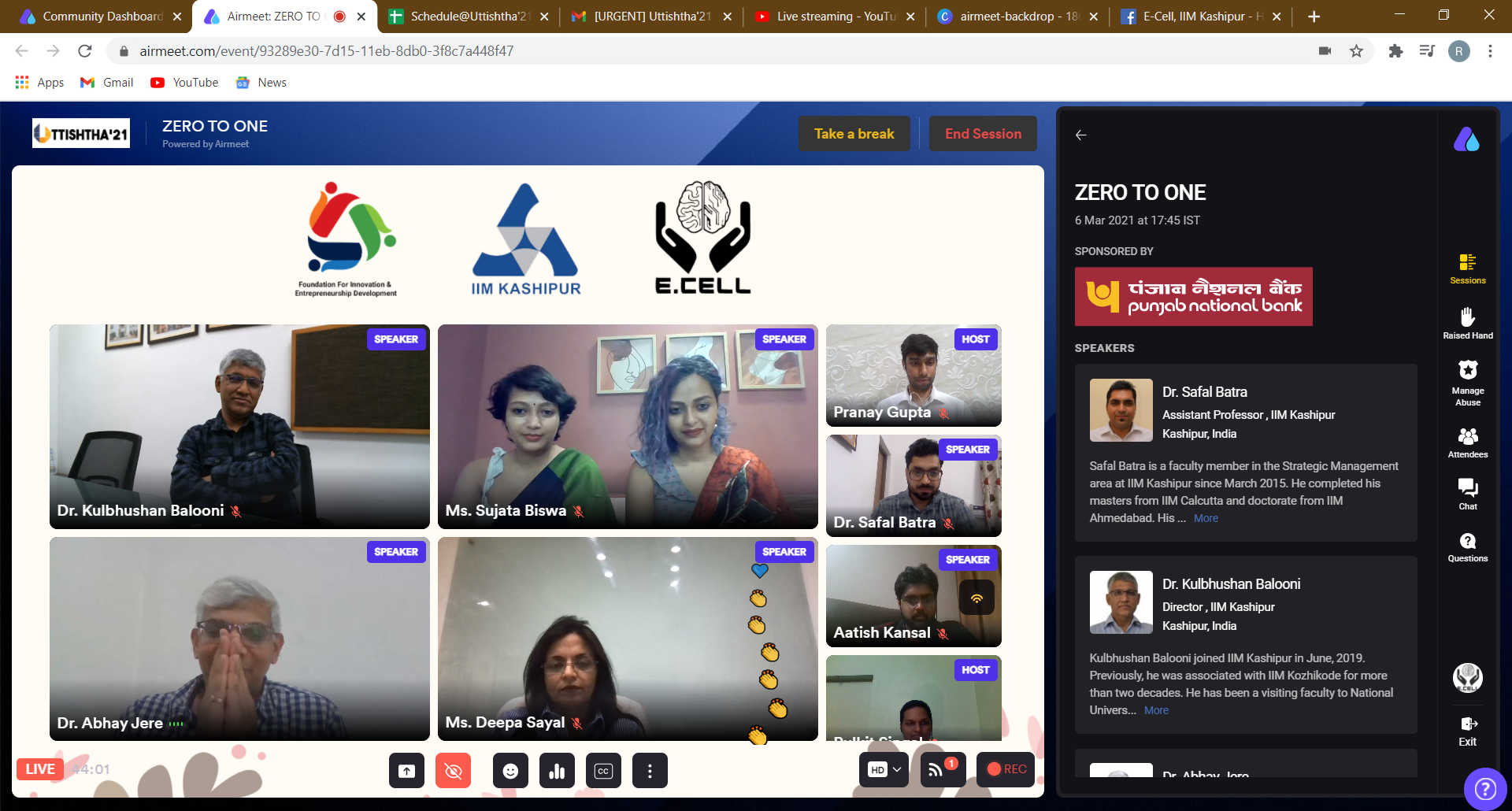
Here is the story by Team E-Cell about how they managed to pull off the event amidst difficulties posed by the pandemic!

Uttishtha is the much-awaited Entrepreneurship Summit which has an objective of revolutionizing how people view entrepreneurship and create an indelible impact in the entire startup ecosystem of the country and beyond!

The restrictions imposed on us due to COVID-19 and taking into consideration the safety of all the stakeholders of the event, we were forced to organize an event of such high magnitude on a virtual platform, which in turn meant restructuring of the entire Summit.

We, the entire E-Cell Team, decided to break the entire summit into small tasks and decided to go about the event in a phased manner. Subsequently we divided the entire summit into 3 phases, namely, the planning stage, the preparation stage and the summit!

So, we divided the team according to the preferences and expertise of the members and set off on our Voyage of “Making Entrepreneurship Bloom”!

The Planning Stage:

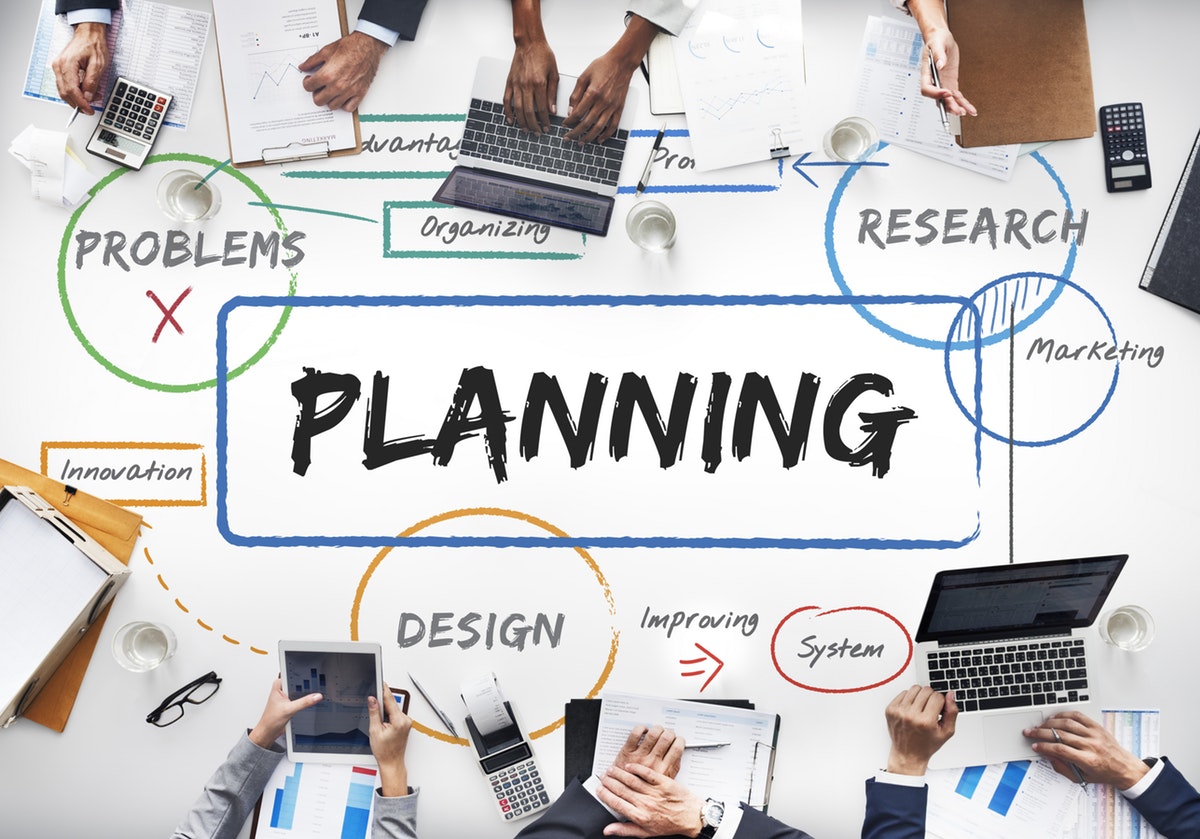
We all knew that Uttishtha’21 was going to be a completely new experience for all the stakeholders and we precisely knew that to create maximum value for everyone we had to restructure the entire summit upside down and planning or ‘Out of the Box’ sessions, we used to call them, were going to be the most important element of the entire summit!
The Importance of a Business Plan for MSMEs - AREAFENCING

In Uttishtha’21, as we were revamping almost everything, we decided to go beyond the mainstream in everything we were doing! While deciding the theme of the event, our thought process was to keep a theme that portrayed new beginnings, asked people to get rid of their winter blues (COVID blues!) and focus on embarking on the journey of 5R, namely, Rejuvenation, Regrowth, Resurrection, Renewal and Regrowth! So, with a decision to keep the whole Summit light and bright, we decided to keep the Theme – “Spring”, or the “Spring of Entrepreneurship”, more holistically!

We believe, the first major challenge that came towards our way in the planning stage was in the form of event crafting and flow mapping! We knew, that events of last year needed a major revamp, if we were to create the Summit engaging and create value for the people involved! Last year Uttishtha, had events like Startup Exhibitions, Entrepreneurship Bootcamp and Expo, which could not be conducted online given the nature of the events. So, we needed to come up with events which could fill the space of these events and so we started brainstorming on the needs and wants of all the stakeholders and subsequently came up with new events such as Not Clubhouse – focused panel discussion sessions, firechat conversation – a dialogue between experts from completely different areas, co-founder dating – a virtual internship fair for students across the country, among others! The molding of events according to the theme of the summit and requirements of the stakeholder involved, was a fun-filled experience!

We believe, ‘Uttishtha’ is an epitome of collaborative effort and it sees contribution and cooperation from each and every member of the IIM Kashipur community. After the planning of events and identifying the work areas, it was very important for us to gather support from the community and form an enthusiastic team comprising people who were motivated enough to work on the event diligently. Given the lack of physical interaction with the people involved, in a virtual setting, it was a bit difficult to find the real potential of the applicants. But after due process, we were lucky enough to have found a team, where members were on their toes to make the best out of the opportunity provided. Given the virtual nature of the event, the division of the functional teams had to be revamped where traditional functional teams such as arrangement teams, People management team and promotions team among others had to be dropped off the chart and made way for new teams such as virtual platform team, Audience engagement team and social media team among others.

The Preparation Stage:

Uttishtha’21 being virtual posed a lot of challenges in the execution of ideas, but along with the challenges involved, it also provided us with a lot of opportunities with respect to the extended reach of the event.

Challenges |

The main challenge that the team had to endure while executing the plans was the possibility of miscommunication at times due to lack of physical interaction leading to redundancy of work. Also, too much follow up on the tasks slowed down the process of execution of plans. Although these were challenges which were natural to come in a virtual setting, the dedicated and mindful work of different functional teams ensured smooth operations throughout.

The teams working on onboarding industry experts, dignitaries, speakers, startup founders, school administrators and students had a large pool of people to target given that there was no need to look after travel and lodging arrangements of the guests and with the click of a button experts could join the sessions. This not only allowed us to reach out to people beyond boundaries, but also opened wide range of opportunities for the teams to reach out to people of high stature. One approach that stand out during the whole process was the use of quirky tweet threads on twitter to reach out to people. The choice of this unconventional way led to us having onboarded a lot of good speakers and industry experts.

One of the tasks, that took substantial amount of our time was choosing an ideal virtual platform for the Summit. It proved to be an exhaustive process, given we had certain criteria such as neat user interface (UI), easy accessibility and usability, and comprehensiveness with respect to functions among others in our mind.  We tried out nearly 12 virtual event platforms before narrowing down on “Airmeet” for conducting the Summit, which we believe served our purpose well.

The digital media team had a humongous task in hand, given they were responsible for creating all the buzz around the event and getting the word across boundaries. They came up with innovative ideas to promote the event to the best of their abilities. With the support from Media and Public Relations Committee (MPRC), the team was able to forge meaningful partnerships with various media partners such as Amar Ujala, Campus Beat among others which helped the team in multi-channel promotions of the event. The digital marketing team came up with numerous creatives and took advantage of all social media opportunities (paid as well as unpaid) to promote the Summit.

The Summit (5th March – 7th March):

Team Uttishtha Meet! Date (4 March, 2021), Time: 10:00 PM! Each and every member from the entire team was there. We all had our cameras switched on! We all were from different functional teams, we all had completely different tasks assigned, but one thing common in all of us was the satisfaction we had with the level of preparedness for the summit that was going to commence next day morning. We all were pumped up and were fully motivated to make the summit a memorable one for everyone and enjoy the three-day summit to the best of our abilities.

Finally, the Spring of Entrepreneurship was here! The first day started off as a warm breeze with esteemed speakers showering their wisdom on the attendees. The first day saw the presence of dignitaries like Mr. Arun Pandey (Chairman and MD, Rhiti Sports), Subhadeep Sanyal (managing partner, Omnivore) among others. We expected that getting the speakers and attendees accustomed to a fairly new platform like ‘Airmeet’ and ensuring the smooth internet connectivity throughout the sessions were something which might play spoilsport during the events, but we are proud of our Techno-savvy team which kept technical issues at bay throughout the Summit.  

The Second and third day were going to be crucial days of the event given we had events lined up in those two days which overlapped too, the risk we had to take because of the limited time we had and plethora of events planned out! We had Clear Harvey workshop for school students, Udaan – a national level B-Plan competition, speaker sessions, panel discussions with school administrators planned out, which led to many of them overlapping. But unconsciously, the bond in the entire team and the culture passed on by our seniors helped us sail through roadblocks smoothly and conduct the events in a synchronous manner. It was great to see people taking ownership for their responsibilities and coming forward to take additional responsibilities! Last minute cancellations of few of the experts was something we always had in our mind, and we are happy that we had backups and plans to deal with those situations!

Overall, we can say that Uttishtha’21 was a roller coaster ride for each and every member of the team. Each turn had some challenge for us and we are proud and happy that we had our experienced seniors (our partners, supporters and mentors), who were not only there to show us the path but were there to handhold us through the trouble times. The support from the entire IIM Kashipur community helped us in making the event a national success!

Uttishtha’21 is indeed an epitome of collaborative effort!
Probable impact of US Elections on global supply chain post-Covid

As the entire world went into the first-ever lockdown of the century, all except the medical staff were confined to their homes. This ensured that everyone stays safe, but every sector of business went into a state of despicableness.

Reason? SUPPLY CHAIN DISRUPTION!

Such is the power of supply chain network especially in this era of Globalization! Any wrong decision can lead to a world full of chaos and violence.

Fortunately for us, the world leaders ensured there was enough supply of essentials required for survival. And now that Covid-19 vaccine shots are being administered, the hopes of Supply chain normalcy seem to be cropping up.

However, one major event that took place towards the fag end of 2020 that could potentially change the way International trade and supply chain worked until now was the U.S. Elections.

As I write this article, Joe Biden is the president-elect and what could it mean to the Supply chain?

During the Presidential debate, Joe Biden emphasized negotiating with the Pacific nations to restructure the international trading rules in order to reduce dependence on China. This would help other Asian & Arabian Countries to improve their economy as they would have the liberty to export more with limited competition from China.

Joe Biden is particularly wanting to support the United States-Mexico-Canada Agreement (USMCA) so that the United Nations’ powers in terms of framing laws for international Supply Chain & International Trade are strengthened. The manufacturing sector in this region will see a boost as North American Countries are given incentives for Automobile manufacturing, especially that of Trucks & cars. With strong agricultural laws, the farmers will get access to the markets in all three countries.

Manufacturers in the US who offshore production and sell the products or services back in the US, have to pay a heart wrenching cumulative tax of 30.8%, to solve this issue. Biden’s policy focuses on local manufacturing, he promised to direct $400 billion in federal procurement towards manufacturing and emphasized on Made in America label.

The federal department many times in the past has claimed that manufacturing certain products is not feasible in America and that has given a huge market to other countries. Biden, while addressing this point, stressed using IT Technology to publish it on a specific website built for the same purpose. Once such requirements are posted on this website, tenders can try their hands on producing such products thus getting eligible for the 10% advance tax credit policy.

During almost all his campaign rallies, Biden mentioned the need to directly support small manufacturers, especially those headed by women, this would ensure the creation of jobs and keep the national per capita income increasing. Biden said he would direct $300 billion towards R&D of electric vehicle technology, 5G, Artificial Intelligence – this ensures procurement of parts required for the same and to ensure smooth supply chain, he promised to amend Custom laws and make it easier to buy.

He said & I quote “While medical supplies and equipment are our most pressing and urgent needs, US supply chain risks are not limited to these items. The US needs to close supply chain vulnerabilities across a range of critical products on which the US is dangerously dependent on foreign suppliers.” This prepares the U.S to be ready for a probable 2nd wave of Covid-19 & any kind of crisis in the future.

Biden spoke about how supply chains laws and the federal Government’s purchasing power can ensure smooth manufacturing of critical parts used in the United States’ defence systems. In this way, not just the end product but also the supply chain of manufacturers receives a boost. Biden mentioned the need to be environment friendly and has pledged to utilize the $500 Billion federal government spends on Zero Emission & 100% clean energy vehicles. This would again create more manufacturing & thus more jobs & thus a bigger growth in the US economy. He also mentioned he would bring in stricter laws that would govern the readiness of environment-friendly technologies in all infrastructure projects, thus, giving opportunities for renewable energy innovation & thus impacting supply chain networks.

All in all, most of Biden’s policies focus on reducing the dependence on China for products & supply chain services. This would only help America as they are moving towards becoming leaders in Mass production, Supply Chain services.

We’ll have to wait & watch how the American labour class reacts to this, since the labour costs are higher in America and the Chinese workforce is almost 5 times larger than in the U.S, the next 4 years is expected to witness intense geopolitical tensions. All the countries that are in Joe Biden’s good books might receive some goodies. In the Post Covid-19 era, America might overpower China on these lines & India must continue to maintain cordial relations with them by being diplomatic on issues & at the same time strive hard to increase in-house production of goods & services through schemes like Atmanirbhar Bharat.

Sumanth S (MBA Batch 2020–22)

Demystifying Stock Market and Economics

Few lingering questions which every common investor has in his mind are how can the stock markets and the economy growth move in the opposite direction? Will the market crash due to poor economic growth anytime?

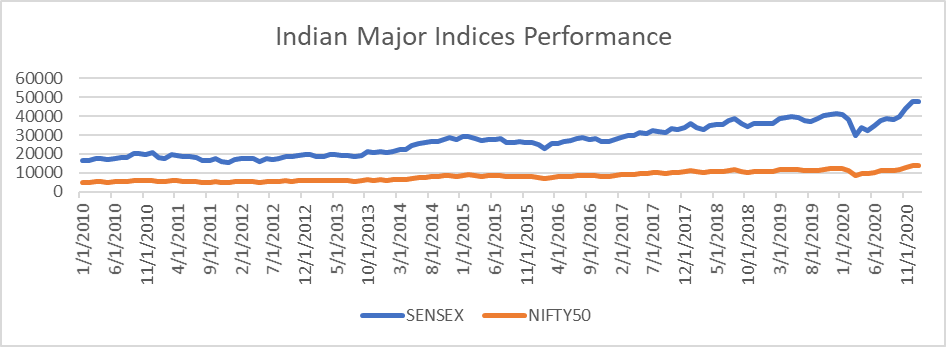
While the Covid-19 pandemic forced all economic activities to a total halt, pushing major economies into a recession, the markets around the world on the other hand had a mixed response showing a steep fall during the initial pandemic breakout and steadily recovering over time to race all-time highs in Indian and US exchanges.

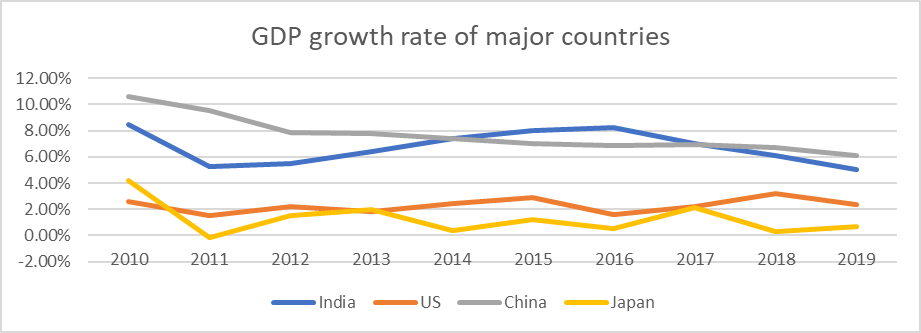
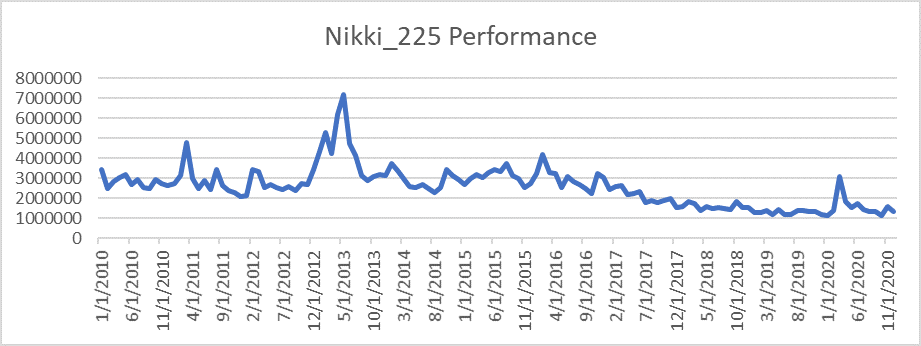
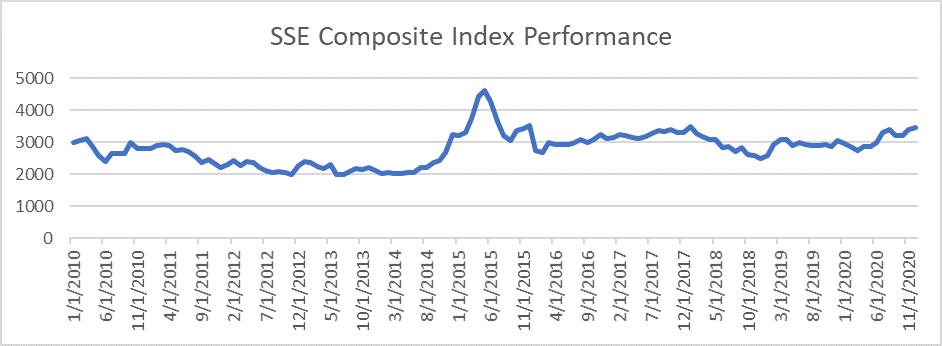
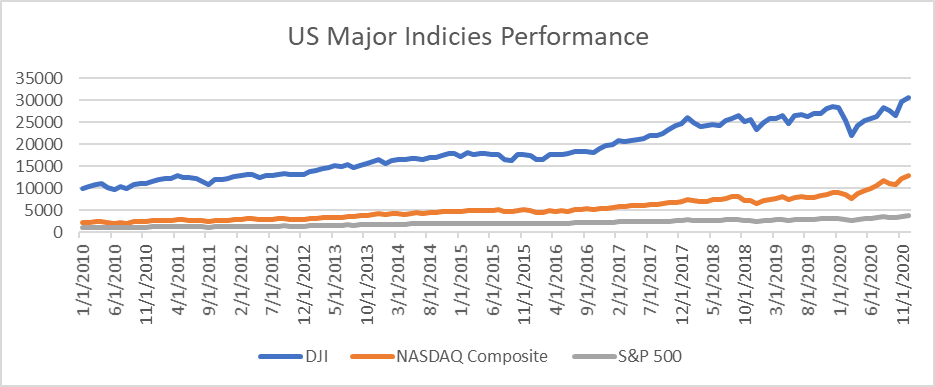
The empirical analysis of the annual GDP growth rate and the historical market performance of leading stock exchange indices of major countries such as USA, Japan, China, and India respectively over the decade show little correlation between the growth of countries’ GDP and performance of stock markets.

Japan faced one of the worst decades of economic growth battling recession and unemployment having a maximum GDP growth rate of a mere 2% in the last decade. While Nikki_225, the benchmark index of the Tokyo Stock Exchange had lost more than 60% of its value over the decade, sharp falls in the index during this period was the result of external events such as Fukushima’s nuclear crisis and the European Sovereign Debt crisis in 2011. The rally in 2013 which surged more than 70% due to the weakening of Yen and expansive economic policy was short-lived as the market plunged by ~60% at the end of 2013 due to the weak GDP growth of China and quantitative easing of US Federal Reserve during the same period.

Though China’s economic growth declined gradually from 10% to 6% over the decade, it was still having the highest growth rate among the developing countries. The Shanghai composite index grew a mere 16% over the decade despite the country having the highest GDP growth among the major economies. The Chinese exchange majorly influenced by the domestic investors who were largely inexperienced and traded using borrowed capital persuaded by the Chinese state-owned media during the period of 2015, saw a bubble in the market with the index soaring more than 150% over the previous year despite the country having poor manufacturing and economic growth. However, the bubble was short-lived and consequently busted as it lost 40% of the value in the month of June and continue to fall subsequently due to the devaluation of Yen.

The turbulence of Chinese stock markets combined with slowing growth of China’s GDP, falling oil prices, and weakening of the Japanese Yen against the US dollar and Brexit event resulted in a global sell-out during the period of 2015–16 which impacted all major stock markets around the world including US and India. 

Despite having low GDP growth of around 2% over the decade, US markets have continued to grow over where the leading indices such as Dow Jones Industrial average, S&P 500 and NASDAQ Composite have yielded returns of over 200% primarily driven by innovation and technology. FAANG companies due to the power of the platform model, network effects have had a compounded annual return of more than 20% individually over the decade. Markets also saw an emergence of new business models and sunshine sectors such as electric vehicles, e-commerce, AI & Cloud computing, alternative energy, OTT etc which continue to have positive investor sentiments.

Globalisation and foreign trade are also important factors to consider why the performance of the Indian stock markets has little correlation with economic growth as the manufacturing sector contributes only ~15% of total GDP compared to China and Japan which has ~ 30% and ~20% respectively. The major sectors such as IT, Pharma, Breweries and Distilleries, Precious Metals, Automobiles are export-oriented which relies on the US and the global economy. Sectors such as Refinery, Paint, Aviation are highly dependent on the price of crude oil as India is one of the major importers.

FII also has a significant factor to play in controlling the direction of the stock markets. Indian equities saw a record inflow of $23 Bn (Rs. 1.6 Lakh Crore) in 2020 as the global investors were optimistic about the strong economic recovery, vaccine progress and low mortality of Covid-19 in India compared to western countries. This liquidity provided by FII continues to drive the market sentiments forward leading the prices to soar all-time high across multiple sectors.

The performance of the stock markets does not rely only on the economic growth of the country. Other factors such as the nature of its constituents, the impact of FII, technology & innovation and global events can also impact the markets. Markets can be both forward-looking and reactive to economic events and will correct themselves in the event of any bubble during times of weak economic growth.

Arjun R. (MBA Batch 2020–22)

Essential learnings from shift to online education amidst Covid-19

Image for post

The business schools have conventionally been staid in their approach to teaching methods — the area in which there have been but few innovative developments for decades. The face-to-face teaching-learning process still dominates despite the advent of online learning. Faculty prefer the face-to-face mode from the viewpoint of convenience in responding to questions from a mass of students, carrying out interactive discussions and explanations, derivations or solving problems on the whiteboard.

However, the change seems to be a constant in education. The paradigm shift in pedagogy to online mode offers one means of making such change due to pandemic. Online teaching is helping us to beat the Covid-19 lockdown and catch up with the academic schedule. Nevertheless, at the same time, I fear that the paradigm shift in pedagogy to online mode may alienate economically disadvantaged students who do not have access to digital classes.

We do have some essential learnings from the online classes.

  1. The online teaching-learning process in business schools is undoubtedly useful. In some ways, such as making (theory and lecture) more structured, promoting self-learning, and prior class preparation among students, reducing spoon-feeding, it is perhaps more effective than the face-to-face mode.
  2. Examinations need not be in sit on-campus mode; open-book take-home exams designed to assess higher-order thinking skills or online exams are more effective, at least at the post-graduate level.
  3. Blended learning as a pedagogy appears superior to the conventional face-to-face teaching-learning process from the student’s perspective, to cater to fast and slow learners equitably.

In general, I believe that the current crisis and the response mechanisms put in place by the institute and other leading business schools will bring about a paradigm shift in pedagogy and that these new teaching-learning processes will be more effective.

Dr. Sunil Kumar Jauhar

Assistant Professor

Operations Management & Decision Sciences

Switching to the virtual mode of learning during the pandemic

Imparting formal education has been traditionally conceived through a single-mode within a close setting. Within this concept, the learning and knowledge are possessed, selected, structured, and transmitted by a teacher to students. This mode does not provide an opportunity for the formation of a dialogue between a teacher and students. Though this mode is rationalized as the finest, the present scenario calls for constructing an alternative virtually based mode.

Image for post

Virtual or online mode creates a co-constructed approach in learning and facilitates the development of online learning communities. This approach allows students to engage actively in the discovery of alternative forms of knowledge and denaturalize the assumptions of a subject. This paradigm shift in pedagogy transmutes the usual transmission of knowledge into cooperative learning, assists in neutralizing the power relations between the positions of instructor and student and brings them together and elevates their creative potential.

In the context of higher education, this shift embraces constructivist pedagogy and technology. The philosophical assumption in constructivist pedagogy is the learner constructs a version of reality that is situated in a context of social interactions with other learners and institutions. As the shift promotes collaborative learning and enhances reflexivity, an action extends thought — reflection shaped by the consequences of the action. It allows learners to actively engage one another in ideas and perspectives they hold to be educationally valuable, exhilarating, and stimulating. It is through the design of the online learning environment, with an emphasis on shared educational goals, support, collaboration, and trust that these processes can be most effectively and functionally activated.

Dr. Rahul Ashok Kamble

Assistant Professor

Organizational Behavior & Human Resource

Dealing with the challenges of online mode of learning amidst Covid-19 pandemic

Image for post

COVID-19 pandemic has forced global experimentation in many facets of lives. Education can be one of the several arenas that this crisis is going to change. Learning online can be a lot more complicated than simply being acquainted with setting up a Zoom account or Google Classroom. Initially, I had two major instinctive apprehensions for remote teaching that could hold me back during the unprecedented transition from offline to online mode. First, being gripped by the mechanics instead of focusing on the purpose of learning. Second, the greater emphasis on the content alone. This pandemic has added an extra layer of complexity to the anxiety associated with online learning. Learning is more than just a transaction between an expert and a novice. So, as an educator, the major challenge was to overcome the temptation of embracing a narrow view of cognitive learning. Because socio-emotional learning is also crucial especially in situations of crisis when one’s anxiety is likely to be much stronger.

Socio-emotional distress like loneliness or anxiety can wear away our cognitive capability also. Therefore, for effective online learning, a balance of knowledge with a focus on people and emotions is required. A shared and holistic learning process in online mode was subject to other challenges like the digital divide, attention span (multi-tasking that we often do in online mode), low motivation, and novelty of online platforms. Virtual office hours provide that another window of conversation and connection that would have been missed in remote teaching. The crisis has caused some disruptions in the learning process but with some readjustments in online learning, we were able to address students’ disorientation as well as getting on with the curriculum. Online learning might be a short-term response to COVID-19 but it has paved way for a lasting digital transformation of education.

Dr. Preeti Narwal

Assistant Professor (Marketing)

Experiences and learnings from the paradigm shift in pedagogy to online mode

Image for post

The onslaught of online teaching-learning practices that entailed the COVID19 outbreak in recent times has outvied the traditional pedagogy of a physical classroom experience both from temporal and spatial contexts. The usual classroom environment has been replaced by a digital space where many of the teaching-learning assumptions are being questioned every day. It has brought new issues, challenges, and opportunities to the omphalos of educational praxis. At best, it has enthroned the learner at the centre and compelled the teacher to negotiate the curriculum through digital intermediaries and applications that were hitherto unknown to both. While the virtual reality has become new normal and opened up avenues for action research, it has once again startled many to the core. Being an abettor of open and distance education since the 1990s, for me, it was a long battle won at last. A battle that we lost innumerable times when our colleagues and fellow educationists vacillated the reliability and validity of teaching, learning and degrees earned through ‘distance mode’. Even after the establishment of an open university almost in every state, the government used to give public notices announcing that degrees obtained through distance education are equally ‘valid’. COVID19 has pushed all those egotisms to the periphery and firmly entrenched the online education system that is going to be the new paradigm for years to come, perhaps much after this pandemic.

While the traditional classroom is seen as a powerful space where the physical presence of the faculty is set as the apotheosis of knowledge, the online classroom has made the field more democratic. I am now au courant of the fact that unless and until I make the content attractive, relevant, and rich, the audience might just occlude me from his/her reality and I would be facing more blank screens (when students’ cameras are off). I can no longer afford to unleash the drudgery of monologues on the students and as such I have to deliver the content from with a design thinking approach where graphics, narratives, and the platform (e.g. Zoom) are all in sync with the theme of my session. The art and the aesthetics of audio-visual contents that were long considered the tinge of the media and journalism experts have now become the existential survival skill for the online faculty. The jury is out and the potential outcome of my delivering classes online over the last few months will perhaps reiterate an apophthegm that I heard from one of my senior colleagues — ‘to teach or not to teach, do whatever you like in class but never bore your students’. That fulmination looms much larger today for any teacher when both the dramaturgy and the stage have gone virtual and if something goes wrong it might even go ‘viral’.

As a researcher, while my field teams are cooling their heels at home, online classes have opened up an enormous space for conducting digital ethnography or Netnographic study from the comforts of our homes. That is an added advantage that would have perhaps remained in the penumbra, had we not been forced into this homebound exile by the pandemic. The Socratic classroom has taken a backseat for now and the flip-class has taken a lead in enriching students’ engagement and active learning at different levels. We are now more conscious of the difficulties, digital divides, affordability, and access issues in connectivity and the differentiated learning preferences of our disciples. That is a new nirvana for me to suspire for.

Dr K M Baharul Islam

Dean (Academics) and Professor (Communications)

Chair, Center of Excellence in Public Policy and Government

Embracing the online mode of learning in the new normal

आत्मानं सततं रक्षेत् (One must save oneself under any circumstances) is a famous quote by Swami Vivekananda. We all in academics did that under the COVID-19 circumstances to save ourselves from stagnancy, by embracing the online mode of teaching and learning.

Interestingly online education, distance mode of education, and learning through correspondence were earlier part of the non-formal education system but today the above mode of teaching and learning is being adopted by the formal education system too. Globally adaptation to the wave of change brought by COVID-19 has become the new normal. How long would this continue, that just depends on the solution scientists would decode to trash the virus! Duration of this new normal may call for change in the definition used for a long, to classify formal and non-formal education. What if the division between both the type of education (formal vs non-formal) based on the mode of teaching and learning, gets blurred! I am thrilled by the idea of more than analyzing its outcomes! Would it be really and only bad? Or there is some good in it as well? The answer lies only in the future.

What is happening at present on the academic front? In my attempt to respond to this I would like to say what the Great Greek Philosopher Cicero, said once, “Summum bonum” which in Latin means the “highest good”. Talking about the present scenario, dealing with the COVID-19 crisis was made possible by technology, by online teaching, was there any better way than this to ensure continuity and overcome stagnancy? Teaching and learning via Zoom (or any online platforms) is the highest good, the thing at this point. Online teaching and learning made possible using the online platforms have the capacity to radically revolutionize the education system, and I presume, it will be for the “highest good” of every stakeholder involved. So I think what has happened in our attempt to adapt and move on is “Good” and what is going to happen in future due to technological development, let’s hope it will also be “Good”.

Dr. Madhurima Deb

Associate Professor (Marketing)