Demystifying Stock Market and Economics

Few lingering questions which every common investor has in his mind are how can the stock markets and the economy growth move in the opposite direction? Will the market crash due to poor economic growth anytime?

While the Covid-19 pandemic forced all economic activities to a total halt, pushing major economies into a recession, the markets around the world on the other hand had a mixed response showing a steep fall during the initial pandemic breakout and steadily recovering over time to race all-time highs in Indian and US exchanges.

The empirical analysis of the annual GDP growth rate and the historical market performance of leading stock exchange indices of major countries such as USA, Japan, China, and India respectively over the decade show little correlation between the growth of countries’ GDP and performance of stock markets.
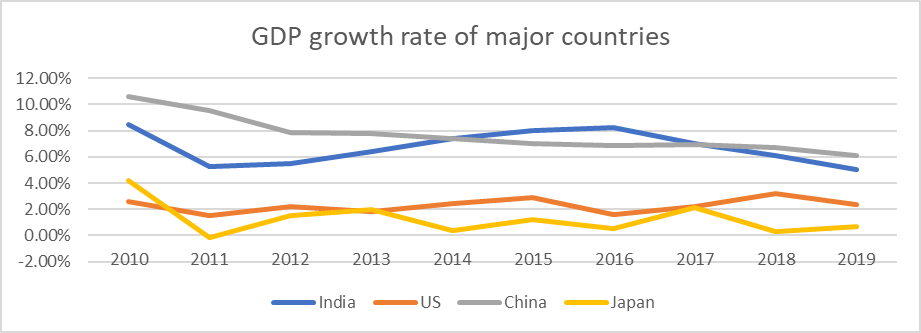
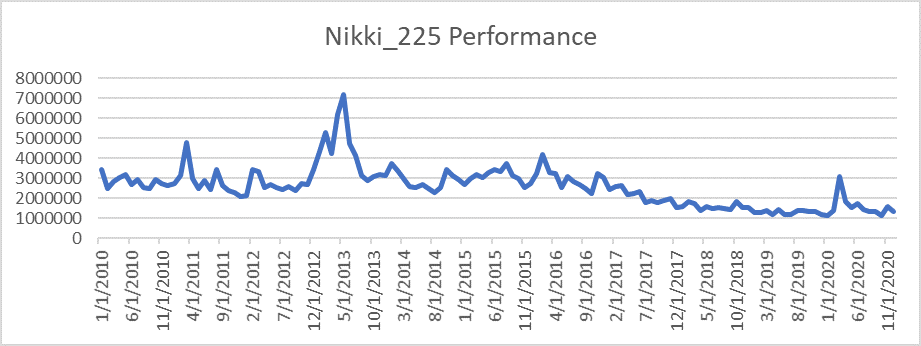
Japan faced one of the worst decades of economic growth battling recession and unemployment having a maximum GDP growth rate of a mere 2% in the last decade. While Nikki_225, the benchmark index of the Tokyo Stock Exchange had lost more than 60% of its value over the decade, sharp falls in the index during this period was the result of external events such as Fukushima’s nuclear crisis and the European Sovereign Debt crisis in 2011. The rally in 2013 which surged more than 70% due to the weakening of Yen and expansive economic policy was short-lived as the market plunged by ~60% at the end of 2013 due to the weak GDP growth of China and quantitative easing of US Federal Reserve during the same period.
Though China’s economic growth declined gradually from 10% to 6% over the decade, it was still having the highest growth rate among the developing countries. The Shanghai composite index grew a mere 16% over the decade despite the country having the highest GDP growth among the major economies. The Chinese exchange majorly influenced by the domestic investors who were largely inexperienced and traded using borrowed capital persuaded by the Chinese state-owned media during the period of 2015, saw a bubble in the market with the index soaring more than 150% over the previous year despite the country having poor manufacturing and economic growth. However, the bubble was short-lived and consequently busted as it lost 40% of the value in the month of June and continue to fall subsequently due to the devaluation of Yen.
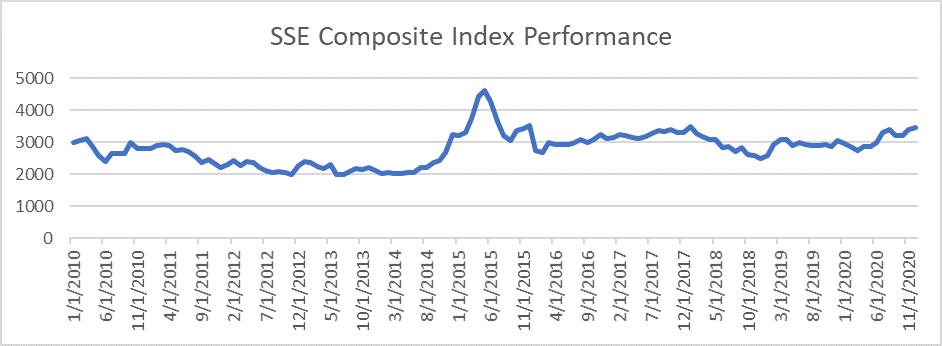
The turbulence of Chinese stock markets combined with slowing growth of China’s GDP, falling oil prices, and weakening of the Japanese Yen against the US dollar and Brexit event resulted in a global sell-out during the period of 2015–16 which impacted all major stock markets around the world including US and India. 

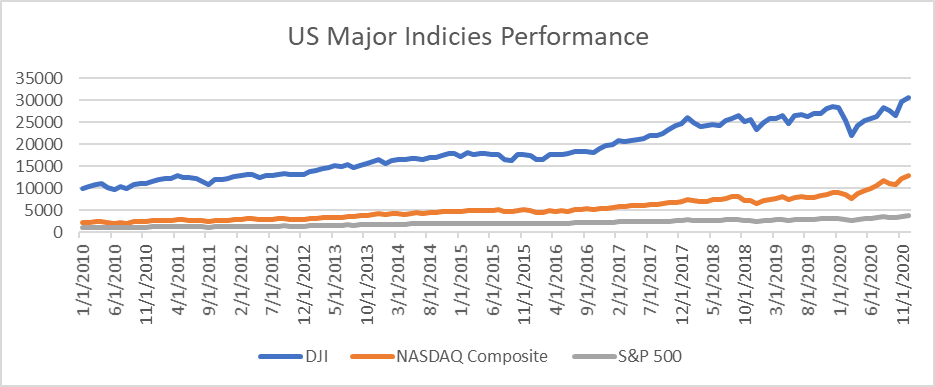
Despite having low GDP growth of around 2% over the decade, US markets have continued to grow over where the leading indices such as Dow Jones Industrial average, S&P 500 and NASDAQ Composite have yielded returns of over 200% primarily driven by innovation and technology. FAANG companies due to the power of the platform model, network effects have had a compounded annual return of more than 20% individually over the decade. Markets also saw an emergence of new business models and sunshine sectors such as electric vehicles, e-commerce, AI & Cloud computing, alternative energy, OTT etc which continue to have positive investor sentiments.
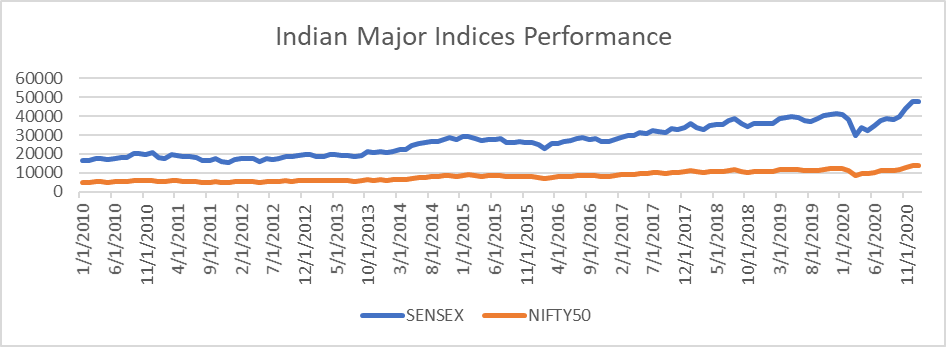
Globalisation and foreign trade are also important factors to consider why the performance of the Indian stock markets has little correlation with economic growth as the manufacturing sector contributes only ~15% of total GDP compared to China and Japan which has ~ 30% and ~20% respectively. The major sectors such as IT, Pharma, Breweries and Distilleries, Precious Metals, Automobiles are export-oriented which relies on the US and the global economy. Sectors such as Refinery, Paint, Aviation are highly dependent on the price of crude oil as India is one of the major importers.

FII also has a significant factor to play in controlling the direction of the stock markets. Indian equities saw a record inflow of $23 Bn (Rs. 1.6 Lakh Crore) in 2020 as the global investors were optimistic about the strong economic recovery, vaccine progress and low mortality of Covid-19 in India compared to western countries. This liquidity provided by FII continues to drive the market sentiments forward leading the prices to soar all-time high across multiple sectors.
The performance of the stock markets does not rely only on the economic growth of the country. Other factors such as the nature of its constituents, the impact of FII, technology & innovation and global events can also impact the markets. Markets can be both forward-looking and reactive to economic events and will correct themselves in the event of any bubble during times of weak economic growth.

Arjun R. (MBA Batch 2020–22)

Econs – The Economics Club | IIM Kashipur

Image may contain: text that says "ECONS ECONOMICS CLUB IIM KASHIPUR"

Econs – the Economics Club of IIM Kashipur is one of the seven academic clubs of IIM Kashipur. Econs bears the responsibility of increasing awareness, generating inquisitiveness, and fostering passion among the students and faculty in the field of economics. 

The economics club was founded in the year 2019 as an interest-based club to impart knowledge, invoke discussions and conversations pertaining to economics, and highlight its importance and linkages to different business domains. Late American scholar Warren Bennis said that “Success in management requires learning as fast as the world is changing”. Keeping up with this notion, the club has found it extremely pertinent for aspiring managers to be aware of “Economics” affecting their daily lives and make them better prepared to tackle business situations efficiently. Since its inception, Econs has gradually attained the status of a core academic club and has carried out a plethora of activities in this direction.

Image may contain: 1 person, sitting, text that says "Budget Highlights the current fiscal. For FY21, Rs 4.99 lakh crore; FY20 fiscal deficit revised .8% from 3.3% fiscal deficit ena 3.5% Net market borrowing for FY20 crore. Nominal GDP growth 2020-21 estimateda 10% Receipts 2020-2 estimated Rs 22.46 lakh crore. Expenditure the year 2020-2 Rs 30.42 lakh crore. FY21 it's pegged"

In the first year of its functioning, the club conducted ‘Arthashastra’, the flagship event of Econs, during Agnitraya 2019, which saw participation by around 450 teams from various B-schools across India. In this competition, different teams designed a feasible economic policy of their choice that resonated with India’s ultimate goal of achieving a five trillion-dollar economy. Along with that, Econs also conducted an ‘Infographics Making Competition’ covering topics like the future of banking, green Economy, and the effects of immigration on the Indian Economy. Econs also conducted the ‘Union Budget Prediction Competition’ wherein the participants had to guess highlights of the Union Budget and the participant with the closest prediction took away the prices. The event was welcomed with utmost enthusiasm.

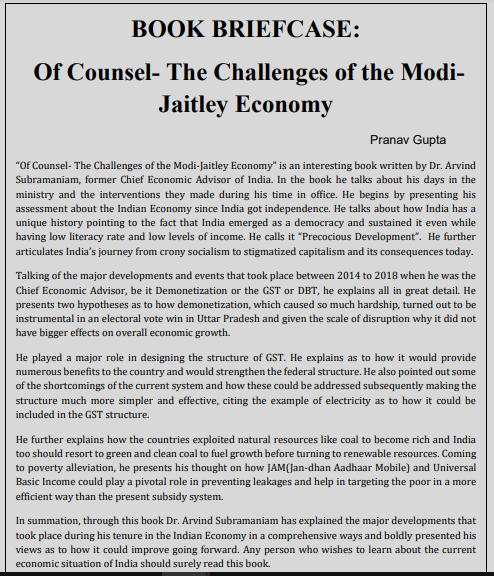
The club makes the students aware of the domain by posting short articles bi-weekly through its social media handles on Twitter, Instagram, Facebook, and LinkedIn. For the academic year 2019-20, the posts have covered topics like RBI monetary policy highlights, US elections impact on the Economy, and Atmanirbhar Bharat 3.0 to name a few. Along with the weekly posts, social media handles also feature monthly newsletters. The club shared this academic year’s first newsletter for the month of October 2020. The comprehensive issue featured the fragile state of the NBFC sector in India along with articles on comparing the Chinese Economy with the Indian Economy and giving a brief about the economic aspect of “Stubble Burning”. With an objective to inculcate the interest in reading in the field of economics, the newsletter also featured a review of a famous book ” Of Counsel-The Challenges of the Modi-Jaitley Economy” written by our former Chief Economic Adviser, Government of India, Mr Arvind Subramanian. Along with these, the newsletter had lighter sections like “Jargons” and “Current Affairs” too.

The club provides a platform for all the people to discuss, debate, and design on the current economic developments and government or regulatory policies and announcements. Throughout the year members of the club also conduct knowledge sharing sessions through case studies, quizzes, and games to instil and fuel a growing interest among students to understand and analyze their theoretical concepts towards practical applications.

Image may contain: one or more people, text that says "Conscientia 2020 27 SEP Dhiraj Nayyar Director, Economics & Policy Vedanta Resources Limited Former- Officer Special Duty Head, Economics, Finance Trade, NITI Aayog 4 PM LEADERSHIP TALK SERIES ECONS IIM KASHIPUR vedanta transforming elements MKASHIPUR KASHIPUR"

On the corporate front, the club extensively interacts with experts and industrial stalwarts in the field of business and economics to share insights regarding the latest happenings through a seminar or a lecture. Econs became the first academic club in IIM Kashipur to conduct a guest lecture in Conscientia 2020 leadership talk series. The eminent speaker of the guest lecture was Mr Dhiraj Nayyar, the Chief Economist of Vedanta Group and a former member of NITI Ayog, who delivered an insightful session on the relevance of economics for the managers.

Through its numerous strides in continuously highlighting different aspects of economics, Econs has achieved a distinct recognition in keeping up with its mission and being a forerunner for the same. The aim is to increase awareness about Economics among students. Our mission is to inculcate interest among the students of IIM Kashipur in economics and help them understand how economics is interlinked with various fields. We work to bring together all the economics and business enthusiasts inside and outside the campus together to discuss and debate the major economic events of the world to foster new ideas for the future.