This article has been adapted from the bestselling book Critical Chain by Dr. Eli M. Goldratt, an internationally recognized industry guru and the originator of the Theory of Constraints (or ToC). This book is one of many business novels written by Dr. Goldratt through which he has transformed and revolutionalized the thinking and actions of management throughout the world.
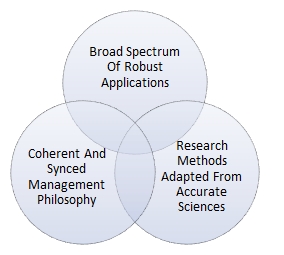
Theory of Constraints is a breakthrough and powerful management philosophy that has evolved in the past couple of decades along with other new-age concepts like TQM, JIT, re-engineering and the learning organization. By complimenting these other philosophies with its clarity and systematic analytical methods, ToC boasts of the following merits:
Now, in layman’s terms, let’s understand the approach of ToC in resolving cause-effect relationships. For instance, what are some of the biggest problem faced by managers today? These include:
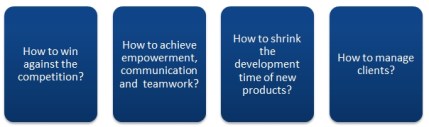
ToC regards that problems such as the ones stated above are just symptoms. It claims that they all stem from one single core problem. Let’s delve into detail on this conclusion.
One assumption or observation in the ToC universe is that most managers want to manage well. In order to manage well, managers must ensure that the right products reach the right clients at the right time and in the right quantity. There are two absolutely necessary conditions to achieve effective and efficient management.
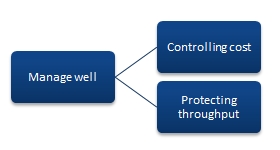
Each of these conditions, controlling cost and protecting throughput, implies a different mode of management. Let us understand this through an analogy. Let’s view a company as a physical chain with many links. You are the President in charge of the entire chain.
In our chain, the closest thing related to cost will be weight. And one way to determine the total cost of the organization is to sum up the weights of all the links. Now, if I am a manager in charge of a specific department, a specific link in the company, then to improve my link the obvious thing to do is to make it a few grams lighter. However, as President you are not interested merely in my link; you are interested in the whole chain. But when I reduce the weight of a link, the entire chain becomes lighter by that amount.

This analogy implies a management philosophy. It implies that any local improvement automatically translates into an improvement of the overall organization. Hence, any global improvement can be achieved by inducing many local improvements. Let us call this management philosophy the ‘Cost World’. Most organizations today function on the principles of the cost world.
Now, let us examine throughput (or flow) through the same analogy. What is the equivalent of throughput in our physical chain? It is the strength of the chain. If one link, just one link in our chain breaks, what happens to the strength of the chain? It drops to zero. This indicates that when we deal with throughput, it is not just the links that are important; the linkages are equally important.
Intuitively, it follows that the strength of the chain (or throughput of the Company) is determined by the weakest link in the chain. And obviously, there can be only one “weakest” link in a chain at a time
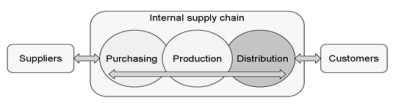
Now, let’s see what this implies. If you are still the President in charge of the entire chain and I’m still in charge of just one department (let’s take the more general case where I’m in charge of a department that is not the weakest link). If I make my link stronger, do I improve the strength of your chain? The answer is … absolutely not!
This leads us to another management philosophy which we shall call the ‘Throughput World’. The throughput world says that most local improvements do not contribute to global improvements. The way to improve the total organization is definitely not achieved by inducing many local improvements.
Considering these two contradicting philosophies, the next obvious question is – Can we manage according to both worlds at the same time? The answer is NO. There is no compromise between the cost world and the throughput world. Not even theoretically. In academia we don’t call it compromise, we call it optimize. To understand why we cannot optimize between the two worlds, we need to first understand an important concept called Focusing.
Any improvement in a company requires basically 3 resources:
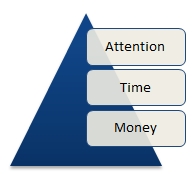
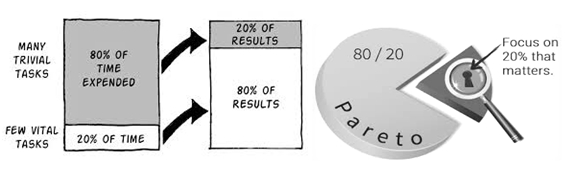
It is important for a manager to know where to focus his resources. A manager who does not know how to focus will not succeed in controlling cost and will not protect throughput. In Statistics, we have come to know Focusing through a tool called the Pareto Principle. Focus on solving 20% of the important problems and you’ll reap 80% of the benefits. But those who teach statistics know that the 80-20 rule applies only to systems composed of independent variables; it applies only to the Cost World where each link is managed individually.
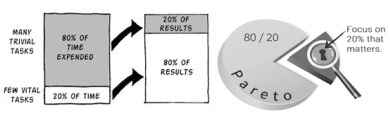
Where linkages are important and the variables are dependent, the Pareto principle is not applicable. So how can we find out on what to focus in the Throughput World? Well, it’s simpler than expected. Just think about the chain and the fact that its strength is determined by its weakest link. If you want to strengthen the chain, the first thing is to find the weakest link.
This leads us to the 5 stages of Focusing as per Theory of Constraints:
Step 1: Identify the system’s constraint(s)
Step 2: Decide how to Exploit the system’s constraint(s)
Step 3: Subordinate everything else to the above decision
Step 4: Elevate the systems’ constraint(s)
Step 5: Avoid Inertia and go back to step one
The above steps are also called the Process Of On-Going Improvement or POOGI. Simply put, it means that once we find a bottleneck, we need to strengthen or improve it. Now, as per the intuition of the throughput world, we should not produce at the non-bottleneck resource any more than we can squeeze out of the bottleneck resource. If we want to increase throughput, we must then lift some of the load from the bottleneck by buying more machines or hiring more people, whichever may be suitable. The logic here is impeccable as well as intuitive. Once the bottleneck is strengthened enough it no longer remains the constraint resource and we must move on to the next bottleneck. And this is the process to focus in the Throughput World.
This learning will now help us understand easily why there is no acceptable compromise between the cost world and the throughput world. Imagine that I am still in charge of the department that is not the weakest link. As per ToC, I must now subordinate my process to that of the constraint resource, forcing me to operate at sub-optimal efficiencies. And in industry, which is governed on the principle of maximizing efficiency, this would be a sure shot way to get oneself fired out of a job.
Do you understand what this means? It means that your intuition lies in the throughput world and in this world the answer is ‘don’t dare to produce more than the constraint resource’. But your performance measuring systems are in the cost world that wants you to reach maximum local efficiency. And therefore, there is no compromise. If one tries to optimize this conflict between the 2 worlds, both worlds will kill him.
The Theory of Constraints firmly believes that there are no inherent CONFLICTS. As mentioned before, ToC is derived from the accurate sciences. And in the accurate sciences, what do scientists do when they face a conflict? Their reaction is very different to that of managers. While we try to find an acceptable compromise, this thought never crosses their minds. Their starting point will never allow it; they don’t accept that conflicts exist in reality.
So, no matter how well the two methods (cost world & throughput world) are accepted, the scientists’ instinctive conclusion will be that there is a faulty assumption underlying one of the methods used. All their energy will be focused on finding that faulty assumption and correcting it.
Can we do the same in our Cost World vs. Throughput World scenario? Can we eliminate the conflict and emerge at a win-win? Think about it. We will elaborate more on this in our next post.
Rishi Varma
OSM




























 The IIM Kashipur Blog