Consilium - the Consulting and Strategy Club | IIM Kashipur

Opportunities! “Consultants must find newer opportunities. If you can’t find one, create one.” This is precisely what Consilium strives to do – creating opportunities!
Consilium, the academic club of IIM Kashipur deals with Strategy and Consulting aspects of  Management. Since its inception, Consilium is determined to assist the students with preparation, comprehension and expertise in this domain. The club continuously collects and updates relevant resources to enhance the knowledge of the community. With the changing business dynamics across the globe and shift in the recent global order, Consilium ensures that the students are equipped with the latest trends and have hands-on learning experience throughout the academic year.

Established with the vision of nurturing students to become the future leaders in the domain of consulting and business strategy, Consilium has been consistently working in this direction by conducting case study competitions, knowledge sharing seminars, guesstimate workshops and the most anticipated-industry interactions.

The Domain

“Without strategy, execution is aimless. Without execution, strategy is useless.” – Morris Chang

Consultants often find themselves interacting with different verticals and domains of the business. It requires solving problems not just through single domain optimization but via a collective approach encompassing all domains. The problems can be visualized with say an example where an organization wishes to analyze the pros and cons of venturing into a new market, which will require an understanding of marketing, finance, supply chain, operations, and a fair knowledge of relevance between all of these. That is where strategy comes into play. The methodology does not limit to one vertical but through a broader lens for looking at multiple domains.

Roadmap

The journey with Consilium starts with the very first month in the MBA curriculum at IIM Kashipur, where students are provided with the introduction to Strategy Frameworks, Consulting interview questions and reference materials. These resources assist students not just to gain a perspective in the domain, but also to comprehend highlights of the practices that are used in further stages.

Moving forward, Consilium provides a variety of hands-on opportunities through case competitions, business simulations, questionnaires and industry connections. The club is managed by Executive members who have demonstrated the knowledge and expertise at National level having a flavour of participating and winning reputed B-school and corporate case study competitions like Flipkart Wired, Thoucentric Bottoms Up, etc.
Consilium Insider

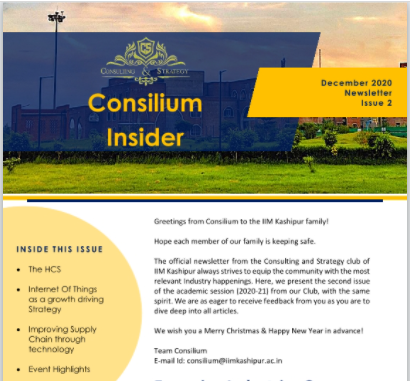
Consilium’s monthly newsletter shares the best practices, strategies and changing dynamics from different industries ranging from sports, FMCG, Petrochemical to latest Industry 4.0. Further, the newsletter comprises frameworks and their usage in real-life business problems from these industries. The club also ensures that the resources are not just limited to a monthly basis, and provide consistent updates through our social media channels.

The theme for the November Newsletter had been Covid-19 impact on business strategies covering the impact on the Sports and Oil industry along with the role of Digital trends in business expansion.

ForeSight Series

“It’s not about money or connections – it’s the willingness to outwork and outlearn everyone…And if it fails, you learn from what happened and do a better job next time.” – Mark Cuban

In Foresight Series, the academic experience in consulting and strategy is tested through gamified quizzes, guesstimates and infographics. Foresight comprises three events throughout the year, offering a constant opportunity to compete with peers and test their mettle in solving real-world problems. Due to pandemic, Foresight 4.1 was conducted online with a mix of quiz to cover domain knowledge and guesstimates problems to prepare students for interviews.

Industry Connect

Consilium brings together experience from industry leaders in the consulting and strategy domain. Students get to explore from real-life experiences of consultants and explore insights from the challenges they face, the thought process behind critical decisions taken and the key takeaways from years of experience in the domain.

EndGame

EndGame is a national level simulation designed on a business scenario wherein the students walk the consultants’ shoes and apply their knowledge to compete with peers from other B-schools. It involves the application of academic knowledge from various facets of decision making, marketing and economics. It also tests the strategic forecasting and understanding of competitive dynamics in real-life situations. Further, the event demonstrates the presence of zero-sum game, to create similarity with as much real-world dynamics as possible.
Consulting Knights and Ranbhoomi

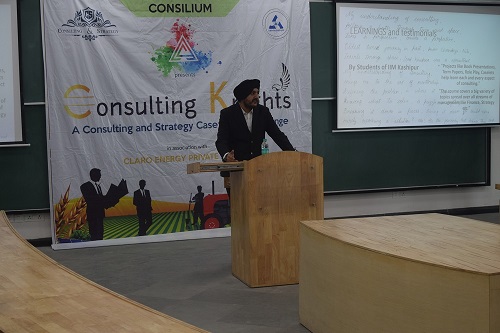
Consulting Knights and Ranbhoomi provides a diverse and enriching experience in solving cases at Pan-India level. Students utilize their knowledge of all disciplines to prepare strategies for business cases in teams. This event is organized in collaboration with various organizations like Havish M Consulting, to get an essence of existing business problems.

Consilium Conversations

In the academic year 2020-21, the club initiated a strategy-talk series “Consilium Conversations” wherein it invites budding entrepreneurs and industry stalwarts from various domains for a conversational interview. It focusses on unearthing the strategies that go behind creating a successful business or project. The motive behind the series is to inspire the students to develop strong critical-thinking skills required in strategy & consulting roles and learn about the latest developments in the industry. With each initiative, Consilium creates a robust environment for the students to learn and challenge themselves in the field of consulting and strategy.
Cause-Effect Relationships – The ToC Way

Theory of Constraints is a breakthrough and powerful management philosophy that has evolved in the past couple of decades along with other new-age concepts like TQM, JIT, re-engineering and the learning organization.

This article has been adapted from the bestselling book Critical Chain by Dr. Eli M. Goldratt, an internationally recognized industry guru and the originator of the Theory of Constraints (or ToC). This book is one of many business novels written by Dr. Goldratt through which he has transformed and revolutionalized the thinking and actions of management throughout the world.

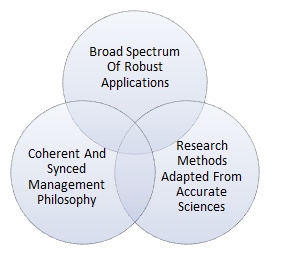
Theory of Constraints is a breakthrough and powerful management philosophy that has evolved in the past couple of decades along with other new-age concepts like TQM, JIT, re-engineering and the learning organization. By complimenting these other philosophies with its clarity and systematic analytical methods, ToC boasts of the following merits:

1 osm

Now, in layman’s terms, let’s understand the approach of ToC in resolving cause-effect relationships. For instance, what are some of the biggest problem faced by managers today? These include:

2 osm

ToC regards that problems such as the ones stated above are just symptoms. It claims that they all stem from one single core problem. Let’s delve into detail on this conclusion.

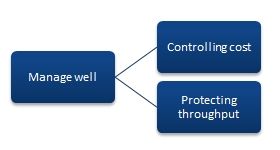
One assumption or observation in the ToC universe is that most managers want to manage well. In order to manage well, managers must ensure that the right products reach the right clients at the right time and in the right quantity. There are two absolutely necessary conditions to achieve effective and efficient management.

3 osm

Each of these conditions, controlling cost and protecting throughput, implies a different mode of management. Let us understand this through an analogy. Let’s view a company as a physical chain with many links. You are the President in charge of the entire chain.

In our chain, the closest thing related to cost will be weight. And one way to determine the total cost of the organization is to sum up the weights of all the links. Now, if I am a manager in charge of a specific department, a specific link in the company, then to improve my link the obvious thing to do is to make it a few grams lighter. However, as President you are not interested merely in my link; you are interested in the whole chain. But when I reduce the weight of a link, the entire chain becomes lighter by that amount.

4 osm

This analogy implies a management philosophy. It implies that any local improvement automatically translates into an improvement of the overall organization. Hence, any global improvement can be achieved by inducing many local improvements. Let us call this management philosophy the ‘Cost World’. Most organizations today function on the principles of the cost world.

Now, let us examine throughput (or flow) through the same analogy. What is the equivalent of throughput in our physical chain? It is the strength of the chain. If one link, just one link in our chain breaks, what happens to the strength of the chain? It drops to zero. This indicates that when we deal with throughput, it is not just the links that are important; the linkages are equally important.

Intuitively, it follows that the strength of the chain (or throughput of the Company) is determined by the weakest link in the chain. And obviously, there can be only one “weakest” link in a chain at a time

5 osm

Now, let’s see what this implies. If you are still the President in charge of the entire chain and I’m still in charge of just one department (let’s take the more general case where I’m in charge of a department that is not the weakest link). If I make my link stronger, do I improve the strength of your chain? The answer is … absolutely not!

This leads us to another management philosophy which we shall call the ‘Throughput World’. The throughput world says that most local improvements do not contribute to global improvements. The way to improve the total organization is definitely not achieved by inducing many local improvements.

Considering these two contradicting philosophies, the next obvious question is – Can we manage according to both worlds at the same time? The answer is NO. There is no compromise between the cost world and the throughput world. Not even theoretically. In academia we don’t call it compromise, we call it optimize. To understand why we cannot optimize between the two worlds, we need to first understand an important concept called Focusing.

Any improvement in a company requires basically 3 resources:

6 osm

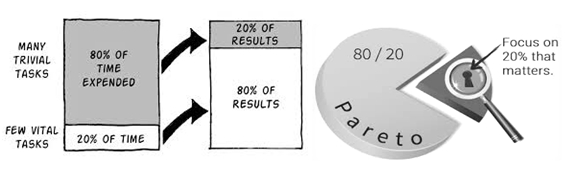
It is important for a manager to know where to focus his resources. A manager who does not know how to focus will not succeed in controlling cost and will not protect throughput. In Statistics, we have come to know Focusing through a tool called the Pareto Principle. Focus on solving 20% of the important problems and you’ll reap 80% of the benefits. But those who teach statistics know that the 80-20 rule applies only to systems composed of independent variables; it applies only to the Cost World where each link is managed individually.

7 osm

Where linkages are important and the variables are dependent, the Pareto principle is not applicable. So how can we find out on what to focus in the Throughput World? Well, it’s simpler than expected. Just think about the chain and the fact that its strength is determined by its weakest link. If you want to strengthen the chain, the first thing is to find the weakest link.

This leads us to the 5 stages of Focusing as per Theory of Constraints:

Step 1: Identify the system’s constraint(s)

Step 2: Decide how to Exploit the system’s constraint(s)

Step 3: Subordinate everything else to the above decision

Step 4: Elevate the systems’ constraint(s)

Step 5: Avoid Inertia and go back to step one

The above steps are also called the Process Of On-Going Improvement or POOGI. Simply put, it means that once we find a bottleneck, we need to strengthen or improve it. Now, as per the intuition of the throughput world, we should not produce at the non-bottleneck resource any more than we can squeeze out of the bottleneck resource. If we want to increase throughput, we must then lift some of the load from the bottleneck by buying more machines or hiring more people, whichever may be suitable. The logic here is impeccable as well as intuitive. Once the bottleneck is strengthened enough it no longer remains the constraint resource and we must move on to the next bottleneck. And this is the process to focus in the Throughput World.

This learning will now help us understand easily why there is no acceptable compromise between the cost world and the throughput world. Imagine that I am still in charge of the department that is not the weakest link. As per ToC, I must now subordinate my process to that of the constraint resource, forcing me to operate at sub-optimal efficiencies. And in industry, which is governed on the principle of maximizing efficiency, this would be a sure shot way to get oneself fired out of a job.

Do you understand what this means? It means that your intuition lies in the throughput world and in this world the answer is ‘don’t dare to produce more than the constraint resource’. But your performance measuring systems are in the cost world that wants you to reach maximum local efficiency. And therefore, there is no compromise. If one tries to optimize this conflict between the 2 worlds, both worlds will kill him.

The Theory of Constraints firmly believes that there are no inherent CONFLICTS. As mentioned before, ToC is derived from the accurate sciences. And in the accurate sciences, what do scientists do when they face a conflict? Their reaction is very different to that of managers. While we try to find an acceptable compromise, this thought never crosses their minds. Their starting point will never allow it; they don’t accept that conflicts exist in reality.

So, no matter how well the two methods (cost world & throughput world) are accepted, the scientists’ instinctive conclusion will be that there is a faulty assumption underlying one of the methods used. All their energy will be focused on finding that faulty assumption and correcting it.

Can we do the same in our Cost World vs. Throughput World scenario? Can we eliminate the conflict and emerge at a win-win? Think about it. We will elaborate more on this in our next post.

Rishi Varma

OSM

980015_509539572476990_215004717_o

Is Market Share still a Competitive Edge?

You might be bemused how our cows became relevant to businesses, that too when the matrix originated in the West. Yes, we are talking of the BCG’s growth-share matrix which is considered so much relevant for the adequate allocation of resources to exploit the growth opportunities.

If you are hearing to a strategy class in any of the B-schools, you are bound to get past this framework which talks of cows, dogs, cash and finally a question mark. You might be bemused how our cows became relevant to businesses, that too when the matrix originated in the West. Yes, we are talking of the BCG’s growth-share matrix which is considered so much relevant for the adequate allocation of resources to exploit the growth opportunities.cash-cow

Rather than describing the nitty-gritty of this matrix, which you are so much cognizant of, we would like to share our views regarding the relevance of its two measures, especially in today’s context.  We are afraid, the two measures of competitiveness, more specifically the market share axis, seem to have lost its pertinence.

Let’s analyze this with the two, not-so-old developments. Take Nokia, with such a huge market share during its heyday, and a high growth, it would have been shining as a star, enjoying an indomitable position vis-a-vis its peers. Or at least as it matured, it would be peacefully sleeping like a cow, with eyes wide open, seeing its competitors struggle and chewing the dollars cashing in. Aghast! Its situation is so contrary. With its operations around the world, assets in the shape of factories, R&D investments, probably patents too, it got bought by our most omnipresent OS provider for a mere $7.2 billion, who hardly had any grasp over mobile handset business.

star

On the contrary, check the valuation of your new messaging tool, hey Whats-app!, it’s worth $19 billion without a factory or an assembly line and other physical assets. Isn’t technology more prominent than market share? There is definitely a next big thing being designed as you read this, so Whatsapp don’t sleep like a cow or be complacent of your shining stars. Businesses are evolving fast, your market share might not be the true testimony of your sustainability in the future. So should we evolve the BCG ‘growth-share’ matrix to ‘growth-technology’ matrix?

Blessen Mathai

Consilium

Consilium

Rediscovering Marketing Media

Neuromarketing is the marriage of brain science and marketing. This field of study answers the questions like why a consumer desires a product and when does he need it the most.

The path to salvation is not through being quiet; one needs to strive, reach out and endeavour. This is very true as far as marketing is concerned and therefore every entity, be it a local supermarket or an MNC, struggles to help us know they even exist. In this pursuit, they resort to one mantra – sell, sell and sell. The selling approach has evolved over time but the struggle has prevailed nonetheless. In conventional marketing, the emphasis is on selling whereas in new age marketing, more importance is given to customer satisfaction. Previously, the products were aggressively promoted on the mass media viz. TV, radio, banners and posters, newspapers and magazines. More reliance was on a thirty second advertisement on television. The major concern seems to be, in traditional marketing, visibility. But now with the advent of the internet and social media, marketing is modernised and is continuously being reinvented. In new age marketing, the focus is more on understanding the needs and desires of customers, satisfying those needs, getting feedbacks and building lasting relationships with the customers.

Internet; what is so amazing out there? Roughly about 40% of the world’s population has an online presence. They all search for information over the World Wide Web to compare products, make buying decisions or even to make a purchase and the search engines are in possession of this information. Using this information, a business organisation could target only those customers who are of its interest. The internet has a huge audience as does television, but the bang for buck is more for the internet marketing because the online advertisements are very specific unlike the TV ads. This type of target marketing saves time and money for both marketers and consumers. Google has capitalised heavily on AdSense and AdWords and has been continuously innovating to ensure better service for its clients as well as users. Out of all internet users, approximately about 70% use social networks and spend most of the time on social media sites like Facebook, Twitter, Pintrest, Tumblr etc. According to Pew Research Center, there are about 1.2 billion Facebook users worldwide and more than 95% of them are aged less than 30 years, the average amount of time spent by a Facebook user is 15 hours and 33 minutes per month, total number of YouTube page views per month is 92 billion. With such demographics and statistics come some of the greatest of opportunities for the marketers. Also on these social media, users reveal a lot of relevant information as to their interests, likes, envies, age, gender, place, education etc. This platform not only helps marketers better understand the needs and desires of the customers but also get their feedbacks. Thus, with all the sensitive and relevant information beforehand, marketers could make better products, give better services and achieve better customer satisfaction.

Forbes

Nowadays, in the marketing world, there is an increasing emphasis on brand positioning i.e. the target customers’ reason to associate with a brand in preference to others’. Through careful and strategic set of marketing activities, brands are made to occupy distinctive place and value in the customers’ mind. At the same time consumers have a strong tendency to avoid advertisements. In such a scenario, marketers have had to ensure that ads do not seem ads and hence the process of disguising ads has given birth to a new marketing concept- Product Placement. Product placement or embedded marketing lays emphasis on making ads less advertorial by creating ads that are stories, mini movies, and real life scenarios. When James Bond endorses Omega wrist watches or the famous Bruce Wayne drives a Lamborghini or the Ironman himself drives an Audi, the audience connect to that scene; build a perception about that brand in their minds. Product placement is a mega industry in itself that creates new identities for brands and increases revenues manifold for the movies. This sort of co-promotion/co-branding has become a trend. On an average, a blockbuster movie partners with more than a dozen brands for promotion. Also, we see franchises like McDonalds partnering with movies for co-promotion and we see celebrities using/promoting certain brands in the middle of a movie. At this juncture, comes one more interesting marketing concept- Neuromarketing.

Neuromarketing is the marriage of brain science and marketing. This field of study answers the questions like why a consumer desires a product and when does he need it the most. Activity tests (MRI scans while being shown a series of mini-films) are carried out on a sample set of people to identify the emotional peaks in the story and this helps to find the best scene and apt time to pitch the product and thus it also helps create more and more memorable and impactful ad campaigns each time. Does it ring a bell? Why these techniques are being adapted? Yes, to advertise without letting the customers know they are being shown an advertisement. Yes, it’s true; marketers are adapting new and complex scientific techniques to dig into consumers’ subconscious minds to make the art of selling more creative and data driven. Many questions might arise: are marketers being manipulative? Is this ethically, socially and morally correct? That’s for readers (and the consumers themselves) to decide.

Marketing activities make customers think; somehow products are connected to their sense of well-being and the sense of happiness. The key here is, it’s not the product or a service that makes a customer happy but what makes a customer happy is how that product is perceived, the sense of joy and pride that comes by being associated with that product/brand. With all the new and fancy marketing techniques, where does the traditional marketing feature in? As mentioned earlier visibility is a requisite for any marketing activity to be successful and the brands could effectively make us feel their presence using the old techniques viz. TV advertisements, banners and posters, newspapers and magazines. I would like give an interesting example as to what happens when one of the traditional advertising techniques is ripped off.

Sao Paolo – The Clean City

Sao Paolo is one of the largest cities in the western hemisphere and a tourism hub; thus a potential marketplace for all sorts of sellers. The city administration of Sao Paolo has banned all forms of outdoor advertisements in a move to fight against visual pollution. There are no banners, no posters, no billboards, no ads on buses and taxis- absolutely no outdoor ads. The revenues, after the ban, of all kinds of stores, boutiques, hotels, restaurants etc… have taken a toll. Sellers in Sao Paolo are now immensely reliant on digital marketing and word of mouth marketing. So what does this tell us? The effectiveness of a marketing activity is dependent on both traditional marketing and digital marketing. Maybe that is why marketers are trying to rediscover traditional media. In fact, conventional advertising and commercials still has the lion’s share of the marketplace—almost double the digital media advertising in terms of money spent. The bottom line is that television and print media are still important because in a world where content is king, television networks and print media publishing houses are some of the best mass content producers. In the world we live in, both credibility and visibility are of utmost importance. A brand cannot be credible unless it is visible and once it is visible, it ought to be credible.


Shankar Shethe,

OnYourMark

1888497_582030368554580_1320831685_n