MBA: From a fresherโ€™s viewpoint

Much bigger than merely a two-year course: MBA is an amalgamation of a plethora of domains, integrated so astutely that each one of them finds a core point of strength that others can gain from. This is exactly what it means when It is said that MBA caters for an overall holistic development of the students. However, the popular opinion states that the journey is slightly more rugged for the freshers. They are the lot without any prior exposure to a corporate world. Unaware of the adversities and the pre-requisites for the same, they step into this course in reticence. Self- consciousness, shyness and insecurity are some of the feelings that gush through their veins at the beginning, but not for long.

The first step in their holistic growth comes from the diverse pool of peers. During the first few weeks of their MBA journey, they meet a lot of people; some sharing the common apprehension while others who have already paced their journey beyond that. Through healthy and continuous interactions, this is where they learn the know-hows of a corporate life and how it changes and molds oneโ€™s personality. 

After a brief glimpse into the kind of life awaiting them, the next step of development comes in the classroom itself. Through experiential learning and case-based approaches that follow, students, irrespective of their academic backgrounds and experiences are invited to speak and encouraged to bring forth their ideas on to the table. None of the opinions are refuted in the classroom. The freshers are said to bring in much more creative ideas as compared to others, reason being their ability to not restrict their thinking in a particular domain. They allow themselves to fly freely. They are the optimistic lot and play the role of risk takers in group tasks and convince their team regarding the feasibility of the strategies undertaken.

The final step, which brings everybody on board and at par with each other on this journey, regardless of their prior corporate exposure, is their commitment to various student bodies. Student bodies are an integral part of an MBA curriculum. They give a glimpse into various aspects of work life that lies ahead. Adhering to the timelines, working in a team, taking leads frequently, dealing with conflicts etc. are the lessons drawn from it. It knows not to see someone from prejudiced eyes. This is the point where all the inhibitions of a fresher shatter and he/she finally starts to believe in being worthy of the course and standing tall with their peers, if not above then at least at par. 

So, it does not matter if you have years of work experience, or you are fresh out of college. An MBA curriculum needs you as much as you need it.

About the Author:
Nancy Raj, a BA honors in Statistics by qualification, is currently pursuing an MBA from IIM Kashipur. She is a part of various student bodies like the cultural committee and Admissions support body. She is fond of reading, writing and travelling. You can connect with her on LinkedIn

An Internship Experience at Agri-Tech Startup and how it converted to a PPO

PPOs are a major aspect for B-School students in securing a qualified and exclusive offer from companies that they wish to work for in the future. The idea to convert your Summer Internship into a full-fledged Placement Offer is not easy but not impossible too. This article provides a better glimpse of what one needs to keep in mind while looking to secure a PPO.

Agrigator, which is a seed-funded Agri-Tech Startup, is involved in Supply Chain and Logistics stream for providing a B2B Marketplace between the Producers and the Buyers. It was duly catering to HORECA outlets (Hotels, Restaurants, etc.) and FPIs by transporting food grains directly from Farmers and related sources, leading to a reduction in transaction costs, time, efforts, and simplifying the operations of such an unorganized system.

Keeping yourself in such a position, there are a few things that you can follow to slowly chart yourself and the learnings you receive in due course. Firstly, it is important to completely familiarize yourself with the ins and outs of the concerned organization and the sector that it functions in. Usual ways include following Annual Reports, Sector-Specific News from verified sources, Online Government Resources and Databases, and interaction with Industry Experts and the employees of the organization themselves. This will build up a robust base for you to understand your line of work for your project

Next, you must continue to interact with your assigned mentor or individuals who work in the same fields/organization to also understand the core competency, relative competition, domain-specific business strategies, and business models. This will ensure you are now settled enough to understand the assigned problem statement for the project and the outcomes/metrics that will measure your performance for the same.

Post this, it is time to directly jump into your project and use your acquired knowledge and resources to design a flowchart of your activities to arrive at a solution. This will involve a preliminary plan to proceed, important parameters to focus upon, following up on previously devised industrial practices, framework analysis, and carefully constructed notes on emerging trends and developments in the industrial market.

To make things easier, communicate with various stakeholders and experts that provide a concise view on the strategic feasibility, implementation, and impacts that a step of approach creates to resolve different issues. Gradually, clarity evolves to choose the optimal way to proceed that provides or maximizes the utility of the defined outcome. Typical meetings or regular brainstorming of ideas can greatly reduce doubts and little hiccups that you encounter on the way. Therefore, donโ€™t rush to obtaining a solution without confirmation and thorough research of facts to avoid last-minute crisis. These little things go a long way to ensure that your final presentation is well received by the majority of stakeholders that reflects the ways and values the company aligns itself to.

Last but not the least, be prepared with anticipated questions and doubts that you are likely to face regarding the work you have done, outcomes achieved and the notes on the Final Presentation you will present to the concerned officials. It is no wonder that your Presentation skills should be excellent with the concise textual matter but supporting visual reports and facts that enforce your views and looks to the proposed solutions concerning various scenarios.
Keep a cool mind and be confident. The rest is on your meticulous way to manage your time and efforts to the fullest.

Getting a PPO depends not only on how well you did, but how well you reflect your skills and knowledge to be part of the company!

About the Author:

Som Samantray, a Chemical Engineer by qualification has pursued MBA (Marketing and Data Analytics) from IIM Kashipur. He has been part of various student bodies like the Econs-Economics Club and TEDxIIMKashipur. He is a fresher and is an ardent reader of books and novels and a blogger. You can connect with him on LinkedIn.

How to ace Summer Internships from the lens of an ICICI PPO holder

The batch of 2020-22 is looking forward to their internships amid all the uncertainties around. Hopefully, this little helping hand from my experience and learnings of my internship with ICICI Bank Ltd. will help you plan your internship better, especially if you are looking to secure a PPO:

1. Understand your deliverables: Be clear with the deliverables and expectations of your project. It is better to know your focus areas in the deliverables.

2. Schedule to finish your SIP deliverables in 6 weeks: If you are on two months SIP, keep the last two weeks for any unforeseen issues, prepare your presentation, practice it and present it to your mentor before your final presentation.

3. Listen to as many employees as possible: You might be new to an industry and organization. It is tough without the experience of people inside to comprehensively complete your deliverables. Hence, listen to as many associated departments and employees as to widen your understanding. 

4. Let your guide keep track: Most of the time, your mentors might also be busy with their routine work. You must update your day-to-day work to them. You can share a tracker sheet where you can update your work regularly. Also, it is good practice to share your weekly reports and presentation.

5. Maintain your relations: While you connect to many employees in the organization, your approach, behavior, and people management are widely noticed and sometimes regarded above your work. Hence, maintain good relations with people around, especially with your guide and manager.

6. Keep your references handy: During your story creation, back your thought process with your research reference. It adds credibility to your ideas, highlights your understanding, and shows your work.

7. Focus on Story Line: During your final presentation, focus on your story and inferences along with relevant data. Try not to pack your presentation slides with data. Also, mention your challenges and learnings from your internship towards the end of your presentation.

With these tips, I wish good luck with your SIP to the whole of the bright minds of batch 20-22. Hope to see you all on the other side with a PPO.

About the Author:

Vineeth Rao Sudhati is a student of MBA, batch of 2019 -21 from IIM Kashipur with majors in Operations and Marketing. He is a part of various student bodies like the Alumni Relations Committee and Prep Cell. You can connect with him on LinkedIn.

Acing the Cases โ€“ From the Horseโ€™s Mouth

Case competitions are an integral part of B School life- not only because you get a kind of exposure but also the enormous amount of learning involved with it. Undoubtedly, academics form the basic ingredient of B School but also fine-tune yourself by participating in several International, National & Corporate Competitions. In one such international competition I participated (Zurich Enterprise Challenge), we did not manage to get into the Semi finale stage, but the problem statement was what attracted us the most. The statement demanded the vision for businesses & multinational enterprises post-Covid world.

Amidst the cramped schedule of a B School life, you would not get the time to do all the cases and do proper justice to them. So, picking and choosing the cases becomes a key aspect. โ€œPick a case and absolutely slaughter itโ€ โ€“ should be the mantra. This indeed goes a long way, as a proper approach to a case requires a lot of research and groundwork & it effectively drains out oneself. Picking up simultaneous case competitions will not be a smart choice as the effort gets divided. Thereโ€™s no fixed one-size-fits-all for the competitions. The main aim of competition varies on a case-to-case basis โ€“ sometimes itโ€™s the PPO/PPI/ personal brand building, sometimes itโ€™s the brand and sometimes itโ€™s just the learning one can get by participating in it.

During my 2 years in IIM Kashipur, one thing I effectively learned is โ€œperseverance holds the key to success.โ€ In the first year, I did not participate much effectively in competitions except the only one in which our team won the title of National Winners in IIM Trichy. I felt that with the second year in the fold, it was wise to participate in the competitions that were restricted only to the first years. 

In the second year, it becomes clearer as the domain gets selective โ€“ for example, in the second year, I mostly participated in Marketing, Consulting, and Strategy competitions. Moreover, you learn a lot from your mistakes, in fact, the bitter pills you swallow shape up for the upcoming ones. In one such corporate competition organized by Infosys, a minor mistake from our end did cost our entry to the next round. So, these competitions, indeed serve as a replica, to what one might expect from the corporate world โ€“ โ€œthere are no free lunches incorporated.โ€ One great aspect of participating in various case competitions is that you get to know in-depth about specific sectors you work in while preparing for the cases. The cases are handpicked live industry cases where the participants work towards developing a feasible and sustainable solution.

Lastly, one key aspect of nailing case competitions is having a core team that is well aware of their capabilities & weaknesses. There would be issues cropping up, arguments but the key is the light at the end of the road โ€“ a potentially feasible solution. A good team can indeed be a game-changer. Everybody must have set, defined roles within the team.

With this, I ended up with 2 National Winners, 2 Runners Up, 1 National Semi-finalist, and 3 National Finalists in my tally. Of course, you win some and lose some, but the key thing is โ€œNever Stop, Never Settle.โ€ The entire journey of participating in several competitions (National/ Corporate/ International) plays a pivotal role in shaping up oneโ€™s journey. For me, it was about going beyond the stereotypes, building and rebuilding myself. Always remember โ€œWhat brought you here, wonโ€™t take you there.โ€

Each individual has a different story to tell, but selecting the right atmosphere is of utmost essential. I would like to thank IIM Kashipur and the stakeholders for putting up commendable effort and providing individuals with the right kind of atmosphere in which they can rebuild and transform themselves throughout their stay.

About the Author:
Rahul is an Electronics & Communication Engineer by qualification & completed his MBA from IIM Kashipur (19-21 batch). He has been recognized as the Top 100 Competitive Business Leadersโ€™2021 by Dare2Compete and has been featured in Forbes India. He is an IT professional with 2 years of experience in Cognizant. In his past time, he likes solving puzzles & binging on OTT platforms. You can connect with him on LinkedIn.

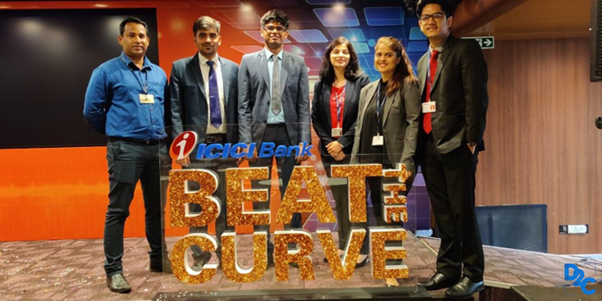
Journey of winning ‘ICICI Bank Beat the Curve 2019’ – A step towards being 4th in D2C Competitive B schools 2021

From the beginning of the campus rounds, we focused on the aspect of bringing the youthโ€™s (millennial) perspective to our case solution. For the competition, ICICI Bank Beat the Curve 2019, we chose to suggest an innovative product that will help attract people from 20 to 30 years of age towards the services of the Bank.  

The Challenge

We started by gathering a lot of primary data by getting responses from more than 1000 individuals of varied age groups and localities. The competition had three stages – a campus round, Stage 2 (semi-final), and a Final round. We spent close to 20 hours on the semi-final and the final rounds. The mentorship provided during the semi-final round was particularly very useful. There we understood what aspects of our solution we need to focus upon.

The Winning team – Team Ideates

There were 6 teams who made it to the Grand finale of the competition. They were from institutes like IIFT, FMS, JBIMS, IIM R, etc. During the presentations of the final round, we particularly felt that the team from JBIMS had put in a lot of research in building their solution. But we were confident about our solution as well as the presentation. Both Shubham and I were part of a winning team even in the first year of our MBA. The experience and learning during that competition certainly helped us here. We had confidence in each other. While preparing for the presentation, we helped each other out in finding faults critically and correcting each other. One of us was a late-night worker and the other was an early bird. Instead of quarreling over finding a common time to work, we took it as a plus point. We worked over this across time, building on each other’s work and just cross-checking before submitting the work when we were short on deadlines!

The moments that mattered

The panel of judges was from the leadership team at ICICI Bank. The competition had a unique and amazing judgment criterion. Along with the jury panel, the audience that comprised 50 senior-level executives of ICICI Bank, scored the different teams on 4 parameters. It was based on parameters like research depth, presentation quality, innovation of the solution, and the QnA round. One key learning in this competition was that the delivery of your presentation is as important as the hard work done while building the solution. Also, it is important that you look at your solution from the audience’s perspective. This helps you judge your own presentation before anyone else does! Well, there were two amazing moments for us. One was during the QnA, where we could justify a question put up by a senior executive sitting in the audience. Later, when we took our seats after the presentation, he came to us and praised our solution. That was really reassuring. The second was obviously during the declaration of results when our team, ‘Team Ideates from IIM Kashipur‘ was announced as the National Winners of ICICI Bank Beat The Curve 2019 and we were called on stage!

About the Author:
Chirag Dixit, MBA from Indian Institute of Management Kashipur and currently works with Bloomberg in their Financial Products team.
He has also been a part of the Placement Committee of the institute for both years and has worked in fostering relationship between the institute and industry on various levels. You can connect with him on LinkedIn.


Future of data visualization tools in business analytics

– Team MPRC, IIM Kashipur – 

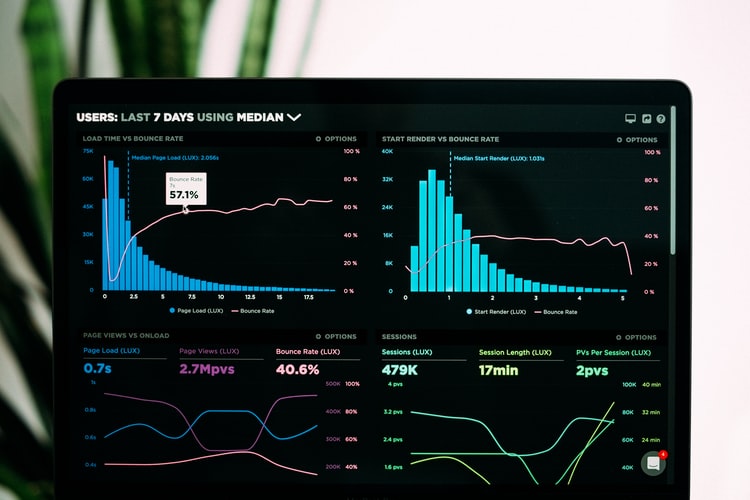
We are in the age of data science. The ever-growing complexities of data science welcome a whole new scope to unlock the power of data. With big data rising at an exponential rate, it is becoming essential to organise, filter, analyse, and visualise data to gain a competitive edge in the business. Data visualization is gaining traction. According to Gartner, by 2025, data storytelling will emerge as an industry trend, with 75 percent of the stories automatically generated using augmented analytics techniques.These techniques are at the center of revolutionising the sense of looking at data differently and thereby enhance the experience of analysing data.

Prof. Vivek Anand talks to the Media and Public Relations Committee (MPRC), about the scope of data visualization for the managers of tomorrow, and more.  

Prof. Vivek Anand is currently associated with Wilson Consulting Private Limited as an operations director. He is a data visualization consultant with 17 years of experience and has done MBA from Monash University Melbourne Vic. with an area of specialization including Marketing & Econometrics. He has a background in Sales & Marketing with leading Indian hospitality brands across the country. His inclination to analytics made him switch roles 8 years ago to become a full-time consultant in analytics and spearhead corporate training for Wilson Consulting in India and the US. He is a qualified trainer of some leading tools in the industry such as Tableau & Power BI and has a passion for teaching. He is also an adjunct or visiting faculty at Great Lakes Institute of Management, Great learnings, SP Jain, IIT Madras, IIM Kashipur, IIM Calcutta, IIM Trichy, IIM Ranchi, IIM Kashipur.

[MPRC]– What is data visualization? How important is it today?   

[VA].- So to give it to you in a nutshell, Data Visualisation is trying to look at data or trying to see or perceive patterns in the most effective manner. That’s what it is. It’s not a tool if I may say, I would rather call it science and I think it forms a vital part when it comes to business operations because we are moving into a phase where data is becoming the key. One of the biggest challenges that organizations face is how to best organize data, how to best seek patterns and once you find a pattern, the next task is how to best present it as a story or a dashboard or something. So I would say it is extremely crucial when you want to kind of make any sense of the data.

[MPRC]– How is this science helping the managers to perceive a pattern?

[VA]–  When you are trying to perceive a pattern, the intent is to try and get the answers. The interpretation must happen as quickly as a reflex action. Say, for example, you are made to touch a 500 degrees Celsius hot iron ball, your spontaneous reaction would be to take a hand off the ball. Now, you need to have a similar kind of reaction when you see data. Without even thinking for a second, you must be able to get the answers as quickly as you can without having too much hand-holding or too much help. That’s when you know that you have actually got it right. And also the thing is no one has the time or bandwidth to really sit and ponder old things to see what it was all about. So if we don’t get things right, we wonโ€™t get that kind of reaction from your audience.

[MPRC]โ€“ From a managerial point of view, prior to 2010, there were not many tools for data visualization. As we remember when we were in school, we were still using PowerPoint and it was just the beginning. But right now a lot of software has come up. So which software is used in the market right now?

[VA]. โ€“ Okay so, I’ll give you an answer for a software. There are so many tools like Tableau to lead with today. There is Power Bi for rich visualization and multiple other tools like Qlikview etc. A lot of tools are there. There are tools which are user-friendly, like drag and drop feature. Some of them require a bit of coding. But, I would say that learning software is not going to give you science. Just to tell you something, whatever that can be done with all these cutting-edge tools, can also be done with Microsoft Excel. It is just that it needs a little extra bit of time and effort.

The tool is not again a bit of a challenge because a tool which is learnt at the drop of a hat today might completely transform tomorrow. So tools should never be a constraint for learning and that is something that I keep telling everyone, organizations and students especially. To students, I advise that don’t worry about the tool at all but rather learn science. Transfer science to whatever tool you have. If an organization has an XYZ tool and you do not have any other choice, you still have to make do with what you have. So that’s something that I always believe in.

[MPRC]โ€“Has there been any instances where this data visualization science has helped you or your clients in figuring out problems that might not have been possible with traditional approaches to data handling?

[VA] – Actually yes. Quite some time back. In fact when I was working for one of the hotel chains. I had joined the company recently and I was looking at its past yearsโ€™ data performances and all that. We realized that the hotel was dipping very largely in terms of occupancies. Now, there were a lot of reasons as to why the occupancies were dippingโ€ฆso on and so forth. Oh! I still remember the charts very vividly in my mind. We had access to a lot of reports from hotel agents, something called a spy report and a lot of other reports, basically numbers. We realized that when we actually did a very effective visual technique, we were able to see how the market is trending. We saw that the market was still growing at a very rapid rate. Everybody was growing except for the company that I worked for. So that was where the problem came about and we realized that it was not the market that was not growing but we were the one not growing. So the next move was to find who is actually the one who has kind of taken away from us and who is doing better. There were multiple lines. We saw that the year that we started having dips in occupancy levels, a couple of chains were actually gaining momentum and there was a very inverse proportion. As ours was dipping down, we saw that they were growing better and better. So that was a very fantastic and early indicator that I saw, the way things are actually coming up pretty well. Another example that I can share is one of the companies that I had worked for. They worked in a manufacturing setup; safety is of utmost importance. It was a US-based company so all the more reason they were very paranoid about safety than a lot of other folks because of a fear of lawsuits or claims. We were able to foresee how accidents were likely to occur. So the kind of visual that we created came with an effective technique which captured a lot of factors indicating a potential accident. We had to take a lot of corrective actions. So that kind of really averted a potential crisis. I mean nothing happened in the end of it but there were a lot of indicators based on things. So that’s another fantastic example that I can think of. There are so many examples we stumble upon every day but these are two diverse examples where I can think of applications.

[MPRC]โ€“ What would you suggest for the managers who are interested in data science and visualization and how they can develop this knowledge?

[VA]– See again, there are two kinds of audiences that one can talk about: a person who creates an actual report and the other who consumes the report. So a report consumer needs to have a different set of skill sets and the one who is going to create the report must have slightly different skill sets. I am assuming if a person is a manager and he may have someone working for him or maybe he is a director or VP of a good company, I don’t expect him or her to learn technology. For example, suppose you got a platform which requires complex coding. All you need to do is know that you have to understand how to read the results and absorb it. That’s the kind of learning that I would recommend a manager to get himself or herself acquainted with. If you are a marching soldier and you are the one who is going to create the reports, then you need to have a couple of tools. First of all, you need to have the technological input. You need to also have the science of visualization. While you have the science, you also need to make sure that you do things right. You must be one step ahead of the manager. Therefore, the one who is developing should be twice as smart as a manager. That’s the irony but then that’s how things work.

So in terms of decision-making, you want to support the manager with the right quality of output so that they are able to absorb. And of course, with their experience in the business, they will make the right decisions.

[MPRC]– So in your opinion at this moment, what is happening in the industry? Do you think that the data visualization is not being given the importance as it should have been?

[VA] โ€“ The thing isโ€ฆit’s the mindset of a lot of people. To give you a little insight into it, the particular clients that I have been dealing with, they had a very stereotypical mindset. They are the ones who have not been able to think beyond what they have been doing. So for them, it is a concept selling that you still have to do.  I think they are happy in their own space. They are happy with what they are doing and they don’t really wish to evolve into the next level. So there is nothing that you or I can do. But having said that there is also another whole bunch of cohorts where things are very different, where people are actually now adapting to this entire concept. They are embracing this whole idea. They want to really see how to make it fit into the reader or the business operations. They are getting very data-driven. But everyone does not have the skill set. Because that’s a different piece altogether that one has to know. But this is starting to grab people’s attention and the trend is changing. I can see it’s slowly changing.

[MPRC]–  When did you realize that you should pursue a career in data visualisation?

[VA] –  So I must admit I am not the brainchild behind this particular thing at least as far as I am concerned. I must owe this to my brother who is taking a leap more than I did to take it back to where we started. To give you a background, he used to work for a utilities firm back in the US. I think he was more on the supply chain side. Back then all that they were doing in his team was simply reporting. They were just getting reports and putting them in different forms. Nobody was really taking any sort of action with the data. So I think what he actually did from there in the early 2000s is to start to take some actions on data. It was a very rudimentary technique to really get going with how to generate some meaningful insights from the data. Back then I think they would not do it anywhere. There was not a lot of content. there was not a lot of technology also to support something in this space. Simultaneously, while my brother was working in the US. I had gone to do Master’s in Australia and I also picked up a sense for Analytics. So to be very honest that’s when I kept hearing things on a very similar note. We also had a lot of exchange students from the US. We interacted with some folks and we understood that there was a buzz. There is going to be some sort of explosive technologies. We could pre-empt. People are talking about it that this is going to be big. There was a lot of hype getting built in its own capacity. So that’s when I started to think about this as a thing. I said, maybe this could be a potential career path, but I guess for me what happened was I was basically inclined into analytics and I found that this was a very useful feature or a very useful skillset to have if you are going to get into the analytics profession. So as a career path, yes, that’s when the whole thing I can take it back.

[MPRC]–  So you have been in the industry for almost the past 10 years. Based on that, what is your opinion about the industry trends or the career option which anyone can have in this field?

[VA]. – A career path just on data visualization alone is something where I would not put all my eggs in one basket. This has to be in combination with all your other learnings.  So today, If you want to make a career path in this alone, itโ€™s a very slim chance. Because right now, as a student if you try to set a career for the first time, you need to be a jack-of-all-trades, you can’t just be a master of none. It happens over a point in time, once you have your expertise. So right now, my recommendation is to learn everything. You don’t know when what will come in handy. Because you need to have your skill set in analytics, data mining, business analytics, forecasting etc. Put all your regressions, your modelling techniques and you should be able to combine visualization as a part of your data model as well. If that works well, I think it is a fantastic career path.

(Prof. Vivek Anand teaches data visualization at IIM Kashipur). 
How to fill the MBA(Analytics) registration form for IIM Kashipur?

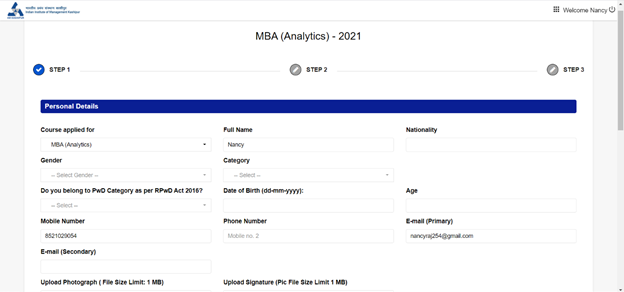
Here is a step by step guide on how to fill the MBA(Analytics) registration form of IIM Kashipur

Step 1:

Go to the link: http://iimkashipur.ac.in/academics/mba-analytics

The official website of IIM Kashipur will open with the registration link for MBA Analytics

Step 2:

Before registering you need to pay the application fee as per your category. The details of the same can be found under the Application fee tab.

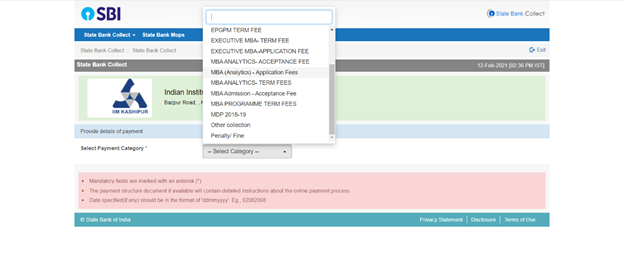
You can pay either through NEFT or SBI collect. In case you choose to pay via SBI Collect the following dialog box will appear

Click on the check box and proceed further.

In the โ€˜Select Payment Categoryโ€™ option, choose the MBA ANALYTICSโ€Šโ€”โ€ŠApplication Fees option and proceed further.

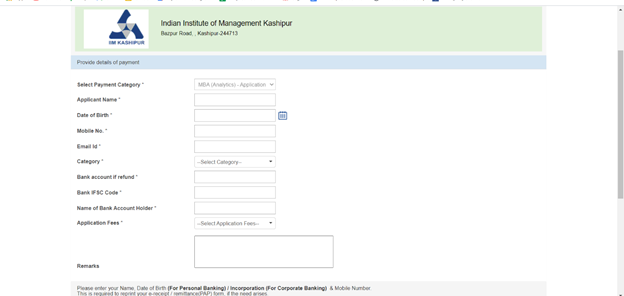
On the next page that appears,

Provide the necessary personal and account details. Pay the fees, download the receipt and note down your transaction ID

Step 3:

Go back to the link: http://iimkashipur.ac.in/academics/mba-analytics and click on the registration link 1 or 2.

The following dialog box will appear

Click on the โ€˜New User Sign-up Hereโ€™ option. It will direct you to the following page

Fill in your name, valid email ID, Mobile Number, and set a password. Click on REGISTER NOW.

Following this, you will receive an activation link on your registered email ID.

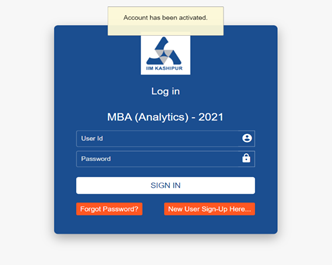
The next step is to click on the activation link which will direct you to the following page

Following this, you will get a message that your account is activated. Login with your credentials and move ahead with the registration. After logging in, the form asking for your personal details will open.


Step 4:

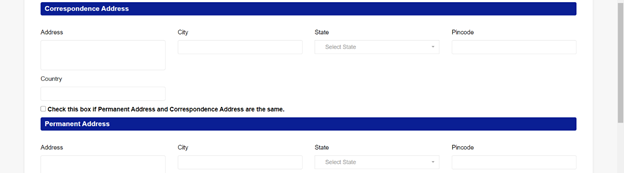
Fill in all the details in the next step. Ensure the desired file size limit when you upload your photograph and signature. Fill in your temporary and permanent address details.

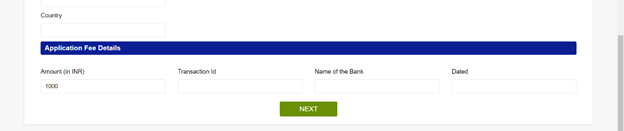
Finally, fill in your transaction details, name of the bank along with other details, and click on NEXT.

Step 5:

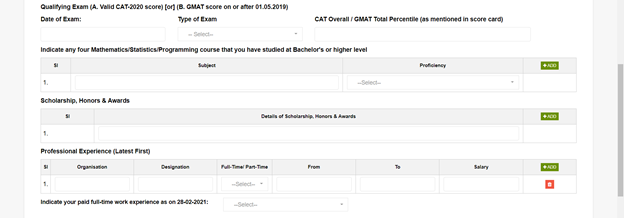
In this step, you have to fill in your educational background and related details. Make sure you fill in the exact figures as mentioned in your original documents. Further, you need to fill in the details of your qualifying exam (CAT or GMAT)

Also, fill in your scholarships and professional work-experience details. Click on NEXT

Step 6:

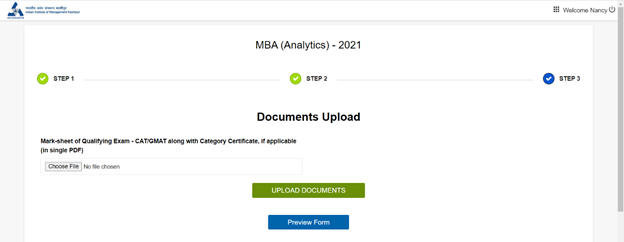
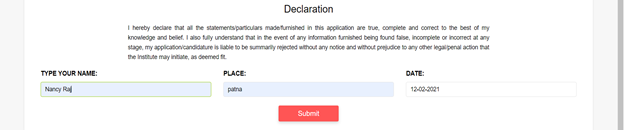
The next step is to upload the mark sheet of your qualifying exam. Post that, you can preview the entire form and check for any errors. Sign the declaration and submit the form.

The Operations and Supply Management CLUB|IIM Kashipur

The Operations and Supply chain Management (OSM) club at Indian Institute of Management Kashipur incessantly works in operations, production & manufacturing, supply chain management, operations strategy, operations research, and project management. The club acts as a perfect medium completely dedicated towards the students. It helps them enhance their domain knowledge and explore new horizons by assisting them in pursuing their interests related to the field. Being established in the initial years of the Institute, the OSM club is one of the oldest academic clubs in IIM Kashipur. By successfully carrying out several inter-college events and interactive sessions, the club has marked its supreme presence amongst the corporates & fellow institutes and has been a front runner in demonstrating excellence & commitment in educating as well as in spreading the domain advancements.

To bring out the best from the Institute’s students, the club organizes different activities throughout the year. This ranges from quizzes, case study competitions, knowledge sharing sessions to guest lectures and industrial visits. The club believes in the philosophy that sharing knowledge is not just a single-day activity and thus operates open platforms in various social media handles for continuous debates & discussions on different topics, sharing recent trends, and molding the students for case study competitions related to the domain. The club, which had already been connected to a vast network over mediums like LinkedIn and Facebook, has chartered its Instagram presence in the AY 2020-21 and regularly posts different articles and updates through these social media handles.

Certifications

The club perfectly aligns with the Institute’s philosophy of ‘Learning by Doing’ and provides a medium for students to understand the practical applications of the theories they learn. Working on these lines, the club leaves no stones unturned on gauging the batch’s interest and facilitating relevant certification courses that can help in imbibing the culture of continuous learning & improvement. This also allows the students to learn new concepts and apply them in real-life business scenarios and case studies. In the AY 2019-20, the Club organized the Six Sigma Green Belt Certification by KPMG where around 40 students had participated and successfully completed their certification. Through the CII certification opportunity facilitated by the Club, 9 students were able to gain valuable inputs on notions such as supply chain analytics and warehouse management. The Club had also been successful in connecting with ISCEA (International Supply Chain Education Alliance). It was able to gain benefits through access to practical implementations, certification courses, and easily connect to the Industries in Operations. The Club had also thrown up a CDDP certification program for the IIM Kashipur student fraternity in the AY 2019-20.

Industrial Interactions / Guest Lectures

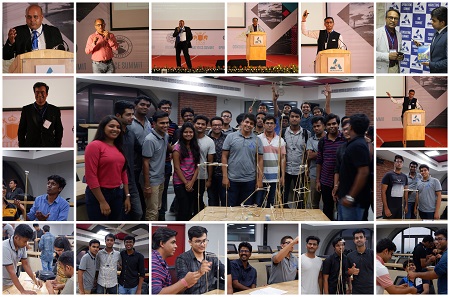
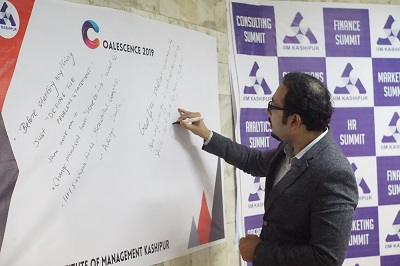
The club also bridges the gap between academia and industry by organizing interactions and lectures with industry stalwarts where the elite industrial professionals share their experiences and guide students to make them acquainted with the relevant skills required to excel in the industry. The club conducted the operations summit of Coalescence on 14th Sept.โ€™19 and erudite speakers from leading organizations like McKinsey, Emami Ltd, Patanjali Ayurved Pvt.Ltd, Globelink India Pvt.Ltd, and IVY Technology India enlightened students on the topic of Process Re-Engineering.

Knowledge Sharing Sessions

The club also emphasizes conducting knowledge-sharing sessions and their effectiveness in helping students, especially those who donโ€™t have any pre-requisite knowledge about different Operations and Supply Chain domain courses. Through this, a platform is being offered to the students to improve their public speaking skills and be on the other side of the table. The club also seeks guidance from the esteemed faculties and helps students embrace the academic culture & rigor of IIM Kashipur.

Industrial Visits 

To bring clarity and exposure to students in a practical working environment, the club organizes industrial visits at different manufacturing facilities. It leverages the most densely industrialized regions in the country with over 180 industrial plants in and around the area. This also serves as a platform for budding managers to understand the manufacturing facilities with a practical lens and learn about best practices opted by different companies. The club has organized industrial visits to companies like Ashok Leyland, Mahindra & Mahindra, and IOCL Bottling plant. 

Events

The club believes that the knowledge without application is like a book that is never read and challenges students to work on their toes and organize different intra-college and inter-college competitions throughout the year. The events include treasure hunts, marshmallow games, quizzes, case study competitions, etc. which allow students to put on their thinking caps and understand the constraints from different cross-functional aspects.

The club has organized intra-college events like Opstructโ€™19 and Ops-Hunt in the AY 2019-20 and AY 2020-21 respectively to make students aware of the various basic terminologies in the field of Operations and Supply Chain Management. In Opstructโ€™19, students played Marshmallow Game which revolved around inventory management, analytical decision making, and lean concepts. The game tested how efficiently the participants utilized their resources while keeping inventory and lead time in mind. The Ops-Hunt event amalgamated the fun & excitement of treasure hunt with the domain knowledge of operations. The student teams were required to solve different picture perception clues, objective questions, and crosswords to reach the destination.  

Operatius is an annual case study challenge organized as a part of Agnitraya, which is IIM Kashipurโ€™s annual management festival. The event was well received and had witnessed participation from students across the top B-Schools in the country. Operacle is a PAN India case study competition. The club collaborated with different companies like Hesol Consulting to formulate the case study by striking the right balance between relevance & complexity and encouraging students to provide the most efficient & feasible ideas. Osmosis is a PAN India quiz competition organized every year by the club. It comprehends three rounds where participants are tested on different domains like Operations, Quality Management, Supply Chain Management, and their business applications. These inter-college events serve as a base for students to interact with each other and build long term connections.    Hence, in a nutshell, the club functions as constant support to the IIM Kashipur student fraternity in pursuing their interests in Operations and Supply Chain Management and works in association with different internal & external stakeholders to maintain and uplift the academic rigor that the

TFC-The Finance Club|IIM Kashipur

The Finance Club is one of the pioneer academic clubs initiated towards enhancing knowledge in the field of finance through innovative activities such as events, hands-on workshops, knowledge sharing sessions, and guest lectures from industry experts.

The club organizes innovative events throughout the year to enhance the knowledge of finance among the student community in various concepts such as trading, risk management, and investment strategies. BullsEye, a virtual simulation game that was conducted online recently saw overwhelming participation where students had an experience closer to real-time trading. Accrual Madness, Trade Wiz, Aestimatus, Open Outcry, The Simulation Challenge, High Stakes were some of the events conducted over the past year where students from various top business schools actively participated and gained exposure to various financial concepts such as risk management, portfolio management, fund allocation, etc.

TFC believes in practical application of financial knowledge and hence, Pragati, IIM Kashipurโ€™s student-run investment fund was set up during October 2019 to foster investment knowledge among the student community. The fund was set up with the objective to provide investors with an opportunity for long-term capital appreciation by investing in a diversified portfolio comprising large and MidCap Securities. Students and alumni of the institution have actively participated in the fund by investing through multiple fund-raising windows and gained knowledge of its working. The fund is managed by the members of the club under the guidance of Prof. Dilip Kumar and has consistently outperformed its benchmark index Nifty 50 since its launch. Members of the club are actively involved in carrying out market research, portfolio tracking, and publishing monthly factsheets on the fundโ€™s performance. The setup of the fund helped in real-time tracking of the securities market for the club members and other studentโ€™s investors during the challenging times of the pandemic which helped in formulating and analyzing various investment strategies to effectively monitor the risk volatility and performance of the portfolio.

The club published articles and newsletters regularly on current financial events through Vit Pratiti and The Financial Gazette. The club has started to post a new series of articles and content related to the working of various financial instruments and analysis of individual companies and conglomerates on social media in order to collaborate and share knowledge with the external community

Recently, the Club has partnered with StockGro, a mobile application for virtual trading and investing where students from leading b-schools get real-time experience in trading and portfolio management. Over 200+ students actively registered and participated in daily contests which helped them to stay updated with the current trends in the stock markets

The Finance Club conducts a number of knowledge-sharing sessions throughout the academic year. A variety of topics such as personal finance, investment, and trading strategies are discussed over a series of sessions which enhances the knowledge of working of stock markets and trading. Special sessions were also held on the discussion on Annual Budget 2019 and its special features which saw participation from more than 100 students.

The club hosted Coalescence – The Finance Summit in association with the academic forum to bridge the industry-university gap. Rakesh Singhania, CFO of Wells Fargo Bank, India, participated as a keynote speaker and shared his experience on how industries navigated adversity in the new era of the post-pandemic. The lecture was attended by over 100 student participants who had an opportunity to interact and gain insights on challenges faced by the financial markets. The club also hosted Money Matters, a guest lecture session in the presence of Prof. Dilip Kumar on discussing various investment-related topics concerning Pragati. The club also aided the students in preparing for competitive examinations by participating in FLIP National Challenge and CFA Research Challenge.

In this way, the club ensures that students get the essence of finance as a domain of management. It helps the students to learn about the scope in this domain and select the best course of action for their future choices. In nutshell, The Finance club fosters a culture for finance within the realms of IIM Kashipur.

10 things that make IIM Kashipur special!

The moment we hear IIM Kashipur we relish the scenic beauty of the majestic Himalayas lining up this exalted building of bricks. IIM in the North(as it’s fondly called) is bestowed not only with the stunning beauty of nature but also ensures wholesome experience to academic rigor. ย So, we have come up with 10 best highlights which makes IIM Kashipur the nostalgic addition to studentsโ€™ memory lane.

MBA Analytics:

This program is specially devised to provide a comprehensive learning platform for the students to make them industry prepared, to suffice the increasing demand for complex data analysis, and thereby helping organizations make better decisions. This aims to make students understand the necessary principles of different forms of analytics to facilitate decision-making in practical business settings. Moreover, this program enables students to acquire and use advanced analytical as well as managerial skills to evaluate uncertain and dynamic business environments and to make effective decisions.

Gender Diversity:

IIM Kashipur has achieved more than a 3X increase in female candidates in the AY 2020 -21 compared to the previous year. Moreover, IIM Kashipur encourages the enrollment of female candidates through points assigned in the diversity metric as a part of its academic policy and it also continued with its initiative of sanctioning 15 supernumerary seats for female students.

Experiential Learning:

The institute comprises of 41 faculties from various domains of specialization with rich experience and showcasing higher research potential. Moreover, IIM Kashipur believes in imparting application-based knowledge to the student fraternity, and as a step to achieve the same, the institute has about  34 visiting faculties from other IIMs and top B schools. The curriculum of IIM Kashipur is structured in a way to instill practical knowledge to the student community through projects and assignments. In addition to this, regular classes are shaped with interactive discussion-based teaching and learning activities through simulations to deliver the inexplicable things in a more fathomable way.

Competitions:

As we know MBA is not a degree that can be acquired through books, IIM Kashipur promotes the participation of students in various corporate and B school competitions. This academic year, students have bagged 100+ achievements to the institute in competitions organised by fortune 500 companies like Xiaomi, One plus and ET, Tata group, Google, Flipkart, L’Oreal, Reliance, Edelweiss Tokio, etc., Students have also bagged prizes from IIMs, IITs and top B schools.

F.I.E.D:

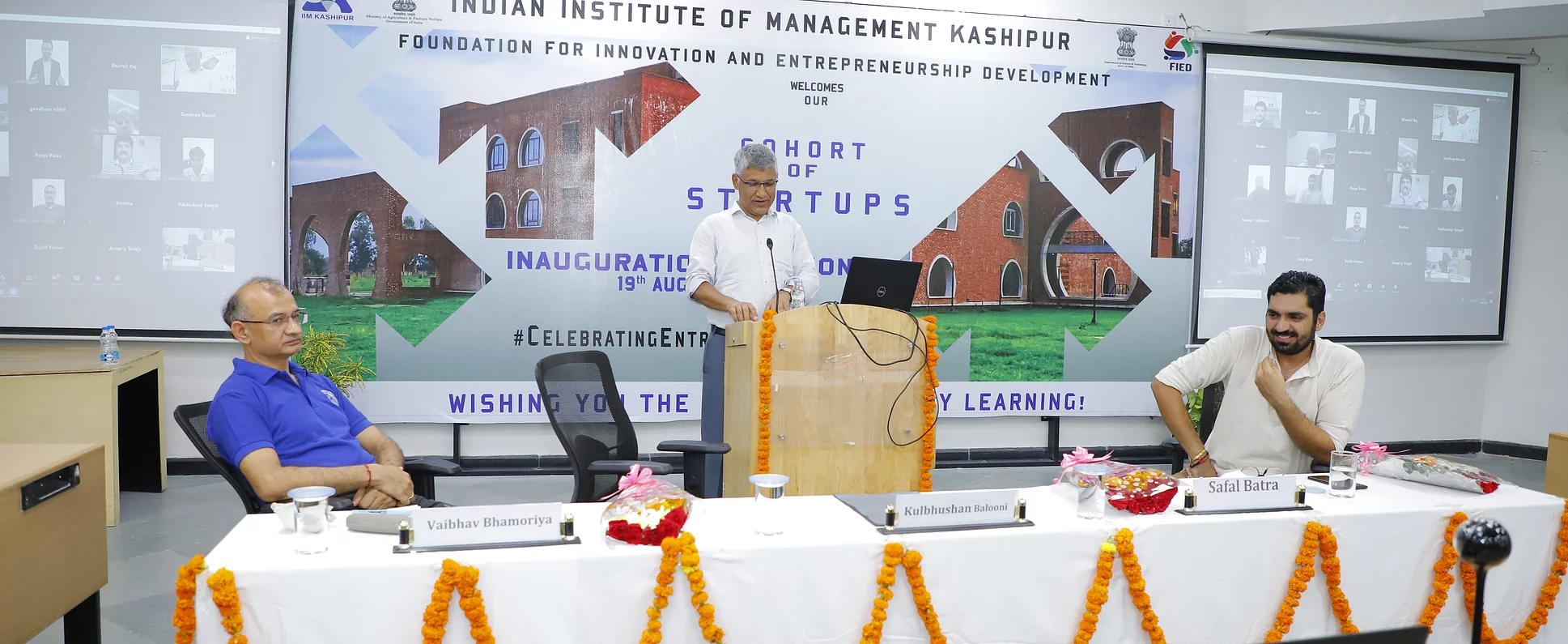
Foundation for Innovation & Entrepreneurship Development (FIED) is the incubation center of ย Indian Institute of Management Kashipur, which is an initiative to cultivate and improve India’s entrepreneurship ecosystem. With the assistance of the Ministry of Agriculture, the Department of Science and Technology, the Government of Uttarakhand, and other supporting partners, FIED is set to incubate India’s most promising start-ups in the areas of tourism and hospitality, agriculture, art and craft, and education. FIED concentrates on the major focus areas which include art and craft, agriculture, technology, tourism, Ayurveda, and education. These areas focus on preserving our rich heritage, spreading the knowledge about science and technology, working towards the betterment of agriculture, enhancing the knowledge level of inquisitive minds, and fostering the inner wanderlust within people. Moreover, FIED has successfully incubated 150+ ventures, has engaged 500+ entrepreneurs, raised more than 50 crore rupees of funding, and has established a network of 100+ investors setting a stage for the budding entrepreneurs to learn and establish their dreams.

๐„๐ฑ๐œ๐ก๐š๐ง๐ ๐ž ๐๐ซ๐จ๐ ๐ซ๐š๐ฆ ๐š๐ญ ๐ˆ๐ˆ๐Œ ๐Š๐š๐ฌ๐ก๐ข๐ฉ๐ฎ๐ซ:

๐—ฆ๐˜๐˜‚๐—ฑ๐—ฒ๐—ป๐˜ ๐—˜๐˜…๐—ฐ๐—ต๐—ฎ๐—ป๐—ด๐—ฒ ๐—ฃ๐—ฟ๐—ผ๐—ด๐—ฟ๐—ฎ๐—บ:

IIM Kashipur has, over the years, developed strong ties with multiple universities and institutes from all around the world. IIM Kashipur students have the chance to visit top MBA institutes in France, Denmark, Greece, Israel, South Korea, Taiwan, UK, Thailand, and many more. In the year 2019-20, 11 students from IIM Kashipur visited 5 different institutes in different countries as part of the Student Exchange Program which lasted for about 3 months.

๐—ฆ๐—ต๐—ผ๐—ฟ๐˜-๐—ง๐—ฒ๐—ฟ๐—บ ๐—˜๐˜…๐—ฐ๐—ต๐—ฎ๐—ป๐—ด๐—ฒ ๐—ฃ๐—ฟ๐—ผ๐—ด๐—ฟ๐—ฎ๐—บ (๐—ฆ๐—ง๐—˜๐—ฃ):

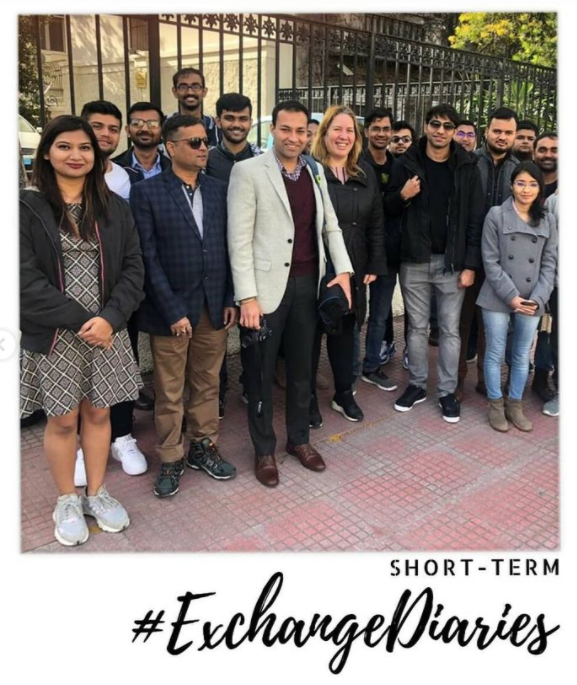
IIM Kashipur also offered its students the opportunity to visit some of these institutes as part of the Short-Term Exchange Program (STEP) which lasted for around 15 days in the academic year 2019-20. A total of 24 students took part in the STEP Program to visit ALBA Graduate Business School, Greece.

The program included 2 weeks of workshops, lectures, and immersion programs wherein the students get an opportunity to explore in and out of Europe giving them significant geographic and cultural exposure.


๐—ฆ๐˜๐˜‚๐—ฑ๐—ฒ๐—ป๐˜ ๐—•๐—ผ๐—ฑ๐—ถ๐—ฒ๐˜€ ๐—ฎ๐—ป๐—ฑ ๐—”๐—ฐ๐˜๐—ถ๐˜ƒ๐—ถ๐˜๐—ถ๐—ฒ๐˜€ ๐—ฎ๐˜ ๐—œ๐—œ๐—  ๐—ž๐—ฎ๐˜€๐—ต๐—ถ๐—ฝ๐˜‚๐—ฟ

IIM Kashipur is a completely student-driven campus right from placements to day to day functioning of the campus. Being a part of the student bodies and event-specific teams, students mold themselves in various spheres of qualities which include time management, team building and management, situation handling, and maintaining cordial relations with the administration.

๐—ก๐—ฒ๐˜๐˜„๐—ผ๐—ฟ๐—ธ๐—ถ๐—ป๐—ด ๐—ผ๐—ณ ๐—œ๐—œ๐—  ๐—ž๐—ฎ๐˜€๐—ต๐—ถ๐—ฝ๐˜‚๐—ฟ:

๐—œ๐—ป๐—ฑ๐˜‚๐˜€๐˜๐—ฟ๐˜† ๐—–๐—ผ๐—ป๐—ป๐—ฒ๐—ฐ๐˜

This year IIM Kashipur conducted guest lectures in various domains like Finance, Marketing, Operations, and HR by inviting industry leaders from organizations like Bain Capital, Henkel Adhesives Technology, Myntra, Jabong, MRF, Karvy Group, Capgemini to name a few. The focus is also on providing live projects to the students of IIM Kashipur that gives them hands-on experience to get the required industry sensitization before actually going out in the corporate world. This year the college has floated numerous projects for students from leading companies like Swiggy, PUMA, Crisil, Dish TV, Ashok Leyland, Reliance Industries, Scale Labs, Faber Infinite to name a few.

๐—”๐—น๐˜‚๐—บ๐—ป๐—ถ ๐—–๐—ผ๐—ป๐—ป๐—ฒ๐—ฐ๐˜:

Creating an engaged, supportive alumni network is crucial to an institutionโ€™s success. With mushrooming educational institutions around the world, one way for an institute to stand out from the domestic and international competition is by promoting its brand. And an instituteโ€™s alumni are its best bet. They act as flag bearers of the institute in the outside world and ensure the current batches are made aware of ongoing trends. IIM Kashipur believes in continuous engagement with its strong alumni network via biannual city meets, annual reunion at the institute, regular webinars, and guest lectures.

๐—œ๐—ป๐—ณ๐—ฟ๐—ฎ๐˜€๐˜๐—ฟ๐˜‚๐—ฐ๐˜๐˜‚๐—ฟ๐—ฒ ๐—ณ๐—ฎ๐—ฐ๐—ถ๐—น๐—ถ๐˜๐—ถ๐—ฒ๐˜€ ๐—ฎ๐˜ ๐—œ๐—œ๐—  ๐—ž๐—ฎ๐˜€๐—ต๐—ถ๐—ฝ๐˜‚๐—ฟ:

  • The new campus of IIM Kashipur is spread over an area of 200 acres, visually very striking and functionally very effective. The campus is equipped with modern technologies in classrooms to provide the best management education.
  • Gymnasium, Library, Amphitheatre, and Mini-Amphitheatre are the other facilities present on campus to ensure the holistic development of students.
  • Sports facilities include TT Table, Lawn Tennis Court, Basketball Court, Badminton court, Futsal Court, Volleyball Court, Frisbee ground, and Cricket Ground.

IIM Kashipur hosts a variety of events across the year to foster all-round development and extend the values of our institute. Coalescence is our annual corporate summit, Uttishtha is an annual entrepreneurial event, TEDx IIM Kashipur, Agnitraya, is our annual flagship cultural, sports and management festival, Convocation, and many others.

In short, โ€˜Life is amazing, here, at IIM Kashipur.โ€™

By

Deshmaa RT and Sakshi Poddar

MBA (Analytics) 2020โ€“22

Indian Institute of Management Kashipur

โ€‹โ€‹