How National Winners of L’Oréal Sustainability Challenge 2020 approached the case!

IIM Kashipur has been building a culture among the students to participate in the case competitions and find ways to express themselves by competing with the other B-schools. Last year, IIM Kashipur saw success in numerous competitions making the culture even stronger. We got to know about corporate case competitions after joining the MBA program at IIM Kashipur. The first year of MBA was no less than a roller-coaster ride, spent in learning key business concepts and time management, we decided to participate diligently in the second year. It took us a while to understand how the case competitions work and what needs to be done to crack them. Firstly, we would say, selecting a good and coordinating team is of utmost importance. A team should consist of members who respect each other’s opinions and believe in having constructive discussions. The strengths and weaknesses of members should be known and utilized well. Above all, there must be strong bonding and a 100% commitment towards teamwork. Three of us worked together on an academic project in the first year and gelled up well. Consequently, we decided that we will team up for case competitions and started preparing for the same. We focused specifically on the presentation skills and having done multiple class presentations in the first year helped us a lot in this aspect.

Image for post

The next thing is to select the right competition. With the busy curriculum of the MBA, it is difficult to compete in all the case competitions. Therefore, it is better to research and select a few competitions based on your domain, interest, or industry and work hard towards understanding and approaching those competitions. At the end of the first year, we had prepared a list of all the competitions and their tentative dates that we were expecting to be floated during our second year. We even tried to plan our electives and other curriculum activities accordingly.

Coming to the competitions, no matter how much you prepare for the case challenges, you will not be able to reach the case study round, unless you clear the preliminary elimination rounds which are usually quiz or simulation rounds. Hence, it is important to take them seriously with a fitting approach specific to each competition. It is important to stay calm and focused even when you are not able to make through the first round in a few competitions. We always tried to stay positive and looked forward to moving ahead.

The main challenge comes after clearing the first round. It is important to understand the case problem clearly. The companies generally organize a webinar or doubt clearing sessions after floating the case. We preferred to attend these sessions — well prepared with our doubts to get everything clarified. Also, efforts should be made to understand the ‘expectations of the jury’ and ‘judgement parameters’ set by the organizer.
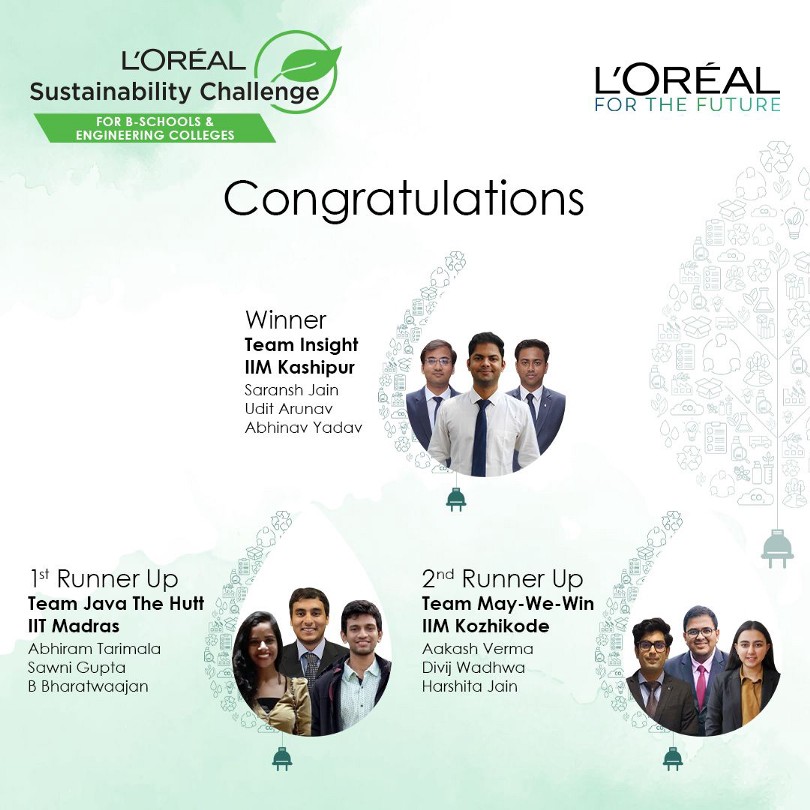
Image for post

L’Oréal Sustainability Challenge 2020

L’Oréal Sustainability Challenge was a challenge of ideation, where we had to provide an innovative solution on how L’Oréal could enable its consumers to reduce the greenhouse gas emissions resulting from the use of its products. Now that is a challenge specific to the behavioral change of L’Oréal’s consumers and at the same time open to any idea which is feasible and scalable to the world. Hence, we focussed on the novelty and simplicity of our idea. We believe that extensive research from reliable sources and brainstorming are the keys to get a novel idea.

For the preparation of the Grand Finale, we thought and discussed on every aspect being brought to our notice by the mentors from L’Oréal. We prepared the final presentation following their suggestions. We tried to keep it as simple as possible to understand, such that it included all the nitty-gritty of the idea. We also kept backup calculations in the appendix. We felt that the Q&A session plays the most crucial role in winning a competition, the jury would be ready to dive deep in your solution and we had prepared for every possible question in advance, at least the ones we could think of.

Winning the L’Oréal Sustainability Challenge was an enriching experience and gave us some key learnings. We faced quite a few challenges as we had our midterm exams just before the final round and the virtual setup had its concerns to deal with. But with some luck, and some sleepless nights of hard work, we are happy that we were able to sail through.

Our Learnings

“If you try to win, you might lose, but if you do not even participate, you lose for sure”

So, participation should be done leaving all the expectations aside. Winning or losing depends on a lot of factors that are difficult to define. Some things are not in our hands. That said, we can always focus on a few factors which have the potential to create a difference.

If we are to say three things that helped us in our journey, it would be Confidence, Simplicity, and Dedication.

Team Insight

Abhinav Yadav, Saransh Jain, Udit Arunav (MBA Batch 2019–21)

National Winners, L’Oréal Sustainability Challenge 2020
Essential learnings from shift to online education amidst Covid-19

Image for post

The business schools have conventionally been staid in their approach to teaching methods — the area in which there have been but few innovative developments for decades. The face-to-face teaching-learning process still dominates despite the advent of online learning. Faculty prefer the face-to-face mode from the viewpoint of convenience in responding to questions from a mass of students, carrying out interactive discussions and explanations, derivations or solving problems on the whiteboard.

However, the change seems to be a constant in education. The paradigm shift in pedagogy to online mode offers one means of making such change due to pandemic. Online teaching is helping us to beat the Covid-19 lockdown and catch up with the academic schedule. Nevertheless, at the same time, I fear that the paradigm shift in pedagogy to online mode may alienate economically disadvantaged students who do not have access to digital classes.

We do have some essential learnings from the online classes.

  1. The online teaching-learning process in business schools is undoubtedly useful. In some ways, such as making (theory and lecture) more structured, promoting self-learning, and prior class preparation among students, reducing spoon-feeding, it is perhaps more effective than the face-to-face mode.
  2. Examinations need not be in sit on-campus mode; open-book take-home exams designed to assess higher-order thinking skills or online exams are more effective, at least at the post-graduate level.
  3. Blended learning as a pedagogy appears superior to the conventional face-to-face teaching-learning process from the student’s perspective, to cater to fast and slow learners equitably.

In general, I believe that the current crisis and the response mechanisms put in place by the institute and other leading business schools will bring about a paradigm shift in pedagogy and that these new teaching-learning processes will be more effective.

Dr. Sunil Kumar Jauhar

Assistant Professor

Operations Management & Decision Sciences

Switching to the virtual mode of learning during the pandemic

Imparting formal education has been traditionally conceived through a single-mode within a close setting. Within this concept, the learning and knowledge are possessed, selected, structured, and transmitted by a teacher to students. This mode does not provide an opportunity for the formation of a dialogue between a teacher and students. Though this mode is rationalized as the finest, the present scenario calls for constructing an alternative virtually based mode.

Image for post

Virtual or online mode creates a co-constructed approach in learning and facilitates the development of online learning communities. This approach allows students to engage actively in the discovery of alternative forms of knowledge and denaturalize the assumptions of a subject. This paradigm shift in pedagogy transmutes the usual transmission of knowledge into cooperative learning, assists in neutralizing the power relations between the positions of instructor and student and brings them together and elevates their creative potential.

In the context of higher education, this shift embraces constructivist pedagogy and technology. The philosophical assumption in constructivist pedagogy is the learner constructs a version of reality that is situated in a context of social interactions with other learners and institutions. As the shift promotes collaborative learning and enhances reflexivity, an action extends thought — reflection shaped by the consequences of the action. It allows learners to actively engage one another in ideas and perspectives they hold to be educationally valuable, exhilarating, and stimulating. It is through the design of the online learning environment, with an emphasis on shared educational goals, support, collaboration, and trust that these processes can be most effectively and functionally activated.

Dr. Rahul Ashok Kamble

Assistant Professor

Organizational Behavior & Human Resource

Dealing with the challenges of online mode of learning amidst Covid-19 pandemic

Image for post

COVID-19 pandemic has forced global experimentation in many facets of lives. Education can be one of the several arenas that this crisis is going to change. Learning online can be a lot more complicated than simply being acquainted with setting up a Zoom account or Google Classroom. Initially, I had two major instinctive apprehensions for remote teaching that could hold me back during the unprecedented transition from offline to online mode. First, being gripped by the mechanics instead of focusing on the purpose of learning. Second, the greater emphasis on the content alone. This pandemic has added an extra layer of complexity to the anxiety associated with online learning. Learning is more than just a transaction between an expert and a novice. So, as an educator, the major challenge was to overcome the temptation of embracing a narrow view of cognitive learning. Because socio-emotional learning is also crucial especially in situations of crisis when one’s anxiety is likely to be much stronger.

Socio-emotional distress like loneliness or anxiety can wear away our cognitive capability also. Therefore, for effective online learning, a balance of knowledge with a focus on people and emotions is required. A shared and holistic learning process in online mode was subject to other challenges like the digital divide, attention span (multi-tasking that we often do in online mode), low motivation, and novelty of online platforms. Virtual office hours provide that another window of conversation and connection that would have been missed in remote teaching. The crisis has caused some disruptions in the learning process but with some readjustments in online learning, we were able to address students’ disorientation as well as getting on with the curriculum. Online learning might be a short-term response to COVID-19 but it has paved way for a lasting digital transformation of education.

Dr. Preeti Narwal

Assistant Professor (Marketing)

Experiences and learnings from the paradigm shift in pedagogy to online mode

Image for post

The onslaught of online teaching-learning practices that entailed the COVID19 outbreak in recent times has outvied the traditional pedagogy of a physical classroom experience both from temporal and spatial contexts. The usual classroom environment has been replaced by a digital space where many of the teaching-learning assumptions are being questioned every day. It has brought new issues, challenges, and opportunities to the omphalos of educational praxis. At best, it has enthroned the learner at the centre and compelled the teacher to negotiate the curriculum through digital intermediaries and applications that were hitherto unknown to both. While the virtual reality has become new normal and opened up avenues for action research, it has once again startled many to the core. Being an abettor of open and distance education since the 1990s, for me, it was a long battle won at last. A battle that we lost innumerable times when our colleagues and fellow educationists vacillated the reliability and validity of teaching, learning and degrees earned through ‘distance mode’. Even after the establishment of an open university almost in every state, the government used to give public notices announcing that degrees obtained through distance education are equally ‘valid’. COVID19 has pushed all those egotisms to the periphery and firmly entrenched the online education system that is going to be the new paradigm for years to come, perhaps much after this pandemic.

While the traditional classroom is seen as a powerful space where the physical presence of the faculty is set as the apotheosis of knowledge, the online classroom has made the field more democratic. I am now au courant of the fact that unless and until I make the content attractive, relevant, and rich, the audience might just occlude me from his/her reality and I would be facing more blank screens (when students’ cameras are off). I can no longer afford to unleash the drudgery of monologues on the students and as such I have to deliver the content from with a design thinking approach where graphics, narratives, and the platform (e.g. Zoom) are all in sync with the theme of my session. The art and the aesthetics of audio-visual contents that were long considered the tinge of the media and journalism experts have now become the existential survival skill for the online faculty. The jury is out and the potential outcome of my delivering classes online over the last few months will perhaps reiterate an apophthegm that I heard from one of my senior colleagues — ‘to teach or not to teach, do whatever you like in class but never bore your students’. That fulmination looms much larger today for any teacher when both the dramaturgy and the stage have gone virtual and if something goes wrong it might even go ‘viral’.

As a researcher, while my field teams are cooling their heels at home, online classes have opened up an enormous space for conducting digital ethnography or Netnographic study from the comforts of our homes. That is an added advantage that would have perhaps remained in the penumbra, had we not been forced into this homebound exile by the pandemic. The Socratic classroom has taken a backseat for now and the flip-class has taken a lead in enriching students’ engagement and active learning at different levels. We are now more conscious of the difficulties, digital divides, affordability, and access issues in connectivity and the differentiated learning preferences of our disciples. That is a new nirvana for me to suspire for.

Dr K M Baharul Islam

Dean (Academics) and Professor (Communications)

Chair, Center of Excellence in Public Policy and Government

Embracing the online mode of learning in the new normal

आत्मानं सततं रक्षेत् (One must save oneself under any circumstances) is a famous quote by Swami Vivekananda. We all in academics did that under the COVID-19 circumstances to save ourselves from stagnancy, by embracing the online mode of teaching and learning.

Interestingly online education, distance mode of education, and learning through correspondence were earlier part of the non-formal education system but today the above mode of teaching and learning is being adopted by the formal education system too. Globally adaptation to the wave of change brought by COVID-19 has become the new normal. How long would this continue, that just depends on the solution scientists would decode to trash the virus! Duration of this new normal may call for change in the definition used for a long, to classify formal and non-formal education. What if the division between both the type of education (formal vs non-formal) based on the mode of teaching and learning, gets blurred! I am thrilled by the idea of more than analyzing its outcomes! Would it be really and only bad? Or there is some good in it as well? The answer lies only in the future.

What is happening at present on the academic front? In my attempt to respond to this I would like to say what the Great Greek Philosopher Cicero, said once, “Summum bonum” which in Latin means the “highest good”. Talking about the present scenario, dealing with the COVID-19 crisis was made possible by technology, by online teaching, was there any better way than this to ensure continuity and overcome stagnancy? Teaching and learning via Zoom (or any online platforms) is the highest good, the thing at this point. Online teaching and learning made possible using the online platforms have the capacity to radically revolutionize the education system, and I presume, it will be for the “highest good” of every stakeholder involved. So I think what has happened in our attempt to adapt and move on is “Good” and what is going to happen in future due to technological development, let’s hope it will also be “Good”.

Dr. Madhurima Deb

Associate Professor (Marketing)