How National Winners of DigiBytes, IIM Bangalore approached the case!

B-school competitions are the first and foremost thing that the students are required to prepare for soon after they enter college. Let alone winning or losing, just by taking part in a competition and honestly putting efforts into research and data collection — which are the starting points of the competition can make one learn a lot. B-school competitions are an invaluable experience and an essential part of an MBA.

Image for post

When it comes to choosing a team for a competition, it is important to remember that all of the members need not be the best in everything — this may work reverse bringing in a lot of rework and discussions that forever go on a loop instead of adding value to the team. A short description of our team for DigiBytes a digital marketing competition conducted by IIM Bangalore will help you get the perspective rightly. One of the team members is a good initiator. With an idea in hand, he knew from where to initiate and was able to give a face, body, and life to the idea. The second member of the team is good at crunching numbers, bringing in facts to support the idea, and draw out revenue plans and cost structures, in short, a person good with data interpretation and understanding numbers. Our third member is a person who is creative, good at presenting his ideas simply, and understandably without diluting the essence of all the efforts that the team has put into building the case solution. Having diverse members in a team helps in bringing different perspectives and formulating a unique winning strategy. Adding on to the above merits, dividing work among the team becomes easy when the team is diverse, which saves a lot of valuable time given our hectic MBA schedules.

The context of DigiBytes case was to launch a new product in a given set of industry sectors and market them organically on social media handles. We can break down our approach in the following steps. The first step is to understand the category (fitness, food and beverages, chocolates, etc.) in which you are competing, whether the category is already established or it is new and developing.

The second step is to identify your immediate competitors and other competitors. For example, for launching new chocolate, its immediate competitors would be other chocolates such as Dairy Milk, Snickers, Milky bar, etc. and other competitors could be native Indian confectioneries, cookies, cakes, etc.

The third step is to understand the offerings of the competitors, what are the benefits that the competitors are communicating to their target group. This process will help in finding white spaces where your product can cash in and win.

The fourth step is to list down a set of your potential target customers, prepare a discussion guide, and conduct in-depth interviews. The fifth step is to identify your final target customer group, define his/her characteristics in-depth by answering questions like who is he, what is his behaviour and why does he behave so. This will help not only in understanding your target group better but also enables you to find tension or say a need state for your target group that you will go on to fulfill with your product.

The sixth step is to create an effective communication strategy for your product which is in line with your brand strategy and purpose, which serves the need of your target group that you identified in the previous step. The final brand communication must be impactful and should guide your target group from their current state to the desired state. For example, the current state of the target group is “ I believe starting my day early is good and healthy, but doing so is difficult, and I don’t find a motivation to do so”. The desired state is “Winners and achievers wake up early and start working towards their goals, and results don’t come easily, one has to work hard to achieve one’s goals”. The brand communication for your product should act as a bridge that moves your consumer from his/her current state to their desired state. For example, “I want my target consumer to believe that A cup of Sleepy Owl coffee is the best possible way to start my day and stay active throughout the day”.

The next step goes on to developing creatives and running campaigns that will take this brand communication to the desired target group. Better content categorization can be done using a funnel approach. The success of this step depends on the impactfulness and creativity of the campaigns.

To conclude, working towards winning a B-school competition along with the regular academic rigour not only adds value to the CV but also sparks innovation, shows the competitive part of you that you never knew existed. Humans are competitive and have been competing over territories, food, mates, etc., for hundreds of years now, and competition makes you better in what you do. The high that you get from winning will push you towards expanding your limits and thrive more for success. All the best. Keep working towards a better tomorrow. The right idea, at the right time and the right place will definitely win.

Team Black Clover

Aravind R, Gaurav Gopal, and Vignesh M (MBA Batch 2019–21)

National Winners, DigiBytes organised by IIM Bangalore

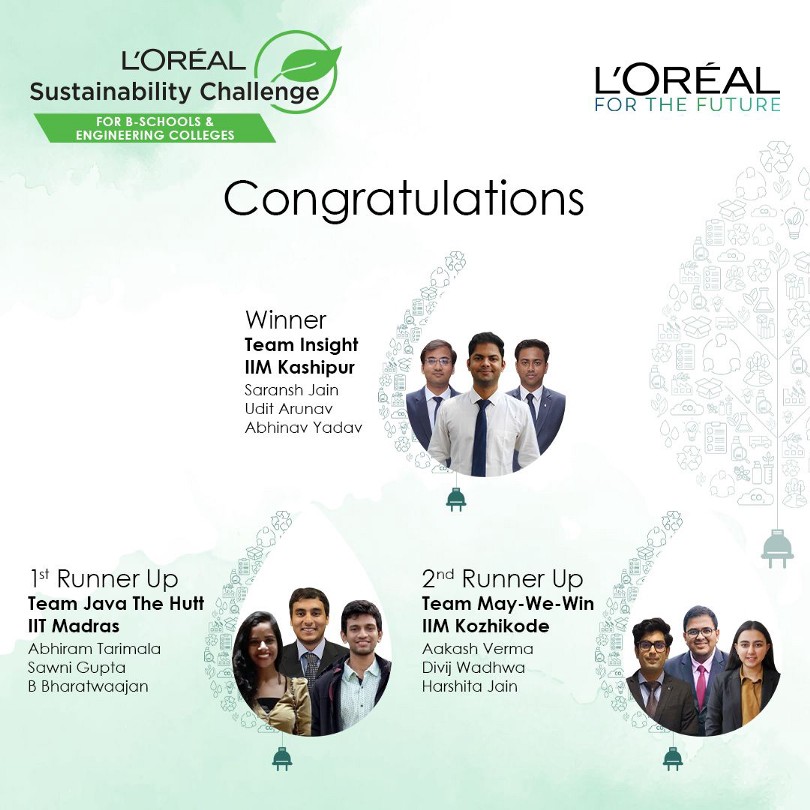
How National Winners of L’Oréal Sustainability Challenge 2020 approached the case!

IIM Kashipur has been building a culture among the students to participate in the case competitions and find ways to express themselves by competing with the other B-schools. Last year, IIM Kashipur saw success in numerous competitions making the culture even stronger. We got to know about corporate case competitions after joining the MBA program at IIM Kashipur. The first year of MBA was no less than a roller-coaster ride, spent in learning key business concepts and time management, we decided to participate diligently in the second year. It took us a while to understand how the case competitions work and what needs to be done to crack them. Firstly, we would say, selecting a good and coordinating team is of utmost importance. A team should consist of members who respect each other’s opinions and believe in having constructive discussions. The strengths and weaknesses of members should be known and utilized well. Above all, there must be strong bonding and a 100% commitment towards teamwork. Three of us worked together on an academic project in the first year and gelled up well. Consequently, we decided that we will team up for case competitions and started preparing for the same. We focused specifically on the presentation skills and having done multiple class presentations in the first year helped us a lot in this aspect.

Image for post

The next thing is to select the right competition. With the busy curriculum of the MBA, it is difficult to compete in all the case competitions. Therefore, it is better to research and select a few competitions based on your domain, interest, or industry and work hard towards understanding and approaching those competitions. At the end of the first year, we had prepared a list of all the competitions and their tentative dates that we were expecting to be floated during our second year. We even tried to plan our electives and other curriculum activities accordingly.

Coming to the competitions, no matter how much you prepare for the case challenges, you will not be able to reach the case study round, unless you clear the preliminary elimination rounds which are usually quiz or simulation rounds. Hence, it is important to take them seriously with a fitting approach specific to each competition. It is important to stay calm and focused even when you are not able to make through the first round in a few competitions. We always tried to stay positive and looked forward to moving ahead.

The main challenge comes after clearing the first round. It is important to understand the case problem clearly. The companies generally organize a webinar or doubt clearing sessions after floating the case. We preferred to attend these sessions — well prepared with our doubts to get everything clarified. Also, efforts should be made to understand the ‘expectations of the jury’ and ‘judgement parameters’ set by the organizer.

Image for post

L’Oréal Sustainability Challenge 2020

L’Oréal Sustainability Challenge was a challenge of ideation, where we had to provide an innovative solution on how L’Oréal could enable its consumers to reduce the greenhouse gas emissions resulting from the use of its products. Now that is a challenge specific to the behavioral change of L’Oréal’s consumers and at the same time open to any idea which is feasible and scalable to the world. Hence, we focussed on the novelty and simplicity of our idea. We believe that extensive research from reliable sources and brainstorming are the keys to get a novel idea.

For the preparation of the Grand Finale, we thought and discussed on every aspect being brought to our notice by the mentors from L’Oréal. We prepared the final presentation following their suggestions. We tried to keep it as simple as possible to understand, such that it included all the nitty-gritty of the idea. We also kept backup calculations in the appendix. We felt that the Q&A session plays the most crucial role in winning a competition, the jury would be ready to dive deep in your solution and we had prepared for every possible question in advance, at least the ones we could think of.

Winning the L’Oréal Sustainability Challenge was an enriching experience and gave us some key learnings. We faced quite a few challenges as we had our midterm exams just before the final round and the virtual setup had its concerns to deal with. But with some luck, and some sleepless nights of hard work, we are happy that we were able to sail through.

Our Learnings

“If you try to win, you might lose, but if you do not even participate, you lose for sure”

So, participation should be done leaving all the expectations aside. Winning or losing depends on a lot of factors that are difficult to define. Some things are not in our hands. That said, we can always focus on a few factors which have the potential to create a difference.

If we are to say three things that helped us in our journey, it would be Confidence, Simplicity, and Dedication.

Team Insight

Abhinav Yadav, Saransh Jain, Udit Arunav (MBA Batch 2019–21)

National Winners, L’Oréal Sustainability Challenge 2020

Internship Insights by IIM Kashipur students: Summer Internship Experience at Puma

It all started with my first interaction with the senior batch. A couple of seniors were describing their internship experiences and that is when a summer internship with Puma became my goal for the year. I had extensive discussions with the seniors who had interned with the organization last year and gained a lot of insights. They helped me prepare not only for the internship interview of the company but also taught me the true meaning of peer to peer learning.

After a few selection rounds and an interview, there it was, my name on the screen. Yes! I managed to make it through. It was all like a dream and there were a lot of expectations. A point came when everything became uncertain, whether the internship will even happen or not but then I received a mail assuring me that the company will be keeping its commitment and the internship will happen virtually.

At first, I thought that there won’t be much of a learning experience, but that thought was soon put to rest. The onboarding team assured that we got a holistic view of the organization with talks from all the vertical heads. The projects were allotted, and I was given a chance to work with the Operations team where the learning experience was incredibly different from what we learn in the classroom.

I was given the task to optimize the current e-commerce operations for the company and develop a sustainable ordering solution for their materials. I was surprised at how well integrated the entire internship experience was and I had never imagined that the largest sports apparel organization in the country would be giving this much time for the development of its interns. The mentors were always available to address any roadblock I faced with regards to the project and the HR team was always ready to support with regards to any cross-team interaction needed during the project.

One thing that the organization embodies is the path towards continuous learning and we were invited to attend a lot of learning sessions on strategy and digital marketing along with the employees. The kind of experience that I gained working with Puma has enriched my way of thinking and approaching problems. Skills like advanced usage of Power BI and applications of advanced excel were added to my skill set and all this is sure to help me in the times ahead and become corporate ready.

Aditya Bharadwaj, Summer Intern, Puma
Class of 2021 | IIM Kashipur

Is An MBA Relevant In Today’s World?

In days, when we read that industry bigwigs like Indra Nooyi, CEO of PepsiCo say that lack of focus on technology is degrading the quality of management graduates from the country; or the whole and sole of Tesla – Elon Musk saying that he wouldn’t recommend an MBA, rather he would prefer not hiring MBAs, how relevant and advisable is it to still pursue an MBA in today’s world is indeed a question to ponder upon! However, contrary to the notion above, with every year that is passing, we can see a gradual increase in the B-Schools in India as well as an increase in the batch sizes of existing B-Schools! This has been an interesting trend to observe indeed.

While there is no question that majority of the individuals pursuing MBA do so in lieu of better career prospects or to be even more specific – bagging big paychecks! But is that all an MBA is about? Definitely not. Those portraying so are insulting the years of legacy that the Indian Institutes of Management have put in front of us. The kind of rigor they instill in the MBA graduates is something which imbibes holistic development of the aspirant along with academics. And yes, this is what an MBA is about. It is about “learning by doing” as one of the IIMs set up in 2011 – IIM Kashipur stresses upon. It is about putting theory into practice. It is about peer learning. Moreover, it is about turning yourselves into a better person, a better manager!

An MBA is probably the most efficient teacher of the importance of time and professionalism. Strict deadlines, cutthroat competitions with implementations of a bell curve, burning the midnight oil to be prepared for the lectures, presenting and studying of numerous case studies – name a thing needed to be done to be a better manager and you get to learn it in a B-School!

Revisiting the point mentioned in the first line of this piece – while Ms. Indra Nooyi complained about the quality of MBA graduates degrading, she never discouraged pursuing MBAs. In fact, she has motivated a generation of female MBA aspirants to join top MBA colleges in India and emerge as world-class business leaders. Similarly, while some perceive the MBA graduates a misfit for the organization, it is probably because of coming across the graduates who did an MBA for the higher paychecks and not for the sake of being a better manager.

Concluding, there is no doubt that the B-Schools are here to stay and so are the MBA aspirants. Similarly, the demand for these MBA aspirants is what the single largest factor is making undergraduates think of doing an MBA. Who are we, then, to question the relevance of an MBA in today’s world?

References:

https://www.jagranjosh.com/articles/heres-what-pepsico-ceo-indra-nooyi-thinks-is-wrong-with-current-mba-programmes-1478503600-1

The above article is written by Chirag Dixit, PGP 2018-20 batch, IIM Kashipur