What we are going to read about will be sort of a story (Fairy Tale! Nothing short of that!) of ‘The Spring in the North’! – The Spring rejoiced by young entrepreneurs, startup owners, industry experts, faculties, college and school children from across the country. Yes, we are talking about Uttishtha – The Annual Entrepreneurship Summit of IIM Kashipur – The Spring of Entrepreneurship!
Here is the story by Team E-Cell about how they managed to pull off the event amidst difficulties posed by the pandemic!
Uttishtha is the much-awaited Entrepreneurship Summit which has an objective of revolutionizing how people view entrepreneurship and create an indelible impact in the entire startup ecosystem of the country and beyond!
The restrictions imposed on us due to COVID-19 and taking into consideration the safety of all the stakeholders of the event, we were forced to organize an event of such high magnitude on a virtual platform, which in turn meant restructuring of the entire Summit.
We, the entire E-Cell Team, decided to break the entire summit into small tasks and decided to go about the event in a phased manner. Subsequently we divided the entire summit into 3 phases, namely, the planning stage, the preparation stage and the summit!
So, we divided the team according to the preferences and expertise of the members and set off on our Voyage of “Making Entrepreneurship Bloom”!
The Planning Stage:
We all knew that Uttishtha’21 was going to be a completely new experience for all the stakeholders and we precisely knew that to create maximum value for everyone we had to restructure the entire summit upside down and planning or ‘Out of the Box’ sessions, we used to call them, were going to be the most important element of the entire summit!

In Uttishtha’21, as we were revamping almost everything, we decided to go beyond the mainstream in everything we were doing! While deciding the theme of the event, our thought process was to keep a theme that portrayed new beginnings, asked people to get rid of their winter blues (COVID blues!) and focus on embarking on the journey of 5R, namely, Rejuvenation, Regrowth, Resurrection, Renewal and Regrowth! So, with a decision to keep the whole Summit light and bright, we decided to keep the Theme – “Spring”, or the “Spring of Entrepreneurship”, more holistically!
We believe, the first major challenge that came towards our way in the planning stage was in the form of event crafting and flow mapping! We knew, that events of last year needed a major revamp, if we were to create the Summit engaging and create value for the people involved! Last year Uttishtha, had events like Startup Exhibitions, Entrepreneurship Bootcamp and Expo, which could not be conducted online given the nature of the events. So, we needed to come up with events which could fill the space of these events and so we started brainstorming on the needs and wants of all the stakeholders and subsequently came up with new events such as Not Clubhouse – focused panel discussion sessions, firechat conversation – a dialogue between experts from completely different areas, co-founder dating – a virtual internship fair for students across the country, among others! The molding of events according to the theme of the summit and requirements of the stakeholder involved, was a fun-filled experience!
We believe, ‘Uttishtha’ is an epitome of collaborative effort and it sees contribution and cooperation from each and every member of the IIM Kashipur community. After the planning of events and identifying the work areas, it was very important for us to gather support from the community and form an enthusiastic team comprising people who were motivated enough to work on the event diligently. Given the lack of physical interaction with the people involved, in a virtual setting, it was a bit difficult to find the real potential of the applicants. But after due process, we were lucky enough to have found a team, where members were on their toes to make the best out of the opportunity provided. Given the virtual nature of the event, the division of the functional teams had to be revamped where traditional functional teams such as arrangement teams, People management team and promotions team among others had to be dropped off the chart and made way for new teams such as virtual platform team, Audience engagement team and social media team among others.
The Preparation Stage:
Uttishtha’21 being virtual posed a lot of challenges in the execution of ideas, but along with the challenges involved, it also provided us with a lot of opportunities with respect to the extended reach of the event.

The main challenge that the team had to endure while executing the plans was the possibility of miscommunication at times due to lack of physical interaction leading to redundancy of work. Also, too much follow up on the tasks slowed down the process of execution of plans. Although these were challenges which were natural to come in a virtual setting, the dedicated and mindful work of different functional teams ensured smooth operations throughout.
The teams working on onboarding industry experts, dignitaries, speakers, startup founders, school administrators and students had a large pool of people to target given that there was no need to look after travel and lodging arrangements of the guests and with the click of a button experts could join the sessions. This not only allowed us to reach out to people beyond boundaries, but also opened wide range of opportunities for the teams to reach out to people of high stature. One approach that stand out during the whole process was the use of quirky tweet threads on twitter to reach out to people. The choice of this unconventional way led to us having onboarded a lot of good speakers and industry experts.
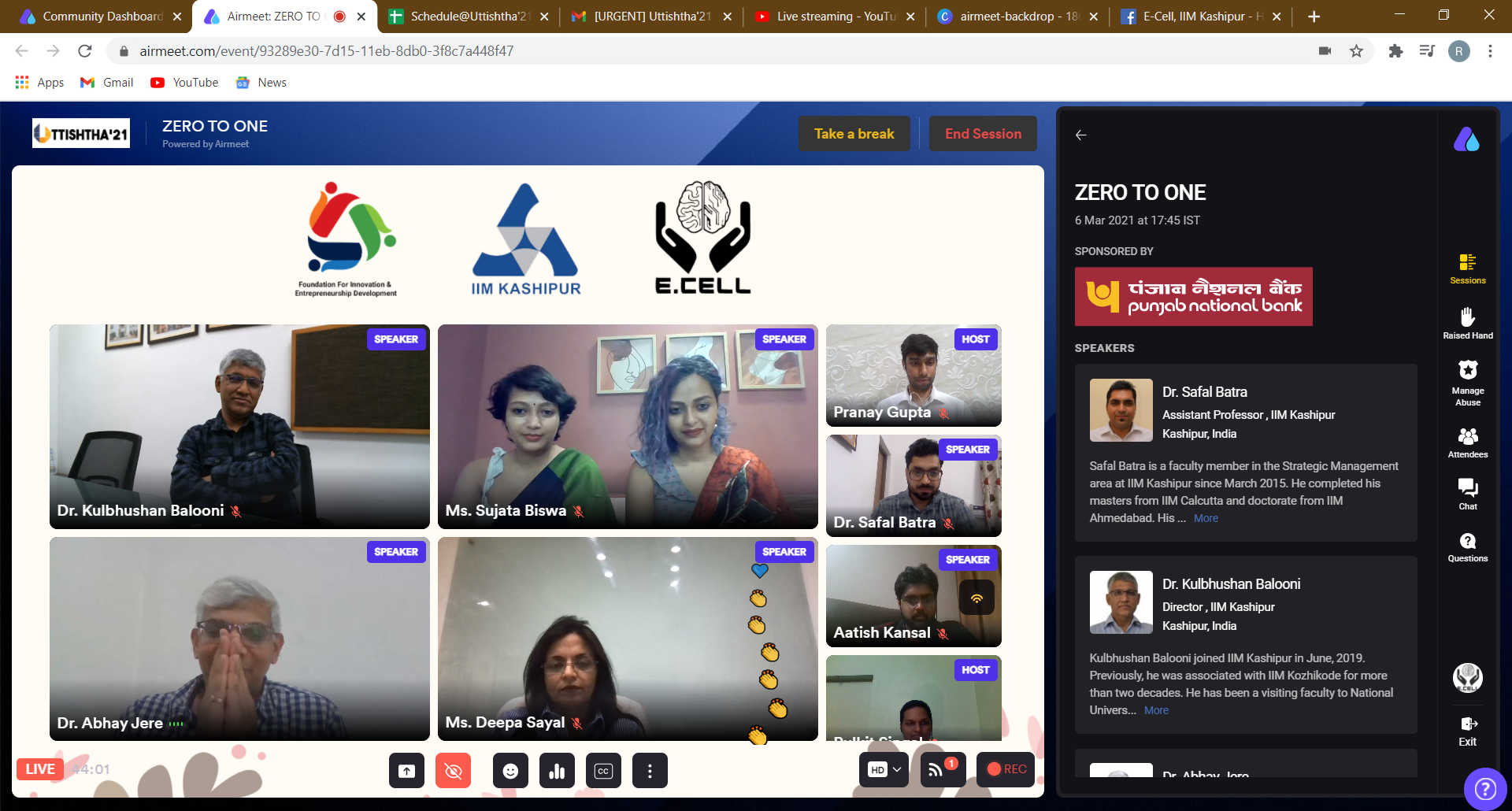
One of the tasks, that took substantial amount of our time was choosing an ideal virtual platform for the Summit. It proved to be an exhaustive process, given we had certain criteria such as neat user interface (UI), easy accessibility and usability, and comprehensiveness with respect to functions among others in our mind. We tried out nearly 12 virtual event platforms before narrowing down on “Airmeet” for conducting the Summit, which we believe served our purpose well.
The digital media team had a humongous task in hand, given they were responsible for creating all the buzz around the event and getting the word across boundaries. They came up with innovative ideas to promote the event to the best of their abilities. With the support from Media and Public Relations Committee (MPRC), the team was able to forge meaningful partnerships with various media partners such as Amar Ujala, Campus Beat among others which helped the team in multi-channel promotions of the event. The digital marketing team came up with numerous creatives and took advantage of all social media opportunities (paid as well as unpaid) to promote the Summit.
The Summit (5th March – 7th March):
Team Uttishtha Meet! Date (4 March, 2021), Time: 10:00 PM! Each and every member from the entire team was there. We all had our cameras switched on! We all were from different functional teams, we all had completely different tasks assigned, but one thing common in all of us was the satisfaction we had with the level of preparedness for the summit that was going to commence next day morning. We all were pumped up and were fully motivated to make the summit a memorable one for everyone and enjoy the three-day summit to the best of our abilities.
Finally, the Spring of Entrepreneurship was here! The first day started off as a warm breeze with esteemed speakers showering their wisdom on the attendees. The first day saw the presence of dignitaries like Mr. Arun Pandey (Chairman and MD, Rhiti Sports), Subhadeep Sanyal (managing partner, Omnivore) among others. We expected that getting the speakers and attendees accustomed to a fairly new platform like ‘Airmeet’ and ensuring the smooth internet connectivity throughout the sessions were something which might play spoilsport during the events, but we are proud of our Techno-savvy team which kept technical issues at bay throughout the Summit.
The Second and third day were going to be crucial days of the event given we had events lined up in those two days which overlapped too, the risk we had to take because of the limited time we had and plethora of events planned out! We had Clear Harvey workshop for school students, Udaan – a national level B-Plan competition, speaker sessions, panel discussions with school administrators planned out, which led to many of them overlapping. But unconsciously, the bond in the entire team and the culture passed on by our seniors helped us sail through roadblocks smoothly and conduct the events in a synchronous manner. It was great to see people taking ownership for their responsibilities and coming forward to take additional responsibilities! Last minute cancellations of few of the experts was something we always had in our mind, and we are happy that we had backups and plans to deal with those situations!

Overall, we can say that Uttishtha’21 was a roller coaster ride for each and every member of the team. Each turn had some challenge for us and we are proud and happy that we had our experienced seniors (our partners, supporters and mentors), who were not only there to show us the path but were there to handhold us through the trouble times. The support from the entire IIM Kashipur community helped us in making the event a national success!
Uttishtha’21 is indeed an epitome of collaborative effort!
 The IIM Kashipur Blog