Operations Club conducted its second session

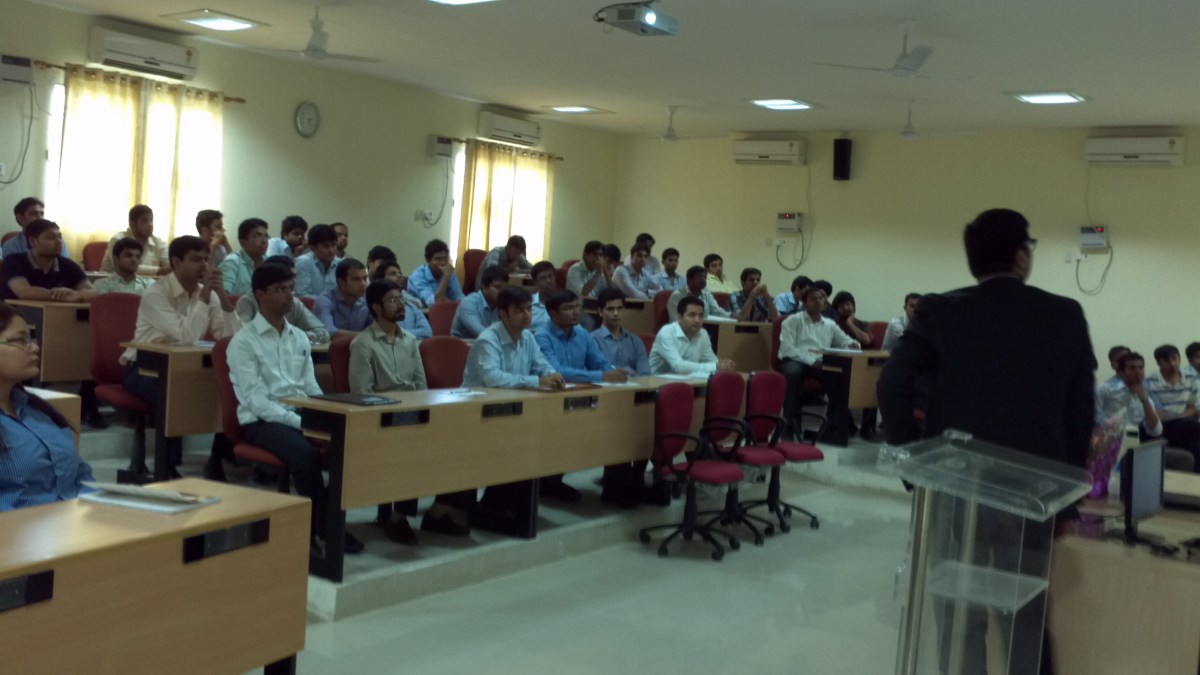
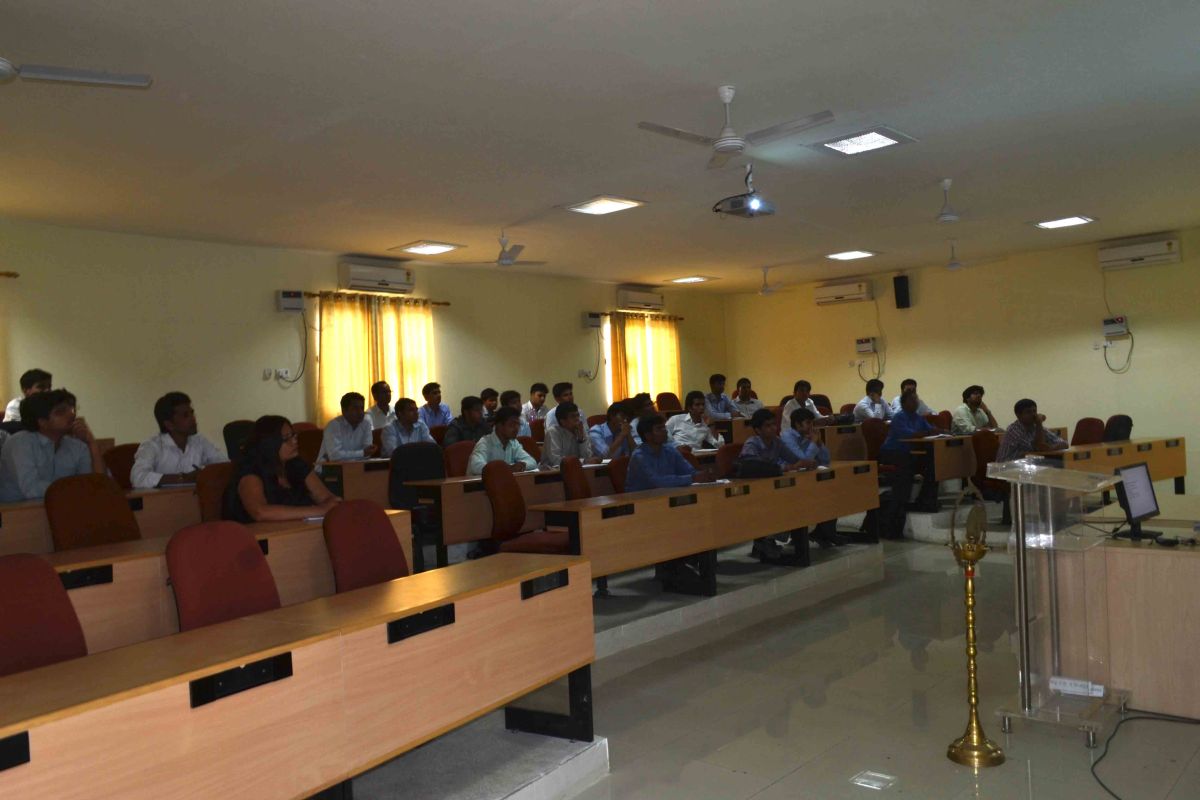
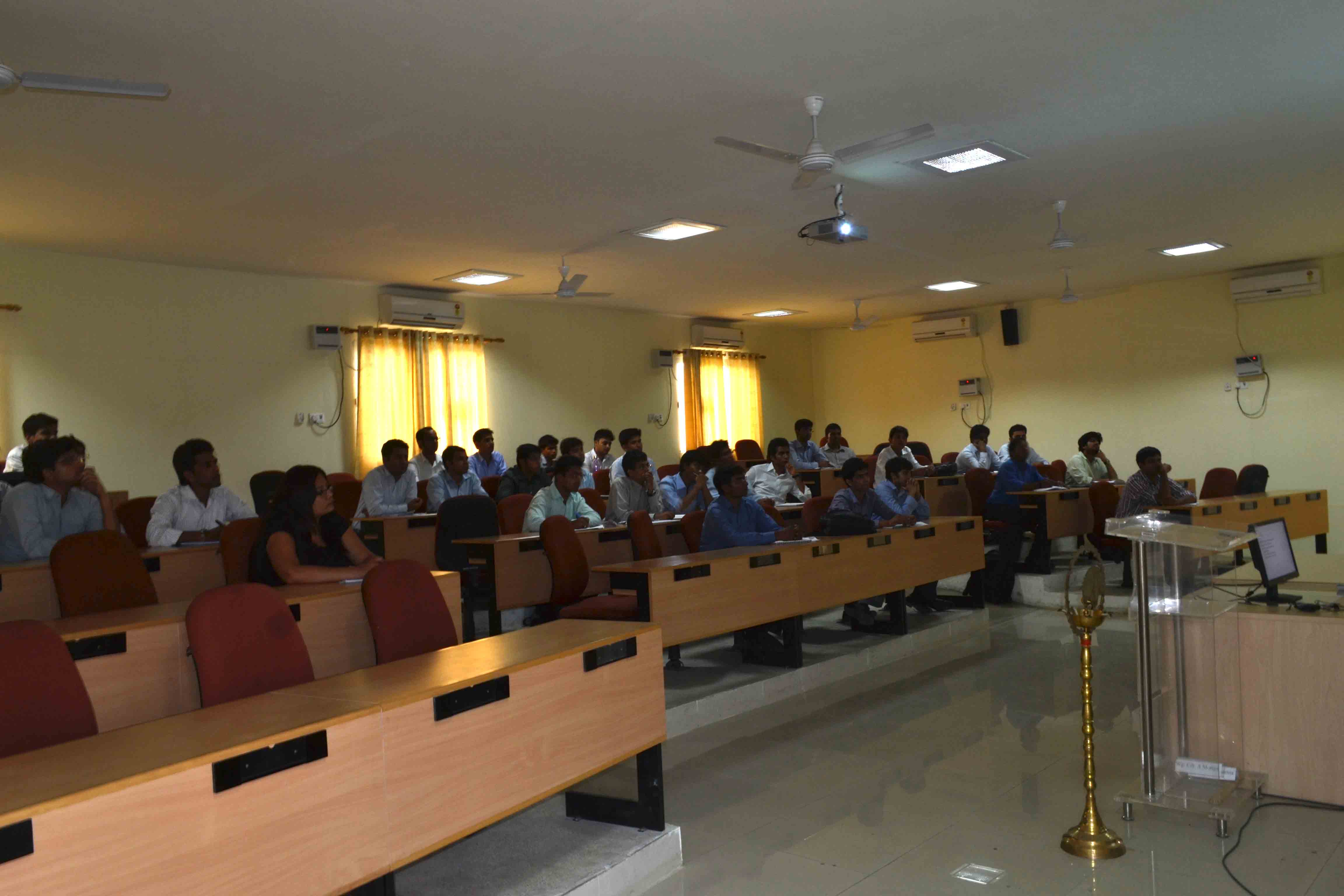
Operations Club conducted its second session on 22nd August 2012. The session was facilitated by Mr Kapil Vaish and Mr Avinash Saha, students of PGP’11-13 and majoring in operations. The session was attended by a bunch of operations enthusiast from PGP’12-14 batch. The session focused on giving a bird’s eye view of all the components of operations from an industrial perspective. An introduction to Mix Integer Linear Programming  Model was also given to the attendees.

The session started with understanding the major components of Operations at a high level. The entire hierarchy and architecture of Supply Chain management was discussed. Enthusiasts were introduced to the concept of forecasting the need, master production schedule, material resource planning, capacity planning. The chronology of events was discussed in detail starting from the vendor finalization for supply of raw materials to the distribution of the final product to warehouses and retailers.

Thereafter, an introduction to Mix Integer Linear Programming model was made wherein members solved a sample optimization problem in excel using Solver. The example threw light on how the constraints are identified for a given problem and entered into the solver to achieve an optimum solution.

The session helped the attendees in understanding what exactly an operation is and to a high extent exposed them to the kind of challenges that entail this area of management.

Mystic land Uttarakhand An Uttarakhand Paean : Mohit Rustogi

Mystic land Uttarakhand An Uttarakhand Paean 

Just like a caring father who never lets you down

The mighty Himalayas embellish its crown;

Provides pride, strength and security quite profound

Chamoli, Champawat, & Uttarkashi, here they are in

abound.

Just like a mother who never gives up on you even

when you fail

The Ganges, The Yamuna bustle across its landscape;

Life creator, nurturing and loving, the qualities to avail

Rishikesh , Haridwar are the blessed ones where these

rivers prevail.

Just like a demure woman with beauty such ethereal

One wonders are the mesmerizing waterfalls &the

sensuous lakes real?

Cloistered away from all the worldly tensions & jaded

affairs

Nainitaal, Almora, a perfect visual treat awaits you here.

Oh Man ! now when you have announced your success

to the world & achieved the desired status

Won a beautiful wife earned lots of money , raised kids

with morally upright nature;

It is time for that perfect denouement when you lose it all

to nature

Submit to God , discover truths of life know thyself,

come & unveil this mystic land Uttarakhand

Interaction with Industry Expert: Mr. Faisal Siddiqui, Vice President, HealthCare division at Technopak Advisors Pvt Ltd.

Interaction with Industry Expert: Mr. Faisal Siddiqui, Vice President, HealthCare division at Technopak Advisors Pvt Ltd.,

Mr. Faisal Siddiqui, Vice President of Healthcare division at Technopak Advisors Pvt Ltd., visited IIM Kashipur campus on 13th August 2012 as a part of the rolling guest lecture series. Technopak is a leading organization providing advisory solutions in setting up of companies in the field of Textile, Retail, Healthcare and Food & Agriculture.

Mr. Faisal did his masters in business from University of Wisconsin. He has also worked at key positions in Apollo hospital group, Fortis Healthcare, GE Health Care and Siemens.

The topic for the discussion was “Service Excellence – the new strategy paradigm”. Mr Siddiqui elucidated the changing trends and the new strategy paradigms in the service industry vis-a-vis the healthcare industry. The two key strategy areas that were discussed were “Process Optimization” and “Customer Services”. He also demonstrated briefly the healthcare sector from different
stakeholders’ point of view, the immense opportunities t

hat lie in this sector for years to come and the qualities that MBA graduates should possess to excel in the field of healthcare consulting.

The session ended with Mr. Faisal’s candid conversation with the students where he shared his personal experiences in the healthcare sector. The session was very informative and increased awareness among the students about the bright prospects in this sector.


Interaction with Industry Expert: Mr. Amol Maheshwari, Head – Corporate Business, North and Central India at Bajaj Allianz Life Insurance Company

Interaction with Industry Expert: Mr. Amol Maheshwari, Head – Corporate Business, North and Central India at Bajaj Allianz Life Insurance Company.

On 12th August 2012, IIM Kashipur PGP Students engaged in an interactive session with Mr. Amol Maheshwari on the topic “Marketing Strategies for Financial Instruments”. Mr. Amol heads the Corporate Business Division of Bajaj Allianz. He has rich experience in domains such as Channel Sales Management, Wealth Management and Corporate Sales. Prior to joining Bajaj Allianz, Mr. Amol was Vice President, Channel Sales Management of HSBC. Mr. Amol started the session with a brief introduction of the current state of Insurance Market and the scope of gr

owth for this sector. He touched upon the recent downturn faced by the industry due to regulations and restrictions imposed on FDI in the sector. Later on, he elucidated the differences in the sales process for Individual buyers and Institutional buyers. Advertising strategies for Insurance schemes such as appealing to emotions of the buyer were discussed through different ad campaigns of financial institutions. Through this session, the students were acquainted with the sales and marketing strategies used in the Insurance sector and also got exposed to the various opportunities available to them in the Insurance sector.

Mr. Amol’s Views on IIM Kashipur

The quality of IIM Kashipur students is par excellence. I was overwhelmed to see their participation and passion in making IIM Kashipur a great success.”

I am overwhelmed to see the live projects that are being taken up by IIM Kashipur students. IIM Kashipur is leveraging its presence in one of the richest industrial belts of India as well as its proximity to New Delhi.”

I am sure that IIM Kashipur will rise through the ranks of IIM fraternity and will create a niche of its own. I wish IIM Kashipur students the very best of success in all their future endeavors.


Candlestick Charting

IIM Kashipur, PGP ’11 student, Varun Agarwal,  A finance enthusiast shares his insight on Candlestick Charting

In the 17th century, the Japanese developed a method of technical analysis to analyse the price of rice contracts. This technique is called candlestick charting. Steven Nison is credited with popularizing candlestick charting and has become recognized as the leading expert on their interpretation.

Candlestick charts display the open, high, low, and closing prices in a format similar to a modern-day bar-chart, but in a manner that extenuates the relationship between the opening and closing prices. Candlestick charts are simply a new way of looking at prices, they don’t involve any calculations.

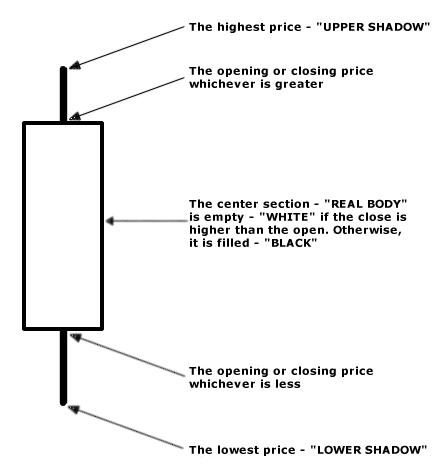
Each candlestick represents one period (e.g., day) of data. The figure below displays the elements of a candlestick.

The interpretation of candlestick charts is based primarily on patterns. The patterns are examined in three main groups as “Bullish”, “Bearish”, and “Neutral”. These groups are further subdivided with respect to the type of the patterns as “Reversal”, “Continuation”, and with respect to their reliability as “High Reliability”, “Medium Reliability” and “Low Reliability”

Candlestick charts are flexible, because candlestick charts can be used alone or in combination with other technical analysis techniques. A significant advantage attributed to candlestick charting techniques is that these techniques can be used in addition to, not instead of, other technical tools. In fact this system is superior to other technical tools. Candlestick charting techniques provide an extra dimension of analysis. As with all charting methods, candlestick chart patterns are subject to interpretation by the user.

Examples

BULLISH MORNING STAR

Type: Reversal

Relevance: Bullish

Prior Trend: Bearish

Definition

This is a three-candlestick formation that signals a major bottom. It is composed of a first long black body, a second small real body, white or black, gapping lower to form a star. These two candlesticks define a basic star pattern. The third is a white candlestick that closes well into the first session’s black real body. Third candlestick shows that the market turned bullish now.

Recognition Criteria:

  • Market is characterized by downtrend.
  • We see a long black candlestick in the first day.
  • Then we see a small body on the second day gapping in the direction of the previous downtrend.
  • Finally we see a white candlestick on the third day.

Explanation:

We see the black body in a falling market suggesting that the bears are in command. Then a small real body appears implying the incapacity of sellers to drive the market lower. The strong white body of third day proves that bulls have taken over. An ideal Bullish Morning Star Pattern preferably has a gap before and after the middle candlestick. The second gap is rare, but lack of it does not take away from the power of this formation.

Important Factors:

  • The stars may be more than one, two or even three.
  • The colour of the star and its gaps are not important.
  • The reliability of this pattern is very high, but still a confirmation in the form of a white candlestick with a higher close or a gap-up is suggested.

BULLISH RISING THREE METHODS

Type: Continuation

Relevance: Bullish

Prior Trend: Bullish

Definition:

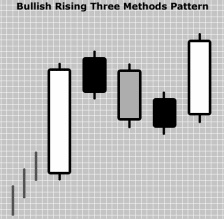
The pattern is characterized by a long white candlestick followed by three small bodies in three consecutive days. The small bodies represent some resistance to previous uptrend and they may even trace a short downtrend. These three reaction days usually have black candlesticks but the bodies remain within the high and low range of the first day’s white candlestick. The pattern is completed by a white candlestick on the fifth day, opening above the close of the previous day and closing at a new high. The small downtrend between the two long white candlesticks represents a break during the uptrend. The upward trend then resumes and continues.

Recognition Criteria:

  • Market is characterized by uptrend.
  • We see a long white candlestick in the first day.
  • Then we see small real bodies defining a brief downtrend but staying within the range of the first day on the second, third and fourth days.
  • Finally we see a long white candlestick on the fifth day opening above the close of the previous day and also closing at a new high.

Explanation:

The Bullish Rising Three Methods Pattern typically represents a rest in the market action. This may be used to add new positions by longs. The pattern is the reflection of doubts about the ability of the trend to continue. This doubt may increase because of small-range reaction days. However, given the fact that a new low cannot be made, the bullishness is resumed and new highs are set quickly.

Important Factors:

  • The high-low range includes the shadows.
  • The reliability of this pattern is very high, but a confirmation in the form of a white candlestick with a higher close or a gap-up still is suggested.


Excel Modeling for Wagner Whitin algorithm

PGP ’11 student, Kapil Vaish,  An Operations enthusiast shares his insight on Excel Modeling

Excel Modeling for Wagner Whitin algorithm

The “Squared root formula” for steady state demand for economic lot size is well known. The calculation is predicated upon balancing ordering cost (Setup Cost) and holding cost. But when the assumption of steady state demand rate is dropped i.e. when demand for the future is known but are not constant and when setup cost and holding cost changes with periods then square root formula for the EOQ not necessary give the optimal result in deciding the lot size.

Wagner and Whitin gives the way to decide for a dynamic lot sizing technique in which above assumptions are dropped to get dynamic lot size optimal result. Assumptions they took was:

1.)    Single product Variety

2.)    Unit production cost in constant

3.)    No orders are overdue/ No backorders

4.)    No capacity constraints

5.)    Zero lead time

Here I have applied the algorithm on a hypothetical data just to illustrate you how excel model can be very easy to come up with dynamic lot sizing method.

Variables used:

1.)    St is the set up cost in period t

2.)    It is the inventory holding cost in period t

3.)    Dt is the demand in period t

4.)    Xt is the production quantity in period t

5.)    Yt is dummy variable representing 1, if Xt >0, else 0

6.)    M is very large number

7.)    Et is ending inventory in period t carried to next period

8.)    P is Production Cost per unit

Objective Function:

Objective is to minimize total cost. Total Cost consist of

Constraints:


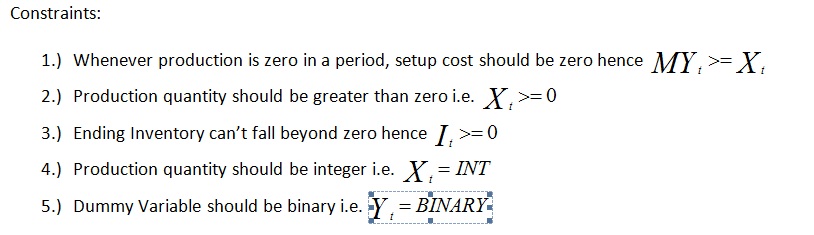
When we apply the objective function and constraints in excel solver we get the optimal solution of lot size per period. An example is given in the link below to illustrate the process. Hope it would be helpful.

Wagner-Whitin Algo

‘The idea must be to learn and not just pass the exam’

PGP ’11 student, Pulkit Taluja,  recently cleared the CFA Level 2 Exam. He shared his insight on need of CFA and approach that is required to clear it.

What is CFA Program and what is its scope in today’s context?

CFA Program is a globally recognized program which equips one with comprehensive knowledge in the field of investment analysis and portfolio management. CFA Program consists of 3 levels (exams) and passing all three would close you to the CFA Charter which additionally requires 4 years of investment related work experience.

While CFA Level 1 focuses on building the basics in all areas related to finance, Level 2 focuses on valuation and Level 3 on portfolio management. In today’s context CFA is a very good course from the perspective of learning and building your credibility in the eyes of prospective recruiters.

Who should pursue this programme? How does CFA add value to a regular MBA?

If you look at CFA Charter, it is specifically designed for people who want to enter portfolio management/ investment analysis. It is not delve deep into other fields of finance like investment banking, commercial banking etc. However, for someone who doesn’t have any prior knowledge in finance and wants to enter the field, CFA Level 1 is a very good course to start with. Level 1 curriculum covers basics of a wide variety of areas like quant, economics, fixed income, equity, derivatives, corporate finance, portfolio management etc. It provides an organized way of learning the basics which otherwise if we try to learn in a haphazard manner takes a lot of time.

In Indian context, for a person entering MBA wanting to specialize in finance, pursuing CFA becomes even more important especially if one is from a non-commerce background. It is because of two reasons. One is that an MBA courses cover topics in a very broad way. Till the students complete their first year, they are taught only about 3-4 course in finance. They are not exposed to the world of complex financial instruments, derivatives, their valuation etc. There is a wide gap between what’s covered and what one is required to know. The CFA curriculum fits into that gap very well. Therefore for those who wish to pursue finance in MBA, they apply for Level 1 exams as early as possible. It clearly gives an added advantage over someone who is only exposed to courses that are a part of curriculum. The advantage of an MBA is that the learning is case-based unlike CFA which is predominantly theory based especially Level 1 and Level 2. Thus both the courses complement each other very well.

Do you think the popularity of the CFA is growing? If yes, what advantage do students have in placements if there are already many people having cleared CFA exams?

The popularity of CFA is growing very fast in India especially amongst MBA students. Since most of the MBAs come from a non- finance background, it provides them an easy way to enhance their resume and express their interest to prospective recruiters. In good B-Schools, where competition is tough for both summer and final placements, taking CFA Level 1 exam has become a necessity for someone looking to specialize in finance. In the process, there are a lot of students who have cleared CFA L1 exam when the applications are sent to recruiter which doesn’t make it a differentiating factor. CFA L2 to some extent may be a differentiating factor.

As per my conversation with some recruiters and industry experts, what they look for is the application of what you have learned in the program. You could regularly publish equity research reports, start your own investment fund, provide financial consulting or engage in a live project with some corporate. That would be much more valuable even if you don’t pursue CFA but for getting to that level you need the understanding of concepts which are provided by the CFA curriculum.

How should candidates prepare for CFA considering academic rigor in MBA?

There is only one answer to this question- regular hard work and practice. Given the academic rigor and fast paced life in MBA, my suggestion is to start early and study a little every day. Also, many people recommend studying from reference books other than those provided by CFA as they contain much less content and can be finished fast. But according to me, they won’t provide you with as much learning and should be referred to if you have very little time for preparation. Apart from that, keep some leeway for your project submissions, mid-term and end-term exams and plan accordingly. Finally, the idea must be to learn and not just pass the exam as during a recruitment interview you would be expected to know what was there in the curriculum.

Candle March by IIM Kashipur students on the occasion of Vijay Diwas

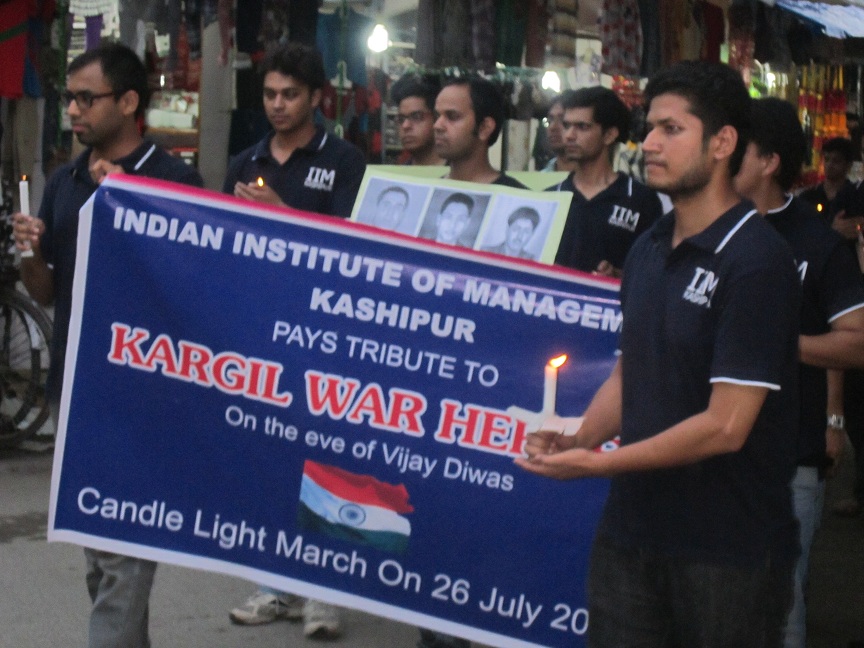
At about 6.30 PM on the 26th of July 2012, the ever-busy Kashipur Chowk stood still and took notice as the students walked with candles in their hand celebrating Vijay Diwas, the day India won its last war with Pakistan in 1999. Students took time away from their classes and schedules to pay tribute to all the brave souls who perished in the war a little more than a decade ago.

The Students started the walk from the Kargil Shahid Vatika and headed towards the Main crossroads where they placed the candles in front of the Maharana Pratap statue. The students also held up posters showcasing the sacrifices and heroics of the soldiers who fought valiantly only so that the rest of their compatriots could lead peaceful lives. The objective of the march therefore was to remind one and all that their role has not been and will never be forgotten.

The march was led by the Director of IIM Kashipur, Dr. Gautam Sinha and also accompanying him were faculty members from the institute. Speaking on the occasion, Dr. Sinha said that “this was IIM Kashipur’s way of saying thank you to the brave soldiers and hoped that their sacrifice would be a source of inspiration and strength for many for years to come.”

 The fact that the vehicles at the crossroads were not blaring their horns in their usual way is proof of the fact that the message was sent through the silent march, Loud and Clear.


Workshop on Career Planning and Design

A two-day workshop on Career Planning and Design was conducted on 24th and 25th of July at IIM Kashipur for the benefit of First year students.

 The Workshop was conducted by the following 2 counsellors:-

  1. Mr. Anamitra Chatterjee (Director& Head – Executive & Career Coaching, INSEAD-ILPSIE at ERUDITUS Education) and
  2. Mr. Subhajit Mazumder (Senior Consultant at Ernst & Young).

 Mr. Anamitra Chatterjee is an alumnus of the London School of Economics (LSE), UK where he studied Economics as a British Chevening scholar. He holds a PGDM from IIM, Calcutta. He held the positions of Head-Human Resources (HR) and Head-Learning & Education (L&E) in PricewaterhouseCoopers (PwC) India.  He had a long stint at Deutsche Bank AG in client relationship management. Mr. Subhajit Mazumder is a management consultant with several years of experience in E&Y and PwC. He has rich and diverse experience in the areas of business strategy formulation, process transformation and IT enablement. He is a regular speaker at IITs, IIMs and Industry forums.

            The workshop mainly focussed on self awareness and identifying one’s natural inclination to any specialisation in management. The session on day one started with a Belbin test. Belbin test evaluates and rates a participant on various roles called as Belbin team roles and helps in identifying ones suitability to a particular kind of role. The day was followed by knowledge sessions on Consulting, IT, operations and HR. These sessions provided insight on the kind of profiles offered to MBA students for summer internship and final placements. The character traits required to excel in each of these fields was also discussed. Afterwards, sessions on Group Discussions were conducted. The session sensitised the students on what to do and what not to do in a Group Discussion.

            Day Two of the workshop began with a Career Development action plan. It focussed of constructing a Positioning statement, which would best describe our past, present, and logically connect it with the future aspirations. Thereafter, Knowledge sessions on Finance and Marketing sectors were conducted. The sessions focussed on the career options within these broad sectors and enlightened students on some very basic things such as the difference between Finance & Commerce; and the difference between the roles of MBAs & CAs in financial services firms. The day concluded with mock interviews and analysis for the summer internships.

The workshop gave the students a new perspective on managerial roles and responsibilities pertaining to different sectors. It also gave the students a chance for introspection, making it easier for them to choose from myriad career paths. The workshop programme was a huge success and will surely become an important part in moulding the success path of IIM Kashipur students.


Finance Club kick-starts its Activities in its Second Year

The Finance Club – IIM Kashipur started its activities in its second year on 1st July’12 with the introductory session for the fresher batch by Pulkit Taluja, 2nd year student and CFA Level III Candidate. He began the session with vision and mission of finance club at IIM Kashipur. He gave an overview of different areas in finance like, Asset Management, Investment Banking, Corporate Finance, Project Finance, Equity Research etc. In the process, he also introduced some basic terms of finance to the audience. He acquainted the participants with terminology and analysis of financial statements. Lastly, Pulkit talked about the responsibilities of a finance club member and how the association with club can help them in staying abreast with the latest in the financial world and build their competencies in financial arena.

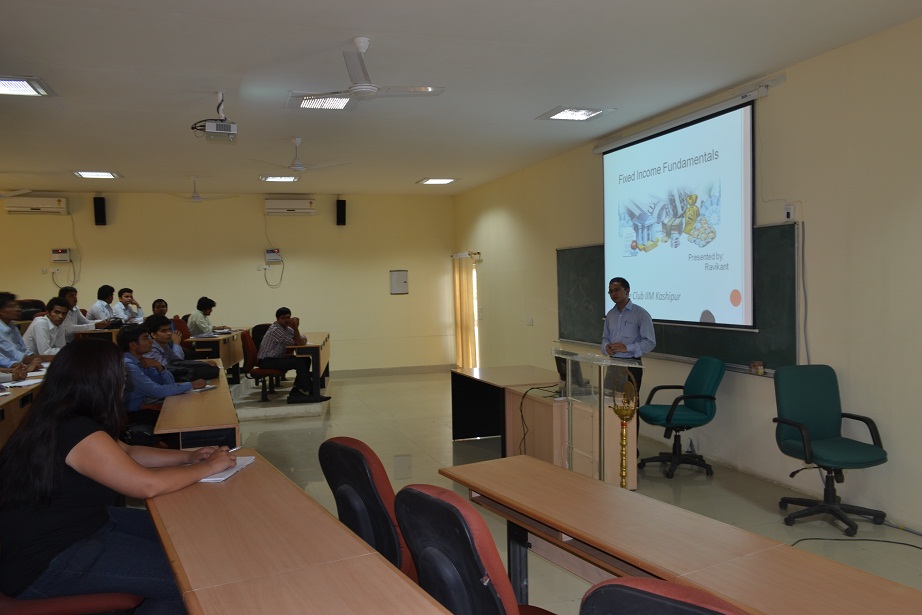
In continuation of the series of knowledge sharing sessions, Ravikant Sharma, 2nd year student has an experience of working with a hedge fund client, delivered the next session on Financial Markets. We covered Bonds and Securities markets, Primary Market, Secondary Market, Stock Exchanges, Sentiments of investors, Credit Rating etc. Utilizing his experience, he used real time examples to make the learning effortless and interesting.

The sessions were followed by a quiz to test the caliber of students and their understanding from the two sessions. Harsh Patel, 1st year student, topped the quiz.