The Operations and Supply chain Management (OSM) club at Indian Institute of Management Kashipur incessantly works in operations, production & manufacturing, supply chain management, operations strategy, operations research, and project management. The club acts as a perfect medium completely dedicated towards the students. It helps them enhance their domain knowledge and explore new horizons by assisting them in pursuing their interests related to the field. Being established in the initial years of the Institute, the OSM club is one of the oldest academic clubs in IIM Kashipur. By successfully carrying out several inter-college events and interactive sessions, the club has marked its supreme presence amongst the corporates & fellow institutes and has been a front runner in demonstrating excellence & commitment in educating as well as in spreading the domain advancements.
To bring out the best from the Institute’s students, the club organizes different activities throughout the year. This ranges from quizzes, case study competitions, knowledge sharing sessions to guest lectures and industrial visits. The club believes in the philosophy that sharing knowledge is not just a single-day activity and thus operates open platforms in various social media handles for continuous debates & discussions on different topics, sharing recent trends, and molding the students for case study competitions related to the domain. The club, which had already been connected to a vast network over mediums like LinkedIn and Facebook, has chartered its Instagram presence in the AY 2020-21 and regularly posts different articles and updates through these social media handles.
Certifications
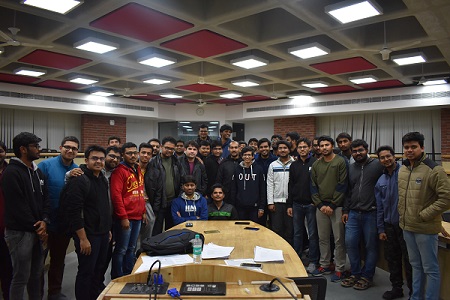
The club perfectly aligns with the Institute’s philosophy of ‘Learning by Doing’ and provides a medium for students to understand the practical applications of the theories they learn. Working on these lines, the club leaves no stones unturned on gauging the batch’s interest and facilitating relevant certification courses that can help in imbibing the culture of continuous learning & improvement. This also allows the students to learn new concepts and apply them in real-life business scenarios and case studies. In the AY 2019-20, the Club organized the Six Sigma Green Belt Certification by KPMG where around 40 students had participated and successfully completed their certification. Through the CII certification opportunity facilitated by the Club, 9 students were able to gain valuable inputs on notions such as supply chain analytics and warehouse management. The Club had also been successful in connecting with ISCEA (International Supply Chain Education Alliance). It was able to gain benefits through access to practical implementations, certification courses, and easily connect to the Industries in Operations. The Club had also thrown up a CDDP certification program for the IIM Kashipur student fraternity in the AY 2019-20.
Industrial Interactions / Guest Lectures
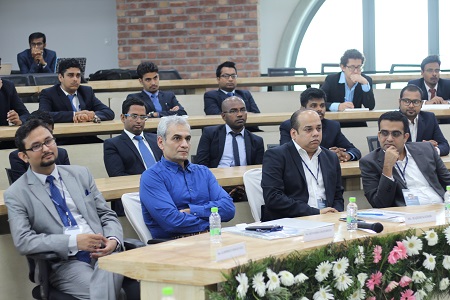
The club also bridges the gap between academia and industry by organizing interactions and lectures with industry stalwarts where the elite industrial professionals share their experiences and guide students to make them acquainted with the relevant skills required to excel in the industry. The club conducted the operations summit of Coalescence on 14th Sept.’19 and erudite speakers from leading organizations like McKinsey, Emami Ltd, Patanjali Ayurved Pvt.Ltd, Globelink India Pvt.Ltd, and IVY Technology India enlightened students on the topic of Process Re-Engineering.
Knowledge Sharing Sessions
The club also emphasizes conducting knowledge-sharing sessions and their effectiveness in helping students, especially those who don’t have any pre-requisite knowledge about different Operations and Supply Chain domain courses. Through this, a platform is being offered to the students to improve their public speaking skills and be on the other side of the table. The club also seeks guidance from the esteemed faculties and helps students embrace the academic culture & rigor of IIM Kashipur.
Industrial Visits
To bring clarity and exposure to students in a practical working environment, the club organizes industrial visits at different manufacturing facilities. It leverages the most densely industrialized regions in the country with over 180 industrial plants in and around the area. This also serves as a platform for budding managers to understand the manufacturing facilities with a practical lens and learn about best practices opted by different companies. The club has organized industrial visits to companies like Ashok Leyland, Mahindra & Mahindra, and IOCL Bottling plant.
Events
The club believes that the knowledge without application is like a book that is never read and challenges students to work on their toes and organize different intra-college and inter-college competitions throughout the year. The events include treasure hunts, marshmallow games, quizzes, case study competitions, etc. which allow students to put on their thinking caps and understand the constraints from different cross-functional aspects.
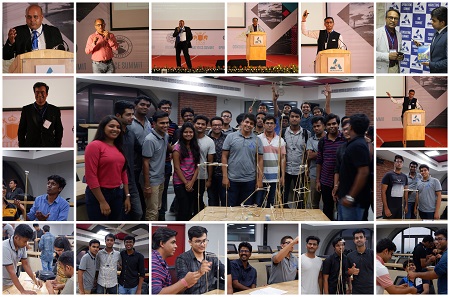
The club has organized intra-college events like Opstruct’19 and Ops-Hunt in the AY 2019-20 and AY 2020-21 respectively to make students aware of the various basic terminologies in the field of Operations and Supply Chain Management. In Opstruct’19, students played Marshmallow Game which revolved around inventory management, analytical decision making, and lean concepts. The game tested how efficiently the participants utilized their resources while keeping inventory and lead time in mind. The Ops-Hunt event amalgamated the fun & excitement of treasure hunt with the domain knowledge of operations. The student teams were required to solve different picture perception clues, objective questions, and crosswords to reach the destination.
Operatius is an annual case study challenge organized as a part of Agnitraya, which is IIM Kashipur’s annual management festival. The event was well received and had witnessed participation from students across the top B-Schools in the country. Operacle is a PAN India case study competition. The club collaborated with different companies like Hesol Consulting to formulate the case study by striking the right balance between relevance & complexity and encouraging students to provide the most efficient & feasible ideas. Osmosis is a PAN India quiz competition organized every year by the club. It comprehends three rounds where participants are tested on different domains like Operations, Quality Management, Supply Chain Management, and their business applications. These inter-college events serve as a base for students to interact with each other and build long term connections. Hence, in a nutshell, the club functions as constant support to the IIM Kashipur student fraternity in pursuing their interests in Operations and Supply Chain Management and works in association with different internal & external stakeholders to maintain and uplift the academic rigor that the





 The IIM Kashipur Blog